Showing posts with label PBL. Show all posts

Sunday, October 26, 2025

The Nature of Expertise in the Age of AI

For several years, I've been providing content and student support for the University of Kentucky's Changemakers program, designed and managed by the Center for Next Generation Leadership. It's an online one year continuing education option where Kentucky educators can get a rank change for successful completion.  I appreciate that Next Gen believes in "parallel pedagogy"; while it provides valuable resources and materials to be read, viewed, and reflected on, it also requires the program's students to complete meaningful transfer tasks, pursue an action research project, and participate in a final defense of learning that demonstrates how transformative practices are happening in the Changemaker's own classroom. 

This professional learning pathway to rank change involves mostly asynchronous work through online modules focused on the awareness and implementation of what Kentucky calls "vibrant learning" in the classroom, with module topics such as Learner Agency and Inquiry Based Learning.  It's my contribution to the latter module where the content below originally began, but I've expanded and added more detail for this blog entry.

Inquiry-based learning is a powerful pedagogy.  For students, it can be as extensive as working on a multi-week project-based learning unit, or as simple as asking more high-quality questions in class.  Inquiry comes from curiosity, and the attempt to answer challenging questions and solve problems that have no obvious solution.

Complicated problems requires help.  Two heads are better than one, after all.  With this in mind, seeking community partners can make perfect sense.  (As an aside, this teacher guide can help shape your conversations when you attempt to bring the community into your classroom; while it mentions PBL, the strategies can help for any scale project or problem you want your students to tackle.)   

Screenshot of the community guidance doc linked above as "teacher guide" in the text.

These community partners or "outside experts" can authenticate what may seem abstract into real world problems, and even motivate students to "dig in" when the work gets difficult, to echo the title of this excellent Next Generation Learning Challenges article.  But before we consider how bringing in experts from outside of your classroom can increase vibrant learning, let’s first discuss inside experts, and even the idea of “expertise.”

Keep in mind that traditionally, and for decades (centuries!), you have been considered to be the expert in the room – of your content, of your pedagogy, of your ability to manage your classroom.  The professionalism required of the vocation, much less the idea of professional standards boards that grant, review, and in some cases revoke certification to teach, adds to the foundational belief that a teacher has earned their well-deserved “expert” credentials.

But you are usually one human in a room of thirty.  Leaning into the expertise of your students can be at its most basic level a strategy of smartly leveraging your numbers.  Viewing your classroom through an asset mindset, we can see students as learners that bring their own powerful POVs which can enrich your culture and community.  For example, with the right scaffolding, structures, and practice, your students are capable of providing peer-to-peer feedback.

However, some of our stumbling blocks in education are self-induced, born out of a desire to remain humble.  For example, calling yourself or anyone else an “expert” can sound or feel lofty and divisive.  Educators are sometimes their own worst critic, and may wonder aloud what right they have to declare themselves the expert on such-and-such.  As for students, they may view their own bountiful and beautiful knowledge with a shrug of their shoulders.  If someone in middle school knows how to disassemble and reassemble a car engine, it simply reflects their personal interests, or the fact that their mother loves hot rods.  They are told early and often in traditional school that such knowledge isn’t “book learnin’.”  Loving hot rods or diesel mechanics doesn’t matter, thinks the student, because it’s not a part of my third period class, and it won't show up on my multiple choice test on Friday.

Therefore, let’s consider a broadening of our definition of “expert,” and look more at the first five letters of the word.  What we really hope to provide, increase, articulate and bring into a classroom is experience.  From another person’s POV, your experience may be long and traveled (which can make you “more experienced”), or simply a road I’ve never traveled upon (which makes your experience a novel one, compared to mine).   Viewing expertise in this kind of inclusive light opens up what an “expert” is.  We can see an expert as simply (but powerfully!) a person with a different, valued perspective.   The key word is “valued.”  You may have a different POV, you may have twelve degrees on the wall, but if I don’t care about you and especially if you don’t care about me, your “expertise” won’t matter much.  We can also see an expert as a person who is recognized as skillfully applying knowledge.  The key word is “applying.” Remember that old chestnut that answers the question, “What’s the difference between intelligence and wisdom?”  Intelligence is knowing that a tomato is a fruit, but wisdom is knowing you would never put a tomato in a fruit salad.  Expertise that feels too detached and theoretical, or a bunch of random facts you can Google anyway, won’t personally matter very much to your learners.

With our new, more expansive definition of “expert” behind us, how do these experts from outside of a classroom still have potential to help?  Vibrant learning is memorable and authentic, and community partners can be both.  A parent who is a car mechanic might come in to demonstrate the torque caused by automobile engines.  Not only does that make abstract laws of motion and physics seem more relevant to students, it also has a far greater chance of making tonight’s dinner conversation when the student is asked “What did you do at school today?”  By permitting alternative voices into your learning space, you open up different perspectives and bring the outside community inside of your classroom community. Outside partners could also provide feedback to students as they ideate and prototype a solution in a PBL, or serve as a panel audience for defenses of learning. Of course, in a world full of wondrous technology, we are not limited to in-person guest speakers.  Someone from a European museum might Zoom in for a mini-lecture and a Q & A.  There are over twenty billion uploaded YouTube videos, so with the right discernment and curation skills, an expert is just a click away.

You might have noticed that artificial intelligence wasn’t mentioned above as a potential “outside expert.”  Going back to our expanded definition, it certainly can seem to checkmark the same boxes.  AI can offer a different perspective, powered by code and fueled by billions of artifacts from our culture and knowledge.  Is that perspective valued, or valuable?  It might, although AI is not always accurate, unbiased, or trustworthy; however, the same can be said of Wikipedia entries created by humans, or the theory from a popular scientist of the past which has been discredited in the present.  Discernment and critical thinking is key, particularly from the teacher who should be monitoring, filtering, and observing the AI usage (and teaching students to be critical AI users as well).  AI can also certainly apply its knowledge scraped across the terabytes of the Internet within (milli)seconds of being prompted.  Is that knowledge skillfully applied?  Based on the uploaded rubric of a teacher alongside the first draft of a student’s essay (being mindful of your platform's privacy protections, of course), or the public domain text of an author, AI could provide nuanced feedback on student writing or pretend to be a character in a book for a fascinating interactive conversation.  But some of the proficiency of AI’s application will depend on qualitative measures: of the rigor of the rubric you uploaded, or the veracity and bias of the knowledge it grabbed from its database, or the depth of skills the AI has been taught to emulate. And again, AI hallucinations can happen.  

What will hopefully emerge, as we become more skilled and critical users of AI, is that our ethical priorities will shape the machines instead of letting the machines shape us.  A promising example is the “Dimensions in Testimony” website, a partnership between the University of Southern California and the Shoah Foundation.  The site began by digitizing recorded interviews of actual survivors of the Holocaust and the Nanjing Massacre.   Next, an interviewee has a separate page where, via a looping video, they seem to sit and wait for your questions.  

Screenshot from the website "Dimensions in Testimony," featuring an older woman sitting in chair with a black background on the left and the interface for questions on the right.


When prompted, a short video plays where the interviewee “answers” your question, creating a virtual conversation.  You can do this via your microphone or by typing.  What may seem miraculous is really just clever programming – the interviews were transcripted and time-coded, so AI simply takes your prompt, scans the text, finds a corresponding clip that seems to best answer your question, and plays from that particular time-stamped portion of the interview. Still, you can see the power of providing such “expertise” to students, giving them a chance to be both empathetic as well as practicing their questioning/prompting skills.  (It should also be noticed the dignity and care given to the subject matter by USC and Shoah.  The interviews were real, using genuine survivors of genocide and the Holocaust, not actors.  While you technically could have AI “pretend” to be a survivor of a war crime as a customized chatbot, or have students interact with some kind of digital fictionalized Holocaust survivor avatar, there are many reasons why this would be an unethical and inappropriate use of such technology.)

As you ponder ways to increase and improve inquiry, reflect on the nature of “expertise,” both inside and outside of your own four walls.  As you do so, you can cautiously consider how AI can be one of many types of “outside experts” you can bring into your classroom.
For more information on Changemakers, be sure to check out this page for the latest links to sign up for updates and apply to join the next cohort.

Monday, December 23, 2024

The Potential Intersection of Megagames and Learning

What is a megagame (sometimes stylized as "Mega Game," "Megagame" or "MegaGame")?   Gen Con's 2024 program defined them thusly:  "Combining aspects of board games and [Live Action Role Playing],  megagames often involve dozens of players weaving interconnected storylines through multiple stages of play.  Each player is assigned a role (sometimes with a backstory, personality, or a secret goal), and as they play through multiple sub-games, the outcomes of their play drive the story of the larger game."  They are generally credited to have started in the United Kingdom by Jim Wallman in the 1970's, but the moment that really made the concept go viral was in 2014, when Wallman's megagame Watch the Skies was highlighted by Shut Up and Sit Down (warning: the article contains some adult language). In the last decade, megagames have become a staple of gaming conventions and major cities.  

The megagame definition could also be stretched to include other experiences.   For example, Andrew Ashby (proprietor of the game store We Geek Together in a Provo, UT mall) had a dream of beating the Guinness World Record of most Dungeons & Dragons players simultaneously playing the venerable tabletop role-playing game (TTRPG), which stood at 500.   In April 2023, with the blessings of the mall owners and the help of a volunteer team of Dungeon Masters (DMs), Ashby staged a massive "megacampaign" across two hundred tables; each table had a DM and up to seven players battling through a scenario.  The battles and successes at each table contributed to an overarching narrative to defeat an ultimate "boss."  By the end of the day, Ashby achieved his world record dream by a country mile, with 1,227 players.  Another adjacent example closer to the classroom level are the dozens of role-playing historical simulations of Reacting to the Past (RttP), a curriculum first started by Mark C. Carnes of Bernard College (NY) over a decade ago.  Like a megagame, these simulations often involve 30+ college students in various, specific roles played over several instructional meetings.  While the use of RttP has spread to universities across the United States, they have recently also been adapted for high school as well.   

Nearly three month ago, I had the opportunity to attend my first megagame in person.  I had discovered Tony Dougherty and The Dukes of Highland last summer and periodically checked their website for the upcoming Kentucky megagaming schedule.  (The Dukes of Highland, while based in Louisville, have held events in multiple states and several cons.)  

Tony Dougherty, in costume as the "Lead Control."

Coincidentally, on one Saturday at the end of September, Dougherty was running It Came from the Skies, a variation of the classic Wallman scenario.  Although I was tempted to play, I instead thought it better to observe and take notes.  And with Dougherty's warm permission to join the fun, note-take I did.  


What first impressed me was the organization to keep nearly fifty players joyfully engaged.  Firstly, each participant was given a role of a near-present Earth nation which formed a team of four players (Head of State, Chief of Defense, Chief Scientist, and Foreign Minister); other options included playing as the Aliens, or as a member of the Press.  Dougherty was the Lead Control (a overall "Gamemaster"), with four staff members as the Control Team.  Each Control Team staff member ran one of the four role nation groups' "sub-games," where Aliens sometimes made appearances and the Press wandered around to cover the happenings.  (While It Came from the Skies occasionally had dice rolling to determine outcomes,  it seems that other megagames can either lean into or away from this mechanic.)  Over various turns, the nation players rotated in and out from their role group game back to their "country table" to share details and plan next steps, feeding into the mega-narrative.   As the day continued, the nations of the world had critical questions to answer:  Are the Aliens benevolent or here to invade us?  What should (and what can) we do about it?  And what diplomatic alliances should we make or betray along the way? 

Each nation team/table received a packet explaining rules, how their various roles worked, and more.

Like gamemasters (GMs) of a typical TTRPG, Dougherty and his Control Team offered guidance, made rulings, and imposed gaming structures, but the story was truly co-created by all the participants; the ending could not be pre-determined, nor could a "win" or "loss" for Earth be neatly defined.  That sense of uncertainty, urgency, agency and play added to a giddy feeling that stayed with the megagame until its conclusion.  Afterwards, Dougherty, the Control Team, and the players socially debriefed at a local bar, sharing the behind the scene conversations they didn't hear and reflecting on choices they did or didn't make.  

Monday, February 5, 2024

Credit Discovery, Not Recovery

Recently, I was flattered and honored to be the guest of Season 2 Episode 2 of Education Perspectives, a podcast hosted by Liza Holland.  Our talk ranged from edtech to game-based learning.  You can listen to the episode on your favorite platform from here.

On the podcast, one of the topics I briefly discussed was the need to shift from a "Credit Recovery" system to one of "Credit Discovery."  I wanted to extrapolate on that subject for today's blog entry,

Credit recovery, as educators well know, is a pretty common hallmark of the traditional educational system.  For a semester or a school year, a student attempts to get a passing grade in a class.  The student is marched dutifully through a curriculum.  For a variety of reasons -- likely aggravated by absences, low grades or missing assignments that creates a statistical hole the student cannot climb out of -- the student reaches the end of the timeline, only to fail.  In some cases, the student may have an opportunity to spend time in the summer "making up" for the class, somehow achieving in a few weeks what the student could not do in months.  In other cases -- especially if there are several such classes to make up -- a student may be put into a program where they can tackle several credits side by side, thanks to an online course platform that asks students to watch a video, take a quiz, watch a video, take a quiz, then take a multiple choice test.

There are, of course, well meaning variations to the above.  Perhaps the student completes a PBL in the summer, knocking out credits for a few classes simultaneously.  Perhaps the online course platform has some interactive tools to make the learning more engaging.  In the end, however, credit recovery is mostly a seat-based solution to learning that rarely takes mastery or personalized interests into account.  It is also an inefficient approach that closes the door after the cow has already left the barn.  Last but not least, it saves the innovation of learning until the end.  If somehow a novel way of teaching can really work in just a handful of weeks -- in a PBL, or through a digital platform --  why would you waste the prior instructional months in frustration just to arrive at failure?

If we don't like such outcomes of a traditional system, let's start something new by changing the questions. What if we instead turn a reactive, post-mortem, negative approach to learning into a pro-active, diagnostic, positive one?   What if students were allowed to discover a way to earn their credits, with their input front and center from the start?  What if the rigor of learning was raised, right alongside the joy?

Breaking away from Carnegie Units and fixed seat-time scheduling is not easy, but it is not impossible either.  I've blogged before about William Smith High School in Colorado, and how its courses (created with teacher passions and student input in mind) ingeniously blend traditional credits into PBL classes that are high interest with a complex, authentic performance assessment as a final product.  Back in November, Cory Steiner, superintendent of Northern Cass School District of North Dakota, visited OVEC educators (he'll return next month to talk to our regional district leaders).  He shared the many innovations of Northern Cass, but one that particularly jumped out for me was the studio classes being put into place at its secondary schools.   From the beginning, these inquiry-based "courses" are co-designed between students and advisors in order to complete credits the way students want to earn them, through independent mastery-based projects.  (For more on Northern Cass and its "microschool" program, read this Getting Smart article from May 2023.)

As educators, we can be commended for all the energy we spend trying to save a student who has already "failed."  But this may not be the best way to focus our time, and certainly suffers from framing a student in a deficit mindset rather than an asset-based one. Instead, let's invert the model.  Let's spend at least the same amount of energy empowering our students who often are the victims of a failed, traditional, outdated school system.  Let's help our students discover their own greatness, and be the exploring pioneers of their own learning.

Thursday, February 9, 2023

EduCon 2023

Last weekend, my teammate Rachel Albright and I went to Philadelphia for a three day event called EduCon.  This annual conference mainly took place at Science Leadership Academy (SLA) High School at Center City. SLA opened around 2006, with EduCon starting a few years later.  SLA has become well known for its focus on PBL and internships, and has led to other Philadelphia schools following its model; most recently they have opened a new middle school (SLAMS).

I've been feeling like attending EduCon specifically, and visiting SLA in general, was being nudged to me by Fate.  I first heard about SLA/EduCon when reading Reinventing Project-Based Learning last fall, and then read about SLA again a few months later as one of four schools highlighted in Running with Robots.  

On the first day of the conference, we were led by a senior student through a tour of the flagship high school.  Besides being impressed with her obvious enthusiasm and knowledge for what SLA has to offer, I was also appreciative that such innovative instructional practice happened in an older facility with few shiny frills, minus some new machinery and equipment.  SLA proves the point that while PBL, passion-based projects, and deeper learning may benefit from a school renovation or a new build, it certainly doesn't require it!

For the rest of the entry, I will highlight three EduCon breakout sessions I attended that personally stood out for me.


"The Case for Dreaming in Public"

This session easily won for best titled, and was facilitated by Timothy Boyle (founding principal of SLAMS) and David Jakes (veteran school designer and author of The Design Thinking Classroom). 

The session mainly consisted of "dreaming big" on what a new school might be and sharing those ideas with tablemates, which was intellectually stimulating.  But Jakes also shared anecdotes from previous school renovation/new build projects.  For example, he recommended having all stakeholders (educators and community members) meet for a "Salon Dinner."  At the dinner, he would pose two provocative questions: What would it take to get it right?  What would it mean if we did?  Jakes also shared an example when the answers to those questions led not to a school that could double as a community center, but instead to a community center that just so happened to be a school during the weekdays.  Such a realization factored heavily into its design choices, and of course the kind of instruction and student interaction such a building would have. 


"Challenging Traditional School Leader Pathways and PD"


This session was facilitated by three leaders of the School District of Philadelphia (SDP), one of the top 10 largest in the nation: Katie Culver, Brandon Cummings, and Rosie Tarnowski.  

A few years ago, SDP did a re-org that included changes in PD development.  Among other changes, they decided to prioritize support for principals -- not only because of the need for hiring, internally growing, and retaining such important personnel, but because philosophically, SDP believes principals are the most powerful change agent of their school building as well as their surrounding community.   This led to creating a new Leadership Pathway Framework (LPF) which articulates criteria for the assistant superintendents, principals, assistant principals, teacher leaders, and central office leaders.   In the session, they concentrated on one strand of LPF, Equity Centered Leadership.   These leadership competencies are nothing if not ambitious.  Consider this example, from the substrand "Trusting Relationships" in the Principal competency "Facilitates and Builds Trusting Relationships":


The SPD presenters noted that similar frameworks for teachers and students were in the works, and acknowledged that while such leadership competencies were meant to drive growth, raise expectations and determine PD needs of principals and others, they were not yet used evaluatively -- and there was internal debate whether they ever should be.

Additionally, SDP had recently launched leadership affinity groups.   To take one group example, black male educational leaders now have meetings and a safe space to share and speak about their unique experiences.  These affinity groups (as well as the leadership PD in general) have been highly successful -- see photo below for data --- but this has led to areas for future consideration.  For example, for educators that identified as another gender, or gay, should they form new and separate affinity groups? Participate in the larger one? Both?

Overall, it was exciting and inspiring to see such a large school district acknowledge the complex needs of its educational leadership and find ambitious ways to serve and grow them, particularly in the area of equity.


Let's Design a School!

While somewhat similar in tone to "The Case for Dreaming in Public," the major difference was the inclusion of a student panel facilitated by Mary Beth Hertz.  Four students from SLA's middle and high schools had some great insights about education.  Here are some paraphrased quotes.

  • Answering the question "I go to school and enjoy..."
    • spending time with my friends and teachers I like.
    • extracurriculars (to allow students to think about what they want to do with their future).
    • classes with connections, teamwork, community.
    • how each class is unique, and teachers that try to make things fun.
  • Answering the question "What is school?" For what I want to do, some of my classes are beneficial, but some classes are hard to take seriously because it feels like kinda the same thing over and over since I was 4.  It doesn't meet everyone's needs.
  • Answering the question "What do you think the purpose of education is? How is 'school' and 'education' different?"
    • Being educated is different for different people.  Some people like to educate themselves. Education is about learning about your own identity, and being mindful.
    • School feels like a competition.  School turns education into a hierarchy.  Awards ceremony can make us feel bad, because who wins feels more subjective than objective.  But sometimes competition can be motivating too.  More than an award, I appreciate a teacher checking in with me with "Are you ok?" Or give me a compliment.
    • I don't want scores and grades to define me.
  • Sometimes you need to be a teacher, and sometimes you need to be a person.  (This quote hit me hard!)

After the Q & A panel, we joined like-minded participants in groups to brainstorm what "our" new school might look like.  The students from the panel even walked around to give feedback and advice!  Although we had limited time, it got some great conversation going and had us questioning aspects of school we always take for granted.

Intriguingly, Hertz also shared that SDP is potentially piloting Walkabout Philly for high school students, hopefully in the 2024-2025 school year.  This would be the first Walkabout school outside of their original location in New York.  Walkabout Education centers around five "Challenge Areas": Wilderness Experience (a leadership building exercise for students before the start of school that involves actual camping), Service Learning, Applied Academics, Career Internship, and Presentation (similar to a Defense of Learning).  A ten minute video that explains each of these Areas is here and embedded below.  I'm definitely interested in following Philadelphia's journey in launching this school!

Walkabout School Model Overview from Walkabout Education on Vimeo.


Rachel and I definitely got some nuggets of gold from the three day conference, and were grateful to the EduCon educators and students who took the time to share their wisdom.


Monday, November 7, 2022

Book Spotlight: Reinventing Project-Based Learning


I mentioned back in the summer that I had purchased Reinventing Project-Based Learning: Your Field Guide to Real-World Projects in the Digital Age by Suzie Boss and Jane Krauss (ISTE, 2018, 3rd Edition), a book I recently finished reading.   The edtech angle implied in the title definitely was my initial hook for buying it (and it is useful providing tools and strategy in this area throughout), but I was quickly thankful for a much bigger picture on PBL; Reinventing Project-Based Learning helps me achieve ways to do just that.  While spending the last few months settling into my role as a Deeper Learning Design Specialist, I was glad to have the text as a companion.  Effective PBL is certainly not the only pathway to deeper learning outcomes, but it is undoubtedly a popular one, so Boss and Krauss's insights are invaluable in how to make project-based learning more impactful and manageable.  While Reinventing Project-Based Learning is highly recommended from stem to stern, I wanted to share some of my personal highlights from the book in this Edtech Elixirs blog entry.

High Quality Project-Based Learning (HQPBL)

While I knew PBLWorks's "Gold Standard" design elements for PBL, I had either not heard of or don't remember the HQPBL Framework until reading this book (pages 18-20).  (I should point out that PBLWorks was one of many partners that helped shape the HQPBL Framework.)

The six criteria for HQPBL are:

  • Intellectual Change and Accomplishment.  "Projects should not just be 'fun activities' or 'hands-on experiences' requiring minimal intellectual effort. ... To complete a project successfully, students need to learn important academic content, concepts, and skills." I appreciate the emphasis on complexity, while also pointing out that PBL should not be just fluffy and devoid of academic rigor.
  • Authenticity.  "[D]o students engage in work that makes an impact on or otherwise connects to the world beyond school, and to their personal interests and concerns?"  The key word here is and:  a good PBL should both impact others outside of the four walls of the classroom while also connecting to student passions.  When asked, a student should be able to answer the question Why does this PBL matter to you?
  • Public Product.  A culminating event where the product is published or presented is an oft-cited hallmark of PBL.  However, the importance of sharing the project not just at the end but throughout is also key: "In a high quality project, students make their work public by sharing it not only with the teacher but also with each other, experts, and other people beyond the classroom. This occurs both during a project, as part of the product development and formative assessment process and at its conclusion, when the product is shared and discussed with an audience." I also discuss the shift in thinking about "experts" as well as the need for continuous formative assessment later in this blog entry.
  • Collaboration.   As the Framework reminds us, collaboration "does not mean simply dividing up project tasks, completing them individually, then putting it all together at the end with no synthesis or discussion." In my early teaching, I often mistook and misassessed the equivalent of "parallel play" as effective student groupwork. Students merely working side by side is not enough to prove evidence of effective collaboration!  Model and scaffold collaboration for students, and help teach the skill if necessary. 
  • Project Management.  While a teacher may initially need to model for, guide and facilitate the students in "manag[ing their] time, tasks and resources efficiently," the goal is that students are eventually doing this for themselves.
  • Reflection.  Again, this is not just something for students to do after the project is published. They should "pause regularly—not just at the end of the project, but throughout the process—to think about what they are doing and learning."

The Framework PDF may only be six pages, but it repeatedly provokes thought on how to improve PBL (as some of the above quotes hopefully attest to), and is well worth the read.   To be honest, I like this Framework more than the Gold Standard of PBLWorks; as it states in the Framework's introduction, while many "models and guidelines have been created" for PBL, they are "typically written from the perspective of the teacher." In contrast, the HQPBL Framework "describes PBL in terms of the student experience."  As a person who is trying to help others envision a better, richer student classroom experience, I appreciate this focus.

Transforming Questions

Another route to deeper learning is Inquiry-Based Learning.  It is not surprising that the idea of asking good questions and a student-centered approach to seeking out content is also a part of transformative PBL.   Boss and Krauss remind us to keep the PBL's outcome in mind, and that asking questions can be part of a great hook to start the PBL.  In the chapter section of the book titled "Promote Inquiry and Deep Learning" (175-178), they use an example of an instructional unit on money to show how to transform closed questions that have a narrow or single answer ("What is money made of?") to more open, driving questions "transformed for deeper inquiry" (such as "How would you analyze coins to learn what they are made of?" or "Is the process of making coins and paper money the same everywhere?").

The Need for Formative Assessments All Along the Way

In my opinion, the biggest difficulty for teachers is how to properly facilitate the long middle portion of the PBL journey.  They may have a great driving question or event to kick it off, and have a solid idea for how to publish and present the end product, but it's the plan to check in on student progress (both in progressing to meet deadlines as well as progress toward mastering the academics) where teachers often get stuck.  Boss and Krauss really shine in this area of support. Table 5.2 "Assessment Options" (131-136), which details formative assessment options during PBL, is alone worth the price of the book.  The table has columns for "Teacher Activities," "Questions," "Assessment Options (means of finding out)," and "Teacher Response"; the rows give examples when to do this, from "During Planning and Preparation" through "Presentation of Project Work." 

Fieldwork versus Field Trips

I've written before about the impact of place-based learning.  Boss and Krauss remind us how place-based learning can be a powerful component of successful PBL as well (212-213).  Firstly, it's a matter of inverting the notion of a class field trip as the "dessert" that may happen at the end of a unit or school year (if there's time, and if everyone pays the fee).  Instead, why not make such a field trip a crucial component at the start or middle of a PBL?  This allows students to do authentic field work, gathering data and ideas.  For example, a visit to a museum may elicit inquiry beyond content and fact collection (149).  How does the docent talk? How are exhibits constructed? How can an unplanned event or discovery trigger a new inquiry?  If you can let go and have the students be the ones to drive learning, you can create a great start to personally driven PBL: "[S]ome of the best learning experiences unfold when teachers are comfortable asking, 'Where will the environment take us on this particular day?' "  (149)

Be Creative in Finding "Experts"

Teachers may consider experts as panel members to make up the audience that students will present their final project to, but Boss and Krauss remind us that it is equally important to consider experts during the PBL as well, in order to provide formative assessment feedback as well as content resources.  But we also must make the idea of "experts" more elastic.  The potential expertise of parents also has to be considered and included (146-148).   How might a teacher, at the start of the year, survey parents to determine their professions, hobbies, availability, willingness to help? (Of course, this should be done with the utmost respect and dignity, with a clear asset mindset that any parent can bring value to the classroom.)  We should also utilize school or district work-based coaches, internship coordinators, and CTE pathway directors who have connections to the community workforce to help create not only partnership for PBL expertise, but potential place-based learning opportunities, or panelists for Defenses of Learning.  


One final humorous note.  As I neared the end of the book, I almost fell off of my couch when I read Carmen Coleman's name (page 246)!  Boss and Krauss quote her from a PBS NewsHour story in 2013, when she was the Superintendent of Danville Independent Schools and an early proponent of PBL.  (It turns out that Carmen was equally surprised and unaware of the mention!) There's nothing like seeing your OVEC Deeper Learning Team leader show up in a best seller to make you proud of your opportunity to work alongside such educational innovators.    


What other PBL books have you found helpful in your educational journey?  Share in the Comments below!


Thursday, July 21, 2022

Streamable Learning

 Streamable Learning is new to me, and something that I'm excited our district is launching this fall.   I would consider it less a digital platform and more of an opportunity to connect with dozens of experts from institutes and museums not just across the United States, but around the globe!

Summed up in an elevator pitch, Streamable Learning gives students an opportunity to take a virtual field trip via two ways: registering for a livestream event, or accessing a voluminous bank of archived webinar videos from the past. 


While access is mainly teacher-centered, some options exist for student access to prior recordings; more on that below.  It should be noted that teachers will need the Zoom program to participate in livestreams, and that Streamable Learning is a paid service.  Licensing is available at the school or district level, and homeschooling options are also offered.


How does it work?

Streamable Learning can whitelist your domain's email address so that staff can self-create accounts, or it will work with Clever integration (which is what we use in Shelby).  Remember, only teachers and staff need accounts.

As mentioned, there is a wide range of content partners working with Streamable Learning.  Once logged in, you can browse them by clicking on the "Content Partners" tab at the top.  You'll see the partners first grouped geographically, then listed alphabetically.   Click on a partner to see more information about them and additional links (for example, to their main website).   You also usually see links to check for upcoming scheduled livestreams and/or archived recordings with that partner.

While many partners exist in the United States, quite a few are in other countries!


Example of information on a partner.


By clicking on the "Livestreams" tab at the top of the page, you can see their scheduled events for the school year via a calendar.  (As of mid-July 2022, you no longer see the 2021-2022 calendar and the 2022-2023 has not been posted yet; it is usually up by early August.) The calendar allows you to find and register for a particular session, and there is no limit to the number of sessions you can choose.  By registering, you will get the Zoom link emailed to you, along with a confirmation of the date and time.  Streamable Learning told me that they usually have an average of a few livestreams scheduled every day Monday through Friday, with 400+ live sessions held over the course of a school year calendar. The sessions themselves are between 30 and 40 minutes.  While the livestream will have some interactive elements such as a chat room and polls, remember that it is the teacher who has the Streamable Learning account and is technically the one logged into the Zoom; therefore, the teacher should be prepared to facilitate their students' discussions in their classroom and will be the one to type in the chatroom or make a poll answer choice on behalf of their students.

By clicking on "Recordings," you can access an archive of past sessions.  (Be advised that some partners choose not to allow their sessions to be recorded and only livestream.)  First, you will see a way to categorically filter for recordings via several checkbox choices, such as grade level and content area; it is also possible to type search terms in the search bar.  One of the strengths of Streamable Learning is that is has surprisingly varied content.   While Science and STEM are clearly popular, there are also Social Studies, Math, ELA, the arts, and even College and Career topics.


Note the numbers in parentheses.  This indicates the number of recordings available for that particular filtered characteristic/category.


Once you find and choose a recording, they are playable on site; there is no need for Zoom for the end user.

An archive recording from an American Civil War Museum webinar.

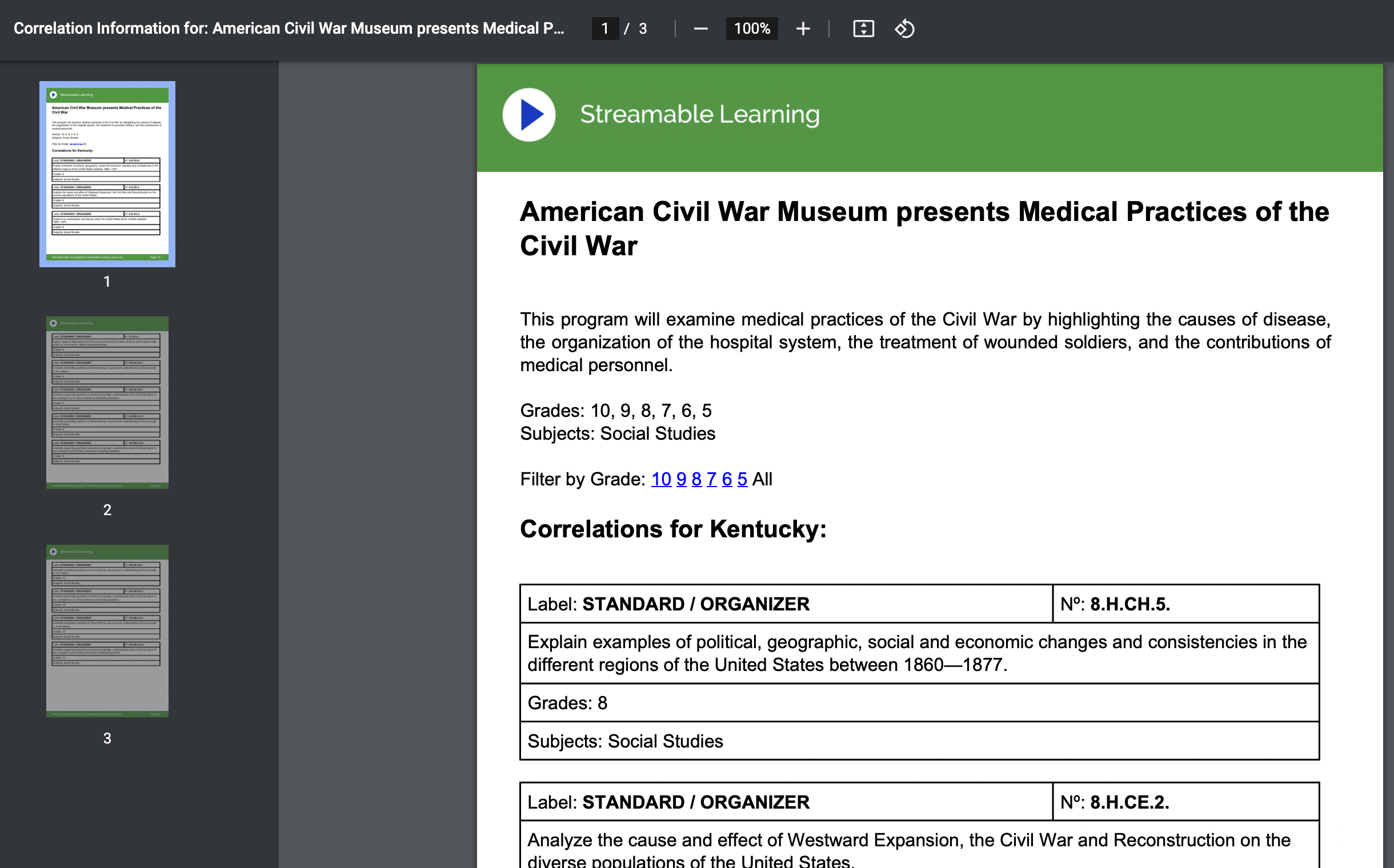
Many of these recordings also have a standards-aligned document to go with them based on a state of your choice.  However, once opened, some of these alignment documents say "Coming Soon" or there is no link at all because no standards doc has yet been made available.

The standard alignment document for the above recording.


A final feature worth noting is that a URL to a recording can be shared with a student directly.  In order to do so, the student will need your district's "code."  (A teacher can look up the code for their district.) Once a student clicks on the link, they will need to type in the district code or they can't watch the recording.  Again, Zoom is only necessary to participate in a livestream; no Zoom is required to watch a recording.

For a video overview of Streamable Learning, here's a screencast I made (11:00):


How could you use it?

Teachers have always loved bringing in a guest speaker, but that might not always be easy or convenient; similar issues with logistics hamper just jumping on a bus with 30 students and going to a museum.  (Especially if it's in Alaska or Australia!)  Streamable Learning gives a convenient, cost effective, interactive, safe way of bringing outside expertise into your own four walls.  Additionally, it's a great way to show authenticity around the content being learned in your classroom, by seeing more vivid examples of its use, impact and application.

Streamable Learning can also address equity issues and give some students virtual opportunities that they may have little to no chance to do in person.  An affluent suburban district may have parents that can easily afford supplementing the cost for that annual class trip to Washington, D.C. or Chicago, but for high poverty schools or rural districts already far away from their own local cities, this may not be an option.   Streamable Learning can potentially level that playing field.  

The ability to potentially share a recorded webinar with students via your district code opens up other options.   A student may get pushed a certain video that fits their personalized learning needs and passions.  Another may use a recording as a way of vicariously exploring a career path.  Or a group of students might benefit from a video to build schema for the focus of their project-based learning.


Downsides?

I wish that search results for recorded webinars were more logically organized, such as the most recent event at top and then going back in time, or perhaps have a few filtering options (alphabetically by partner, for example).   Also, it would be helpful if the standard alignment documentation was more consistent. While I understand this may possibly be uploaded sometime after the archived video is put online, several that I randomly found were missing this information even months later.  


While the platform costs, the number and variety of content partners and the ability to access previous webinars can make Streamable Learning a valuable instructional resource for students!


Have you used Streamable Learning or another "virtual field trip" platform?  Share in the Comments below.

Thursday, July 7, 2022

ISTE 2022

 My first trip to an ISTE (International Society for Technology in Education) conference was to San Diego a decade ago.   I was still a classroom teacher at the time, hungry for digital tools and strategies; to put the trip in historical edtech context, iPads were only two years old when I went to that first ISTE!  Unfortunately, I haven’t been to an ISTE conference since then…so I was extremely grateful for the opportunity to go (along with some SCPS teachers, and 14,000 others!) to this year’s ISTE conference in New Orleans.  It did not disappoint!  


Briefly, here are some of my personal highlights.

EEEASE into an “Explore Board”

Holly Clark may promise a lot with a session name like “The Perfect Blended Lesson,” but if anyone can come close to that ideal, it’s likely her.  One aspect I found particularly illuminating was her distinction between a “Choice Board” and what she felt was a better branded “Explore Board.”  An Explore Board is a hyperdoc carefully constructed with a pedagogical purpose, infusing digital tools; a Choice Board is often only a “tic tac toe”-style worksheet that asks the student to complete tasks that are digital or analog.  (The presentation Slides linked above have some templates and examples of Explore Boards.)

After the session, I reflected on Clark’s defined features of an Explore Board along with what I already knew about effective digital pedagogy.  I then made an acronym (because we all agree that education needs another one!):  EEEASE.  While this list of key characteristics certainly can specifically apply to essential aspects of an Explore Board, they could also apply to a well made blended learning lesson in general:

  • Engage the audience (the “hook”).
  • The students should Explore the topic to build schema, within a digital resource framework of “bumper rails” provided by the teacher. 
  • Explain what you want the students to do: the directions and step-by-step of the task(s), the desired outcomes, and possibly a rubric.
  • Students should Apply what they have learned or what they can do.  Optimally, the type of final product that demonstrates the learning is the choice of the student.
  • Students should digitally Share or publish their work (outside of the classroom when possible) or reflect/self-assess on what they have done; ideally, they will do both!
  • Offer a way to meaningfully Extend the learning for those that need more help or complete the work early.


STLP Gets a Shoutout! 

On the second day’s opening session, a panel of students shared their insights….and Luke from Trimble County was one of them!   He particularly praised Kentucky’s STLP Program as a crucial learning opportunity that he personally enjoyed and benefited from.  


LeVar Burton

Whether you know him from Roots or Star Trek: The Next Generation or Reading Rainbow, LeVar Burton has been at the forefront of culture and education for decades.  Recently, he’s joined forces with BYJU'S (the parent company of Osmo) as their new Chief Reading Officer in order to create a new literacy app that’s about to launch, so ISTE became an opportunity to talk edtech and his life journey in an hour-long interview conducted by Donnie Piercey.   To sit in the front row of Burton’s talk will be a wonderful lifelong memory for me.


Learning and Practicing SEL in Virtual Reality

I found out about Project VOISS, a combination VR platform and lesson resource site where students can interact in a virtual school, practicing their choice of responses in various social emotional learning scenarios and seeing the consequences of those choices.  I’ve been intrigued by virtual reality learning for years, but admittedly the hardware requirements can sometimes be limiting (for example, the need for headsets); I was impressed that VOISS will work on Chromebooks.  They are currently seeking district and school partners to expand its platform usage. 

New Book

As a fan of PBL, I was excited to pick up a copy of Suzie Boss and Jane Krauss’s Reinventing Project-Based Learning (Third Edition) at ISTE’s onsite conference store.  It already looks promising to provide some insights for my district leadership in the coming school year.


Thank you to ISTE for facilitating such an inspiring and learning-packed conference!


Wednesday, January 26, 2022

From Good to Great, Initial to Ideal: A Way to Improve Exhibitions and Other Performance Assessments

When our district began its journey into competency-based education (CBE), one of the significant early steps was the publication of our Profile of a Graduate (PoG) in 2017.  The Profile was crucial in developing our current Strategic Leadership Plan for 2018-2022, where Personalized Learning is the top strand.  "Embedded Performance Assessments" -- demonstrated applications of student knowledge intentionally timed at key points of a student's learning path -- is a feature mentioned throughout that strand, and one of our frequent examples of such an assessment is student exhibitions: a culminating celebratory event where they can "show what they know," often with the attendance of parents and community members as an audience.

From a certain perspective, student exhibitions are not new.  Indeed, if the phrase conjures up images of a junior high science fair with trifold presentation boards, homemade dioramas and solar system mobiles, or perhaps cute elementary students dressed up as famous people for a living wax museum, you would be forgiven. But there is a difference when defining exhibitions in the context of CBE or as a high quality performance assessment.  Features of such an exhibition would include the instructional intentionality in how they are designed and assigned by teachers, the agency of the students behind them, and the depth of the mastery of learning the exhibition can demonstrate.  Furthermore, if your objectives from student exhibitions include students producing rich artifacts of learning and having some practice runs leading up to a rigorous Defense of Learning performance summative assessment -- more on both of these later -- it is imperative that students exhibit and exhibit often.  

For a further exploration and explanation of the power of student exhibitions, watch this short video (2:14) from High Tech High:


Our district was not naive about what it would take to achieve these richer and deeper exhibition experiences.  Teachers needed to learn strategies and see good models for student-centered learning; students could not become empowered, confident, and self-directed overnight.   However, one of the wisest moves from our leadership was to encourage our teachers, and by extension students, to just try.   We knew that some of our earliest exhibitions would be rough and wouldn't look much different than those old fashioned science expos with the trifold presentation boards, but we had to start somewhere, so we could baseline, learn, and improve.  While we are still (and should always be!) "becoming" and improving, we can use the integration of our Profile of a Graduate as an example of how exhibitions have deepened and gotten better.  At first, students may have been asked to reflect on a Profile competency or two at the very end of the process, if at all, perhaps as an afterthought ("Reflect on which PoG competency you think this exhibition best exemplifies").  But then we developed single-point rubrics to measure whether the student met the competency . . . teachers began developing exhibitions with an intentional focus on a PoG competency made clear to the student from the start . . . and we are in the process of launching four point mastery scales on the PoG competencies to better assess the student's "performance."

The launch of the Profile of a Graduate five years ago certainly gave us a new "why" for student exhibitions and a way to deepen and better measure student learning. But looking back and looking forward, what if we had a tool or a more insightful lens to look at performance assessment more effectively?  

This is where an excellent book enters stage left: Deeper Competency-Based Learning: Making Equitable, Student-Centered, Sustainable Shifts by Karin Hess, Rose Colby, and Daniel Joseph (Corwin, 2020).  I'm halfway through reading it as an anchor text for my chosen SCPS PD strand this year, and in full disclosure (and to my delight), Rose Colby also joins Shelby County periodically to virtually lead workshop sessions on CBE for myself and other CBE strand learners.**   Deeper Competency-Based Learning is dense in the best sense of the term, full of CBE shift strategies, rubrics, and metrics to measure where you are in competency-based education and where you want to be.

In their chapter "Making Shifts in Teaching and Learning Structures," the authors share a table of criteria types to plan performance assessments (Table 3.6, page 94).  The criterion types, example questions typically answered by each type, and the Depth of Knowledge (DOK) one would usually expect for each type, are as follows:

  • Process: "Will the student follow particular processes (e.g. procedures for a science investigation; data collection; validating credibility of sources)?" [DOK 2]
  • Form: "Are there formats or rules to be applied (e.g. correct citation format, organize parts of lab report; use camera shots/visuals; edit for grammar and usage)?" [DOK 1]
  • Accuracy of Content: "List essential domain-specific terms, calculations, concepts, or principles to be applied." [DOK 1 or 2]
  • Construction of New Knowledge: "How will the student go beyond the accurate solution and correct processes to gain new insights and raise new questions? Are there any personal success skills that might also be employed?" [DOK 3 or 4]
  • Impact:  "How will the final product achieve its intended purpose (e.g. solve a complex problem; persuade the audience; synthesize information to create a new product/performance)?" [DOK 3 or 4]

The authors point out that "[a]ll rubric criteria do not need to be included for every summative assessment, but they should [all] be considered during the design phase," with a particular emphasis on Construction of New Knowledge and Impact for performance assessments that are to truly assess deeper learning (94).  Furthermore, these criteria are an excellent first step for either designing a new performance assessment or analyzing an existing one. Additional steps include considering an authentic context for application, identifying a proper format for such a demonstration, determining how much students will have voice and choice in the process or product, and last but not least, identifying and aligning success criteria to the task (94-95).

All of this brings us back to student exhibitions.  Even as many exhibition examples in our district often had a "good" quality to them, I struggled to articulate feedback in what could make them "great."  One thing I realized early on was the need to present an original idea, rather than just a regurgitation of what others have said or done, no matter how well it is packaged or communicated.  Put another way when I was discussing project-based learning in a previous blog entry: "It is not transformative learning if the end result...is merely a well presented aggregation of researched bullet points instead of a new idea or creation that shows real reflection and growth of student thinking."  (Note also that the word choice of the criterion Impact, as well as its definition, can strongly suggest how a well designed PBL can end in a high DOK performance assessment that "impacts" the community outside of the four walls of a school.)

It was this insightful criteria from Deeper Competency-Based Learning that illuminated how I could improve the way I evaluate and give feedback on performance assessment.   Firstly, as the authors point out, there is nothing inherently wrong with a performance assessment that only remains at the level of Process, Form, and/or Accuracy of Content (and by extension, at DOK 1 or 2).  I will label these as Initial performance assessments. Depending on the intentionality of the lesson/unit design, this might very well be instructionally sound -- for example, perhaps the competency is only being introduced and full mastery would not be expected.  The issue is when a teacher either stays at the Initial level for all such assessments for the entire course, or worse, misinterprets a performance assessment best designed only for these lower levels as a demonstration of mastery.   For a performance assessment to truly apply a student's knowledge with depth, the student should "gain new insights," "raise new questions," "employ personal skills" (like the ones from our Profile of a Graduate!), "solve a complex problem," "persuade an audience," and/or "synthesize information to create a new product or performance."  I would label these Construction of New Knowledge and Impact performance assessments as Ideal, especially if a student's mastery of learning (with a task at DOK of 3 or 4) is your goal.

This concept of Initial and Ideal can be further applied to other semantic aspects of teaching and assessment, as we transition from the traditional to the transformational.  For example, an Initial "folder" might contain artifacts selected by the student, but the wording shows a limited goal; it may be more concerned with being a container of student work, rather than with the depth of the work contained, and an emphasis on an end product rather than an ongoing process.  An Ideal "portfolio," on the other hand, can suggest a living collection ever changing, expanding, and improving over time; a perpetual artifact curation that should spur a student on to continually reflect on their growth academically and personally.   While this process of a portfolio may eventually culminate in a Defense of Learning -- a type of performance assessment where the student draws on their body of work to present as evidence of mastery (say, once a student is ready to complete their senior year) -- the day of the defense where a student stands in front of an audience should "Ideally" not overshadow the months and years leading up to the event.  Conversely, if the day of defense is a performance assessment that consists only of a student compliantly marching through a showcase of past work ---  in the parlance of the Process/Form/Accuracy of Content criteria, the student is merely following a process, applying formulas and rules, or listing definitions  --  this "Initial" kind of performance could silently be replaced by a single slide with a bulleted inventory or a one page table of contents and not skip a beat.

From Initial to Ideal (whether it be exhibitions specifically or performance assessments in general) and from good to great is not just a straightforward journey but a non-linear learning path that may circle back and then turn forward again over time.  The secret, as it is with many things in competency-based learning, is to do the journey with as much intentionality, reflection and metacognition as possible, with the aspiration to always go deeper. 


** For further reading on Shelby County's professional development personalized learning plan led by our Staff Developer Tracy Huelsman, please read Eliot Levine's CompetencyWorks 11/4/21 blog entry profiling her work. 

Wednesday, December 9, 2020

Google Earth for Web

The earth expanding right hand and left hand,
The picture alive, every part in its best light,
The music falling in where it is wanted, and stopping where it is not wanted,
The cheerful voice of the public road, the gay fresh sentiment of the road.

                                  -- Walt Whitman, "Song of the Open Road" 

We are in a season that in pre-pandemic times usually meant unfettered and uncompromised traveling and geographic relocation.   In the midst of COVID, doing such movement and visiting of others safely is challenging, which leaves me a bit gloomy.  It is likely that such a melancholic mindset has inspired me to think of Walt Whitman (a balm to the overcast soul if there ever was one!), as well as digital tools that allow at least a virtual facsimile of travel.

Google has a long history of such geographic, useful digital tools.   Of course, Google Maps has long been a mainstay of their Suite, with upgrades along the way like Street View.  Google Earth started as an impressive downloadable program, but originally took a sizable hard drive footprint and considerable computer processing power.  Yet both of these began as consumer, and not creator, tools.  That changed with Tour Builder, which allows you to utilize the Google Map data and create narrative presentational "stories" you could share with others. Unfortunately, Google recently announced that Tour Builder will be shuttered in July 2021.   The good news?  Google Earth for Web -- a browser-based version of Google Earth that works without a download, which means you can use it on a Chromebook! -- now has similar creator tools.


How does it work?

Google Earth for Web (hereafter "GEfW" for short) allows you to make a guided map journey that you can present to, or share with,  others.  In some ways, it is like an interactive geographic timeline, in that you can take any place on Google Earth as one of your "stops" and add contextual text, videos and pictures.  A key advantage that GEfW has over Tour Builder is that it is now seamlessly integrated into your personal Google Drive. Your projects save inside a "Google Earth" folder (created the first time you save a GEfW project), which makes finding and sharing them very easy.  Note that your Chrome browser must have hardware acceleration on for Google Earth to work; this is under "Advanced" in your Chrome's settings.  (Hardware acceleration is sometimes disabled by your district's Google admin.)

In this tutorial video (2:06), you learn how to start a Google Earth project and a quick overview of its tools:


This video (2:59) goes more into depth about the creation tools of GEfW:


When you decide to present a finished project, the navigation feels very similar to Google Slides.  In fact, inserting a slide is a media option for GEfW, allowing you to have an introduction and conclusion, as well as possible transition slides throughout.   

Speaking of a similar feel to other Google products, you will find the sharing tool of Google Earth for Web just like any other Google Doc.  You can simply create and share a link for "view only" rights, but you can also invite contributors to collaborate with you on editing the project.

How could you use it?

A Google Earth for Web presentation would certainly be more dynamic than a typical direct instruction "click through the slides" experience.  But the ability to empower students to tell their stories in new ways is really where GEfW can elevate learning.  This video (2:12) gives some great examples of how your students could integrate GEfW into their next passion project or PBL:


Downsides?

When opening up a previous project, or even just opening up Google Earth for Web, be prepared for a little lagginess as the media loads in your browser.   Your mileage may vary depending on your Internet connection and the performance ability of your device.  Considering how graphic-intensive the application is, this is not a surprise.  When presenting or editing a GEfW project, I highly recommend shutting down unused programs and minimizing your open browser tabs.


Enjoy creating unique stories utilizing the vast Google Earth data!  And if the current holiday season and the pandemic is making you as melancholic as it is me, remember Whitman's wise words:

The earth never tires,
The earth is rude, silent, incomprehensible at first, Nature is rude and incomprehensible at first,
Be not discouraged, keep on, there are divine things well envelop’d,
I swear to you there are divine things more beautiful than words can tell.


Monday, May 4, 2020

New Vodcast Series for Educator Reflection During NTI

First, we must honor the date of this entry!  Not only is today Star Wars Day, but it is the start of Teacher Appreciation Week.  Has there ever been a school year where all teachers have not easily earned the rank of Jedi Knight?  I can't imagine one.  Thanks to all of the compassionate teachers out there who strive to innovate in these challenging non-traditional instructional (NTI) times...and that includes a nod toward the parents and guardians who are co-teaching these lessons at home.

It was an awareness of our Shelby educators who are innovating during NTI that inspired Lora Shields, our district Staff Developer.   Knowing that some hard-won professional learning was happening out there, she proposed a vodcast that could both capture this moment in time as well as share the learning with others.   As we teamed together to make this happen, we shaped the focus of the vodcast series to be guided by two questions:  what new tool or strategy are you currently learning to use during NTI, and in what ways will that transform your teaching when you return to the brick and mortar of your school buildings in the future?


Thus, the vodcast series "Shelby Speaks: Looking Forward" was launched, sharing our facilitated interviews with the creative educators of our district.  As of today, over half of our recorded episodes have been published (see the playlist on SCPS's YouTube channel), and we have already earned acclaim from other education leaders and even local television news:


In particular, I'd like to highlight three episodes that address a few of my favorite educational topics: project based learning and libraries.

In Episode 3, Martha Layne Collins art teacher Lukas Allison talks about how important cross-content PBL and design thinking is to his lesson planning (9:43):


In Episode 5, West Middle School teachers Casey Robinson, Sarah Buchanan, and LaPorsha Jackson talk about the process of moving PBL exhibitions to an online space (12:26):


Lastly, in Episode 10, Julie Webb (Shelby County High School) and Emily Northcutt (Marnel C. Moorman, our K-8 school) discuss how librarians and libraries play an essential role in NTI (18:20):


Thanks to all of the educators worldwide who are attempting the Herculean task of continuing student learning at home, even when our students face substantial inequities of Internet access, food insecurities, and understandable anxieties about our unprecedented present.