Showing posts with label wakelet. Show all posts

Sunday, August 24, 2025

Serious Play Conference 2025


Ever since the first time I discovered the Serious Play Conference, I was eager to attend.  However, for several years it was at the University of Toronto and therefore didn't seem to be an affordable option for a work trip.  This year, however, it was at St. John Fisher University in Rochester, New York.  I was thankful to have the conference approved by OVEC as my annual out-of-town professional learning, and doubly grateful when I was asked (along with my TTRPG educator colleague Kalli Colley) to speak on a panel!  On a side note, I've been curious about the Erie Canal ever since I sang a folk tune in pre-school, so I was also glad for the chance to see it in person, as it ran just outside of our hotel.  (On a side note to my side note, the Del Monte Lodge was a beautiful place to stay, run by an incredibly friendly staff.)  While in Rochester, I even ate a version of their local delicacy: a "garbage plate" (it was delicious).

Canals and garbage plates aside, how was the three day conference?  In a word: illuminating.   Like the Play Make Learn conference in Wisconsin I attended last year, it was energizing to be around hundreds of educators and game designers who enthusiastically believe in the power of play- and game-based learning.  While I created an extensive Wakelet covering the depth and breadth of the sessions I attended and the resources I gained (also embedded at the end of this blog entry), here I will share a dozen highlights:

  • Michelle King, our keynote for the first day of conference, inspired us with the notion that "words create worlds," and told us a paraphrase of Brian Eno's difference between the solitary genius (an "egosystem") and the collective innovation from a scenius (a vibrant and healthy "ecosystem").  What kind of playful and positive world will we create together?
  • Stephen Reid, our second day keynote, implored us to not forget that "play matters."  We are often limited by anti-play policies and taught to be suspicious of adults who engage in what is perceived as frivolous activity; as a particularly evocative example, he showed us the difference between what you find when you google "man in a tree" and "child in a tree."  Reid also shared anecdotes of using Command and Conquer and Minecraft in his classrooms.
  • Deb Fuller and Luigi Guarniccio discussed the need for accessibility in games.  As Fuller reminded us, things like curb cuts are not just niceties for those permanently in wheelchairs, as "we are just temporarily abled" and, with age or an accident, will eventually need such supports.  How can we design better for those that are (among many other examples Fuller and Guarniccio provided) left-handed, or have vision challenges?
  • Meghan Gardner discussed what makes a game truly "transformative" versus merely "remarkable."  Additionally, Gardner is the founder of Guardian Adventures, a treasure trove of educational gaming resources and examples.
  • Kelly McNeil, a Learning Experience Designer with Digital Promise, shared her journey in bringing play into professional development.  She reminded us that while fun can help in engagement, we still need to construct adult learning around evidence-based practices, such as Darling-Hammond, Hyler and (Madelyn) Gardner's "Seven Models of Effective Professional Development."
  • I first read about Dr. Megan Connell's work using Dungeons & Dragons as a part of her therapeutic pedagogy in Shelly Mazzanoble and Greg Tito's book Welcome to Dragon TalkSo I was particularly excited to hear her speak, alongside learning what teacher Greg Gordon has done in his own classroom.
  • MagiKids is a charitable foundation that donates Magic: The Gathering kits to learning spaces.  From that session, I was also blessed to meet Lyla Ross, the head of the Washington State-based 501(c)(3) Gamers Engaged, one of the many "backbone organizations" that help fund MagiKids.
  • Sharon Peck demonstrated multiple examples of how games can improve literacy.  (Also, check out Professors at Play!) 
  • Speaking of professors...University of Toronto professors Leslie Stewart Rose (Ontario Institute for Studies in Education) and Quinn Jacobs (Department of Arts, Culture, and Media) shared "How Play Solves Problems of Practice in Classrooms."  One of the examples indicated was the use of Dungeons & Dragons!  I appreciated their ample research references throughout their presentation, and how we better appreciated play in a learning setting by actually playing a game.
  • Lt. Col. James "Pigeon" Fielder (ret.) uses a semester-long simulation game for one of his political science courses at Colorado State University.  He was candid about what worked, and what he would do differently in the future.
  • I picked up two books while at the conference:  Becky Keene's AI Optimism and Tracy Fullerton and Matthew Farber's The Well-Read Game: On Playing Thoughtfully.  I can't wait to dive into both!
  • Last but not least, I visited The Strong National Museum of Play twice for after-hours conference events.  It was a charming and delightful institution, and it alone would make planning a trip to Rochester worthwhile.  (For a plethora of pictures, check out my Facebook post from my KyEdRPG Page.)


As I mentioned at the beginning, Kalli Colley and I were asked to speak on a session panel: "Adventures in TTRPG: Building Learning Worlds with Dice, Devices, and Dialogue."  It was wonderfully moderated by Sana Alimohamed, and we were joined by an impressive group of educators: Sharon Lee De La Cruz, Phill Cameron, and Huaidian (Daniel) Hou.  Thank you to the 50+ attendees of the session, who leaned in with great interest and questions!  A special thanks to Sana, who in addition to her moderation duties took the time to curate and share several resources discussed in the panel in a LinkedIn post.


From left to right: Sana, Phill, Kalli, me, and Huaidian.

Besides the learning gained at the Serious Play Conference, I am grateful for the chance to have met so many admirable people in person.   A final shoutout needs to be given to Paul Darvasi and Elisa Navarro for putting together the event (and for Dr. Darvasi's personal reach out that led to Kalli and I submitting proposals).  If you have a chance to attend a future Serious Play Conference, I highly recommend it.

Speaking of Kalli Colley, our "Dungeons & Desks" FREE regional PD series returns this fall to two Kentucky locations:  London (October 20) and Hazard (November 3).  Come play and learn with us!


Sunday, November 17, 2024

Aurora Institute Symposium 2024


A few weeks ago, I was fortunate to have the opportunity to be in New Orleans attending the annual Aurora Institute Symposium.   It was my fourth time over the last decade, and my second time presenting!  I discussed tabletop roleplaying games in the classroom, particularly from the perspective of personalized competency-based education (CBE) and equity.


Special thanks to my colleague Kathy House for taking photos of my session.

Besides my gratitude at being able to lead a session, there were plenty of memorable learning experiences, from keynotes to breakout sessions to chance encounters in the hallway.  Here are a handful of highlights:

  • Rhonda Broussard was a keynote speaker. (Later, I purchased her book One Good Question and was excited to get it signed!) She helped me think differently about classroom inquiry by posing the following three characteristics of what makes a good question for students: 
    • It's not about the teacher (don't reveal your own teacher bias).
    • Anticipates multiple perspectives.
    • Requires mixed-methods reflection (needs sources outside of yourself).
  • There was a student panel (led by Broussard) which generated some great quotes.  Samarah Bentley, a freshman at LSU, pointed out that when looking at what we value in school, an educator's "investments reveal your intentions," and when including students in your learning space, it should be beyond tokenistic representation in your curriculum or just asking survey questions, but a true dialogue: "Not just input, but an exchange!"  When Broussard asked the students to pose one good question for us in the audience, David Ramirez (a student at New Orleans Charter Science and Mathematics High School) gave a powerful plea: "Will you listen?"
  • Representatives from CAST -- Melissa Sanjeh (Senior Professional Learning and Implementation Specialist) and Sherann Jackson-Alkins (Head of ABCD University HS, an alternative school in Boston) -- shared some wonderfully pragmatic and effective tools when universally designing for learning (UDL).    I particularly liked the website's interactive guidelines, as well as the idea of "journey mapping" to see the lesson/unit from the perspective of different students to determine barriers and plan for scaffolding.
  • Another keynote by Sabba Quidwai on artificial intelligence reminded us that our concern that AI is producing the work and not the human doesn't quite fit how we treat assistive, collaborative writing in other contexts: "Politicians have speechwriters. Authors have ghostwriters. Musicians have songwriters. Entrepreneurs have investors."
  • A panel on "Advancing Equity Through Grading Reform in K-12 Education" was led by Starr Sackstein (Mastery Portfolio), Bryanna Hanson (Learner Centered Collaborative), and Sierra Holtzheuser (SpacesEDU).   Among many good points and shared resources, I particularly appreciated Mastery Portfolio's glossary of equitable grading terms, Learner Centered Collaborative's CBE Reporting Playbook site, and Holtzheuser's reminder that digital portfolios should avoid a "scrapbook mentality." 
  • Finally, it was good to run into old friends. Laurie Gagnon and Chris Sturgis reminded us where we've been and where we are going with CBE.  Karin Hess, Jonathan Vander Els, and Brian Stack have recently published a wonderful new book Elevating Competency-Based Learning in a PLC at Work (full disclosure: I'm quoted in the introduction and first chapter!) and ran a helpful session about effective professional learning communities.  With an introduction from David Cook (former Kentucky Department of Education Director of Innovation), Adrienne Usher, Jesse Bacon, and Michael Ekbundit shared how strategically and intentionally they have involved the Bullitt County community with implementing their Graduate Profile.  Sarah Snipes (the current KDE Director of Innovation), along with members of the University of Kentucky's Center for Next Generation Leadership (Susan Dugle, Karen Perry) and the Center for Innovation in Education (Gretchen Morgan), discussed Kentucky's journey toward a local assessment accountability system.  Last but not least, my OVEC colleagues Carmen Coleman, Lacey Eckels, and Rachel Albright presented on their portrait of a learner work with Kentucky's Fayette County Dixie Magnet Elementary School.

My embedded Wakelet collection below has an expanded story of my Symposium experience with additional resources and links.   Be sure to also check out social media posts from the event using the hashtag #Aurora24.


Thursday, October 26, 2023

Aurora Institute Symposium 2023

 Last week, my colleague Kathy House and I went to the Aurora Institute Symposium 2023 (#Aurora23).  It's the first Aurora Institute Symposium I've attended in person since a pre-pandemic one in Nashville several years ago when I was still with Shelby County Public Schools. I was so thankful to go, and it was a great conference. In short, it replenished my well to the brim and beyond!  

One of the most unexpected delights of the Symposium happened in the hallway of the convention center.  I was talking to Eliot Levine, the Research Director of Aurora Institute.  We had emailed and Zoomed over the years but hadn't been face to face for a stretch.  Suddenly, a young man who was walking by had stopped to stare at me.  

"Mr. Watson?" he asked.

I took him in.  There was a beard now, but he looked familiar.  Of course I cheated and looked down at his lanyard.  My mind reeled backwards to my classroom teaching from a decade ago.  This young man was a former student of mine. 

"Clay?" I was gobsmacked.  How on earth could a Kentucky high school graduate (who had never expressed the desire to teach), per his lanyard, move to Utah, become a teacher, and now be standing in front of me in Palm Springs, California?  

Eliot graciously yielded the space, and Clay and I quickly caught up.  Turns out that a few years ago, Clay was feeling burnt out in his then career of finance and his wife suggested he teach instead.  As he shared with me, "At first, I thought of all the reasons that teaching wasn't a great choice.  Then, I thought of some teachers that I really loved, the ones who made a difference for me.  What if I could be one of those teachers?  And Mr. Watson, you were one of those teachers."  A few hops later through a job interview, a move to another state, and an alternative certification pathway, Clay and his colleagues are now preparing to open a new school in Utah in fall 2024.  The Symposium was helping the school's staff get ready for their innovative road ahead.

You might not believe in fate or destiny, but while I was staring at this young man in the middle of California, teary eyed, I had to feel that the Spirit of Life had conspired to make us cross paths, and to send a message.  And that message was one that all of us as educators should heed: If you are unsure that the learning you facilitate and the relationships you develop today make an impact, be patient.  Sometimes, seeds you plant may take years, or even decades, to sprout.  

But they sprout.

So, Clay, if you read this, thank you!

Back to the conference.  I was busy posting on social media and taking lots of pictures and notes, so as I was mulling over how best to share my Symposium journey, I decided to utilize Wakelet and curate a multimedia collection to put on Edtech Elixirs.  You can click here or view it embedded below.  

As I wrap up this entry, THANK YOU to all the presenters and facilitators, particularly the several Kentucky friends you'll see in the Wakelet.  I can't wait to go back to the Symposium next year.  Mark November 4-6, 2024 in New Orleans down on your calendar!


Saturday, March 5, 2022

Share Fair 2022

 After a year off because of COVID-19, Share Fair came back!

Last weekend, we held Share Fair 2022 and had several firsts, which included ending with a "campfire reflection" (attendees sharing takeaways and gratitudes for what they experienced that day) and door prizes donated by DreamBox Learning and Sixth and Main Coffeehouse.  But the most important "first" was a keynote presentation panel of Shelby County students that I moderated around the theme of "My Shelby County Personalized Learning Story."  I really have to thank Kerrigan Aldridge, Bryce Applegate, and Regan Ross for their poise, insights, and demonstrating such effective communication!

Last but not least, thanks to all who attended or presented on a Saturday morning.  If the comments during the campfire reflection was any indication, the Share Fair was worthwhile.

As I've done previously, I've documented the event via Wakelet, linked directly here as well as embedded below.


Tuesday, February 22, 2022

Edtech and preK-8 Literacy: A Template to Help with Deeper, Intentional Integration

If you are an educator who is wrestling with improving preK-8 student literacy, you likely are already very familiar with Irene C. Fountas and Gay Su Pinnell.  As their Twitter profile summarizes, they are "authors of books, videos, & websites that are considered standards in the fields of literacy and professional development."  Besides a very helpful website full of resources, they have also created a preK-8 Literacy Continuum published in a popular book, most recently given an expanded edition in 2016.

As a former high school English teacher with limited foundational elementary reading and writing instructional expertise, I have to admit that I did not have a deep knowledge of Fountas and Pinnell until Jill Brookman, our district Literacy Coach, met with me to discuss their Literacy Continuum book -- in particular, an intriguing part of the book that details their "Technological Communication Continuum."  (The entire book and its extensive Literacy Continuum has proven very effective in helping Ms. Brookman coach our teachers in improving their instructional pedagogy.) As the authors explain, the literacy of learners today is much more expansive than just engaging in printed text.  Students must also demonstrate their computer literacy (the use of various devices to "create documents, find information, and communicate with others"), online reading and information literacy (comprehending, as well as critically evaluating, such text), and composing and publishing digital texts (which in a multimedia world is much more complex than simply typing a story in a word processing program!) (pp. 346-347).   With such digital communication in mind, Fountas and Pinnell put their preK-8 Technological Communication in a continuum as a progressive set of standards, or in their parlance, "goals" to select.  These student "behaviors and understandings to notice, teach and support" are organized into two categories for each grade level: Digital and Media Literacy (reading, or the consuming of electronic text) and Communication and Publishing (writing, or the creation of electronic text) (pp. 348-356).

Ms. Brookman knows I am constantly looking for ways to more authentically connect learning objectives to technology integration.  (A recent example: how I crosswalked edtech with competency-based design principles, as featured in Eliot Levine's July 2021 CompetencyWorks blog entry.)   So she posed a challenge.  Using the Technological Communication Continuum standards, could I describe how a specific edtech tool could exemplify high rigor literacy?  Would these standards help me articulate how you can integrate edtech with greater intentionality in a teacher's lessons plans to invoke deeper student learning?

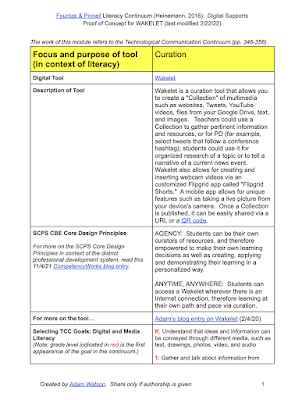
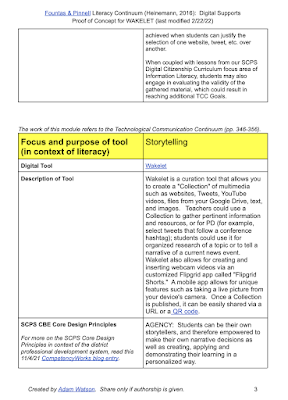
Challenge accepted!  As a proof of concept, I used Wakelet (a wonderful tool I previously discussed here) as my prototype modules; Wakelet is a natural fit for curating resources (reading) as well as storytelling (writing).  These two modules were organized around a template I created with several sections, such as:

  • Description of Tool.  Explaining briefly what the edtech tool is, and how it works.
  • SCPS CBE Core Design Principles.  How does the tool align with our district's competency-based education beliefs what is best for learners, such as supporting student "Agency" or "Anytime, Anywhere" learning?  (These Principles were adapted from Aurora Institute's updated 2019 definition of CBE, explained here.)
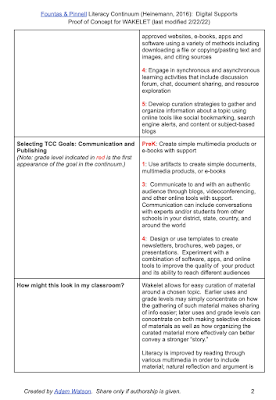
  • Selecting TCC [Technological Communication Continuum] Goals: Digital and Media Literacy.  What reading or media consumption Continuum goals does the tool best achieve?  The grade level where the goal is first stated in the continuum is highlighted.
  •  Selecting TCC [Technological Communication Continuum] Goals: Communication and Publishing.  What writing or media creation Continuum goals does the tool best achieve?  Again, the grade level where the goal is first stated in the continuum is highlighted.
  • How might this look in my classroom?  Further detailed explanations and concrete examples of how the intentional usage of the edtech tool helps further literacy. 

Both modules for Wakelet are together and viewable in the PDF linked here. You can also see screenshots of the first three pages of the document below, with the focus on using Wakelet for curation:


Besides Wakelet, there are certainly other worthy edtech tools that can go hand in hand with exemplifying these Fountas and Pinnell Technological Communication Continuum literacy standards.  I encourage others to use the template above to do so, and articulate their own deeper, richer synthesis of intentional edtech with more effective literacy instruction.  And I thank Jill Brookman for introducing me to the highly illuminating Literacy Continuum book!


Tuesday, February 25, 2020

Share Fair 2020

Our sixth annual Share Fair is now in the rearview mirror.  Thanks to our teachers, students, librarians and building tech who led fantastic presentations!

While I must give special thanks to all of our attendees, I feel it necessary to point out a group of educators who likely win the contest for "longest distance traveled to come to Share Fair."  Principal Shannon Treece and her team from Babcock Neighborhood School traveled a thousand miles from Babcock Ranch, Florida in order to attend our sessions.  (Well...in full disclosure, they also visited several Shelby schools earlier in the day!)  Not only did they appreciate what our presenters discussed, but they were also so inspired by the Share Fair format that they have already started work on hosting a Share Fair of their own this fall.  It is beyond flattering to think that the first (known!) Share Fair outside of Kentucky will soon be happening.

Speaking of firsts: This year, I used Wakelet for the first time to create a Collection for Share Fair 2020, capturing the story of the event -- in particular, the #SCsharefair tweets.  It is embedded below or available directly here.

Thanks again, and we can't wait to see you next school year!


Tuesday, February 4, 2020

Wakelet

For several years, Storify was one of my favorite free "go to" edtech tools.  You could use it to collect digital artifacts -- URLs, pictures, YouTube videos, social media posts -- and you could sequence these items to create a narrative in order to share with others.    However, like other online tools that come and go, it unfortunately shut down in May 2018.

When one edtech door closes, another one often opens.   Last year, I was excited to be introduced to Wakelet.   In the months since, I've not only seen how Wakelet is more than able to fill the void that Storify left, but I have also been impressed with how it continues to mature and improve with new features.

How does it work?
Making a "Collection" in Wakelet is quick and easy; the interface is very user friendly.  First, you need to create a free account.  You can use Google, Microsoft, Facebook, or just use your email address.   When you create an account, you will choose a name that will determine your profile's URL.   (Here's mine as an example.)   Once your account is created, you can follow other Wakelet users, and they can follow you.  Your followers will be notified when you publish a public Collection, as you will be notified when the people you follow do the same.

As you create a new Collection, you begin to make choices such as the title and whether it will be public or private.   Once you start a new Collection, what can you add?  You can insert text, websites via their URLs, YouTube videos, tweets (you can search by username or hashtag), pictures, PDFs, and even include files straight from your OneDrive or Google Drive.

As you add certain content, Wakelet remembers them as "Bookmarks."  This makes it easier to insert that content in future Collections.
One of the newest features of Wakelet is inserting "Flipgrid Shorts."  This is an opportunity for the person making the Collection to record a webcam video up to three minutes long; as with standard Flipgrid videos, you can use fun filters or insert graphics and text. The 49 second video below shows how this works.   Note that this Wakelet option is not really the full Flipgrid experience; you cannot log into your separate Flipgrid account to natively insert what you've already created, nor are viewers of the Collection able to respond to your "Flipgrid Short" with comments or video replies of their own while within the Wakelet site.   (Tip: if you're wanting to create an opportunity for an interactive Flipgrid experience, simply insert your grid's URL into your Collection like you would any other website.)


There are other Wakelet features that affect the viewing experience.  The creator of the Collection can choose various ways of presenting the materials, including a "Mood Board" option.  Another new feature utilizes Microsoft's "Immersive Reader" in order to read aloud your Collection!   Lastly, if viewers are logged into their own Wakelet profile, they can copy a Collection to their account to edit and publish their own version as they see fit, assuming that the creator of the Collection permits this to happen.

Wakelet makes sharing a published Collection very simple, with built in tools for several social media platforms, as well as options like a shortened URL and a QR code.


Recently, Wakelet now allows multiple ways for users to collaborate on the same Collection.  In theory, collaborators do not even need Wakelet accounts to interact in a Collection.   Collaborators can be given access directly via their Wakelet profile name or email, or indirectly via URLs and QR codes.   (Keep in mind that collaboration tools are in beta as of February 2020.)


Last but not least, Wakelet offers iOS and Android apps.   This allows users to be able to create Collections from their mobile device, albeit the options are more limited than the full website version of Wakelet.  I've created a Collection that demonstrates how the mobile app works, which is also embedded below:


How could you use it?  
Teachers could use Wakelet to capture resources while at a conference -- the key tweets sent out from a hashtag, the Google Docs shared by presenters, and so on.  You could also create narratives consisting of text, websites, and social media posts that chronicle a current event to share with students.  Students could use Collections as a way of saving research, composing mini-"hyperdoc" essays, creating an online portfolio of learning artifacts, or collaborating with team members on resources while working through a PBL.

Downsides?  
Storify allowed you to natively find and embed Facebook and other social media posts; I would like Wakelet to easily do the same beyond just Twitter.  For now, the workaround would be to find the social media post's public URL and add it to your Collection as you would any other website.

As I mentioned above, I first discovered Wakelet last year at KySTE 2019 thanks to Stella Pollard, a wonderful educator and frequent presenter!   Because Stella is an experienced user of Wakelet -- be sure to check out her Wakelet profile -- what better time to interview her, as well as share her thoughts on other edtech tools?

Stella, welcome to Edtech Elixirs!  Please share your educator story.
I have been an educator since 2013. My journey began in Perry County Schools as a para-educator for a first-grade classroom. My husband and I moved to central Kentucky in 2014 where I was offered my first official teaching position as a middle school math and science teacher at Williamstown Jr. High School. I was offered a job closer to home in 2015 as a 6th-grade science teacher at Bondurant Middle School in Franklin County. I am currently an Instructional Technology Coordinator (Digital Learning Coach) for Franklin County Schools and I work with each of our 13 schools on effective implementation of instructional technology. 
How do you personally use Wakelet?
I started using Wakelet back in early 2018. I jumped onto the #WakeletWave because I was #NotAtISTE18 and needed a way to store all of the resources I found so I could come back to them at a later date. Since then, I have made Wakelet Collections for recipes to resources, lesson materials to videos, and everything in between. I love how easy it is to use on every platform (iPhone, Chrome browser, Chromebook, etc). 
Have you seen students and teachers use Wakelet?
I have! I have seen teachers use Wakelet as a collaborative workspace for students to digitally share and explore the work of their peers. 
What is one of your favorite features of Wakelet? 
I love the ability to automatically store your Screencastify videos directly to a Wakelet. It's quick and effective and in my role as a Digital Learning Coach, I am always making videos for our teachers. Since you can easily access your Google Drive inside of a Collection, this gives me the ability to share those videos quickly. 
Besides Wakelet, what are some other new edtech tools you are currently using?
One of my newest edtech tools that I have found recently is Actively Learn - it's similar to Newsela but has features that include: asking questions in the text, including specific notes for sections for your students while they're reading, the ability to embed a video or link to a different website, and more. In addition, it speaks directly to Google Classroom so there's minimal set-up for teachers to begin. Finally, one of my favorite things about it is that the free version is pretty solid.


What's your advice to teachers just starting to integrate edtech into their classrooms?
It's okay to not know everything about a tool. Students can and will figure it out long before we ever will. Don't be afraid to have your students try new things and give them the chance to input their voice in the assignments.
I want to thank Stella for taking the time to share her wisdom.  Be sure to follow her on Twitter, Wakelet and beyond! And be sure to share your creative ways for using Wakelet in the Comments below.

Monday, March 18, 2019

KySTE 2019

Every March, I make my edtech pilgrimage to the Galt House in Louisville, Kentucky to attend the KySTE Spring Conference.  It was a record attendance this year (nearly 2000 registered!).    It's been a few days since the close of the conference, and I wanted to share several highlights.

1.  I did presentations on Shelby County's Digital Citizenship curriculum as well as some recommended digital equity tools to help personalize learning.   I was pleased to get attendees for both, but in particular, I hope to continue conversations with several people on how we can collaborate on digital citizenship for Kentucky students in the future.

2. Much like I missed TodaysMeet and was thankful to find YoTeach, I have missed Storify since it shuttered, as it was an easy and useful curation tool...but now I think I have a replacement!  From Stella Pollard, I learned of a new tool, Wakelet.   It allows you to make "collections" that can consist of images, PDFs, texts, Tweets, YouTube videos, and of course hyperlinks.  Wakelet is very user friendly, and even allows the ability to search tweets and YouTube videos from within the tool much like Storify did.  A social aspect of Wakelet is that you can have followers, and there is a beta feature where you can collaborate on the same collection.  I created a profile page here.

3.  URL shorteners like Bit.ly and Tinyurl.com have three main issues: a) your audience has to type a complicated URL where upper and lower case letters make a difference, b) you can personalize the URL to make it more straight-forward, but the more simple it is the more likely it's already taken, and c) both A and B may seem like a lot of effort for what often amounts to just a one time hour-long presentation.   That's why Yellkey is fantastic!  Simply give the URL to shorten and choose the duration you need it, anytime from 5 minutes to 24 hours.  You will get a shortened URL in simple language, such as yellkey.com/computer. Note these are both disposable and reused; a few days or even a few minutes from now, yellkey.com/computer will point to something else. (Thanks Leslie Fisher!)

4.  As a former high school English teacher, it is easier for me to imagine a librarian to help collaborate with staff on literacy and not numeracy needs.  Obviously, I am short sighted!  One of the best KySTE sessions I attended involved Sarah Zender (math teacher) and Amanda Hurley (librarian) from Henry Clay High School (Fayette County).  They talked about their work together, and it was impressive: scavenger hunts, geometry animated STEM projects, Math Inquiries that connected personal interests (such as guitar playing, MMA fighting, and fantasy football), and involving students in library renovations.

5.  Last but not least, it was a highlight of not just the conference but of my career to receive the KySTE Outstanding Leader of the Year award for 2018-2019.


As I've already said in various social media posts, in a life there are hundreds of people who give you wisdom, teach you a lesson, or model by example.  Whoever I may be or accomplish is the accumulation of all of those people and moments.  Thank you to all of my friends, family and colleagues who I have had the privilege of sharing a part of my educational journey.  And of course, thank you to KySTE for the award!  I'll always treasure it.

I'll end this entry with a video of my acceptance speech.  Special thanks to Cyndi Skellie for recording it!