Showing posts with label equity. Show all posts

Sunday, November 17, 2024

Aurora Institute Symposium 2024


A few weeks ago, I was fortunate to have the opportunity to be in New Orleans attending the annual Aurora Institute Symposium.   It was my fourth time over the last decade, and my second time presenting!  I discussed tabletop roleplaying games in the classroom, particularly from the perspective of personalized competency-based education (CBE) and equity.


Special thanks to my colleague Kathy House for taking photos of my session.

Besides my gratitude at being able to lead a session, there were plenty of memorable learning experiences, from keynotes to breakout sessions to chance encounters in the hallway.  Here are a handful of highlights:

  • Rhonda Broussard was a keynote speaker. (Later, I purchased her book One Good Question and was excited to get it signed!) She helped me think differently about classroom inquiry by posing the following three characteristics of what makes a good question for students: 
    • It's not about the teacher (don't reveal your own teacher bias).
    • Anticipates multiple perspectives.
    • Requires mixed-methods reflection (needs sources outside of yourself).
  • There was a student panel (led by Broussard) which generated some great quotes.  Samarah Bentley, a freshman at LSU, pointed out that when looking at what we value in school, an educator's "investments reveal your intentions," and when including students in your learning space, it should be beyond tokenistic representation in your curriculum or just asking survey questions, but a true dialogue: "Not just input, but an exchange!"  When Broussard asked the students to pose one good question for us in the audience, David Ramirez (a student at New Orleans Charter Science and Mathematics High School) gave a powerful plea: "Will you listen?"
  • Representatives from CAST -- Melissa Sanjeh (Senior Professional Learning and Implementation Specialist) and Sherann Jackson-Alkins (Head of ABCD University HS, an alternative school in Boston) -- shared some wonderfully pragmatic and effective tools when universally designing for learning (UDL).    I particularly liked the website's interactive guidelines, as well as the idea of "journey mapping" to see the lesson/unit from the perspective of different students to determine barriers and plan for scaffolding.
  • Another keynote by Sabba Quidwai on artificial intelligence reminded us that our concern that AI is producing the work and not the human doesn't quite fit how we treat assistive, collaborative writing in other contexts: "Politicians have speechwriters. Authors have ghostwriters. Musicians have songwriters. Entrepreneurs have investors."
  • A panel on "Advancing Equity Through Grading Reform in K-12 Education" was led by Starr Sackstein (Mastery Portfolio), Bryanna Hanson (Learner Centered Collaborative), and Sierra Holtzheuser (SpacesEDU).   Among many good points and shared resources, I particularly appreciated Mastery Portfolio's glossary of equitable grading terms, Learner Centered Collaborative's CBE Reporting Playbook site, and Holtzheuser's reminder that digital portfolios should avoid a "scrapbook mentality." 
  • Finally, it was good to run into old friends. Laurie Gagnon and Chris Sturgis reminded us where we've been and where we are going with CBE.  Karin Hess, Jonathan Vander Els, and Brian Stack have recently published a wonderful new book Elevating Competency-Based Learning in a PLC at Work (full disclosure: I'm quoted in the introduction and first chapter!) and ran a helpful session about effective professional learning communities.  With an introduction from David Cook (former Kentucky Department of Education Director of Innovation), Adrienne Usher, Jesse Bacon, and Michael Ekbundit shared how strategically and intentionally they have involved the Bullitt County community with implementing their Graduate Profile.  Sarah Snipes (the current KDE Director of Innovation), along with members of the University of Kentucky's Center for Next Generation Leadership (Susan Dugle, Karen Perry) and the Center for Innovation in Education (Gretchen Morgan), discussed Kentucky's journey toward a local assessment accountability system.  Last but not least, my OVEC colleagues Carmen Coleman, Lacey Eckels, and Rachel Albright presented on their portrait of a learner work with Kentucky's Fayette County Dixie Magnet Elementary School.

My embedded Wakelet collection below has an expanded story of my Symposium experience with additional resources and links.   Be sure to also check out social media posts from the event using the hashtag #Aurora24.


Thursday, February 9, 2023

EduCon 2023

Last weekend, my teammate Rachel Albright and I went to Philadelphia for a three day event called EduCon.  This annual conference mainly took place at Science Leadership Academy (SLA) High School at Center City. SLA opened around 2006, with EduCon starting a few years later.  SLA has become well known for its focus on PBL and internships, and has led to other Philadelphia schools following its model; most recently they have opened a new middle school (SLAMS).

I've been feeling like attending EduCon specifically, and visiting SLA in general, was being nudged to me by Fate.  I first heard about SLA/EduCon when reading Reinventing Project-Based Learning last fall, and then read about SLA again a few months later as one of four schools highlighted in Running with Robots.  

On the first day of the conference, we were led by a senior student through a tour of the flagship high school.  Besides being impressed with her obvious enthusiasm and knowledge for what SLA has to offer, I was also appreciative that such innovative instructional practice happened in an older facility with few shiny frills, minus some new machinery and equipment.  SLA proves the point that while PBL, passion-based projects, and deeper learning may benefit from a school renovation or a new build, it certainly doesn't require it!

For the rest of the entry, I will highlight three EduCon breakout sessions I attended that personally stood out for me.


"The Case for Dreaming in Public"

This session easily won for best titled, and was facilitated by Timothy Boyle (founding principal of SLAMS) and David Jakes (veteran school designer and author of The Design Thinking Classroom). 

The session mainly consisted of "dreaming big" on what a new school might be and sharing those ideas with tablemates, which was intellectually stimulating.  But Jakes also shared anecdotes from previous school renovation/new build projects.  For example, he recommended having all stakeholders (educators and community members) meet for a "Salon Dinner."  At the dinner, he would pose two provocative questions: What would it take to get it right?  What would it mean if we did?  Jakes also shared an example when the answers to those questions led not to a school that could double as a community center, but instead to a community center that just so happened to be a school during the weekdays.  Such a realization factored heavily into its design choices, and of course the kind of instruction and student interaction such a building would have. 


"Challenging Traditional School Leader Pathways and PD"


This session was facilitated by three leaders of the School District of Philadelphia (SDP), one of the top 10 largest in the nation: Katie Culver, Brandon Cummings, and Rosie Tarnowski.  

A few years ago, SDP did a re-org that included changes in PD development.  Among other changes, they decided to prioritize support for principals -- not only because of the need for hiring, internally growing, and retaining such important personnel, but because philosophically, SDP believes principals are the most powerful change agent of their school building as well as their surrounding community.   This led to creating a new Leadership Pathway Framework (LPF) which articulates criteria for the assistant superintendents, principals, assistant principals, teacher leaders, and central office leaders.   In the session, they concentrated on one strand of LPF, Equity Centered Leadership.   These leadership competencies are nothing if not ambitious.  Consider this example, from the substrand "Trusting Relationships" in the Principal competency "Facilitates and Builds Trusting Relationships":


The SPD presenters noted that similar frameworks for teachers and students were in the works, and acknowledged that while such leadership competencies were meant to drive growth, raise expectations and determine PD needs of principals and others, they were not yet used evaluatively -- and there was internal debate whether they ever should be.

Additionally, SDP had recently launched leadership affinity groups.   To take one group example, black male educational leaders now have meetings and a safe space to share and speak about their unique experiences.  These affinity groups (as well as the leadership PD in general) have been highly successful -- see photo below for data --- but this has led to areas for future consideration.  For example, for educators that identified as another gender, or gay, should they form new and separate affinity groups? Participate in the larger one? Both?

Overall, it was exciting and inspiring to see such a large school district acknowledge the complex needs of its educational leadership and find ambitious ways to serve and grow them, particularly in the area of equity.


Let's Design a School!

While somewhat similar in tone to "The Case for Dreaming in Public," the major difference was the inclusion of a student panel facilitated by Mary Beth Hertz.  Four students from SLA's middle and high schools had some great insights about education.  Here are some paraphrased quotes.

  • Answering the question "I go to school and enjoy..."
    • spending time with my friends and teachers I like.
    • extracurriculars (to allow students to think about what they want to do with their future).
    • classes with connections, teamwork, community.
    • how each class is unique, and teachers that try to make things fun.
  • Answering the question "What is school?" For what I want to do, some of my classes are beneficial, but some classes are hard to take seriously because it feels like kinda the same thing over and over since I was 4.  It doesn't meet everyone's needs.
  • Answering the question "What do you think the purpose of education is? How is 'school' and 'education' different?"
    • Being educated is different for different people.  Some people like to educate themselves. Education is about learning about your own identity, and being mindful.
    • School feels like a competition.  School turns education into a hierarchy.  Awards ceremony can make us feel bad, because who wins feels more subjective than objective.  But sometimes competition can be motivating too.  More than an award, I appreciate a teacher checking in with me with "Are you ok?" Or give me a compliment.
    • I don't want scores and grades to define me.
  • Sometimes you need to be a teacher, and sometimes you need to be a person.  (This quote hit me hard!)

After the Q & A panel, we joined like-minded participants in groups to brainstorm what "our" new school might look like.  The students from the panel even walked around to give feedback and advice!  Although we had limited time, it got some great conversation going and had us questioning aspects of school we always take for granted.

Intriguingly, Hertz also shared that SDP is potentially piloting Walkabout Philly for high school students, hopefully in the 2024-2025 school year.  This would be the first Walkabout school outside of their original location in New York.  Walkabout Education centers around five "Challenge Areas": Wilderness Experience (a leadership building exercise for students before the start of school that involves actual camping), Service Learning, Applied Academics, Career Internship, and Presentation (similar to a Defense of Learning).  A ten minute video that explains each of these Areas is here and embedded below.  I'm definitely interested in following Philadelphia's journey in launching this school!

Walkabout School Model Overview from Walkabout Education on Vimeo.


Rachel and I definitely got some nuggets of gold from the three day conference, and were grateful to the EduCon educators and students who took the time to share their wisdom.


Thursday, July 21, 2022

Streamable Learning

 Streamable Learning is new to me, and something that I'm excited our district is launching this fall.   I would consider it less a digital platform and more of an opportunity to connect with dozens of experts from institutes and museums not just across the United States, but around the globe!

Summed up in an elevator pitch, Streamable Learning gives students an opportunity to take a virtual field trip via two ways: registering for a livestream event, or accessing a voluminous bank of archived webinar videos from the past. 


While access is mainly teacher-centered, some options exist for student access to prior recordings; more on that below.  It should be noted that teachers will need the Zoom program to participate in livestreams, and that Streamable Learning is a paid service.  Licensing is available at the school or district level, and homeschooling options are also offered.


How does it work?

Streamable Learning can whitelist your domain's email address so that staff can self-create accounts, or it will work with Clever integration (which is what we use in Shelby).  Remember, only teachers and staff need accounts.

As mentioned, there is a wide range of content partners working with Streamable Learning.  Once logged in, you can browse them by clicking on the "Content Partners" tab at the top.  You'll see the partners first grouped geographically, then listed alphabetically.   Click on a partner to see more information about them and additional links (for example, to their main website).   You also usually see links to check for upcoming scheduled livestreams and/or archived recordings with that partner.

While many partners exist in the United States, quite a few are in other countries!


Example of information on a partner.


By clicking on the "Livestreams" tab at the top of the page, you can see their scheduled events for the school year via a calendar.  (As of mid-July 2022, you no longer see the 2021-2022 calendar and the 2022-2023 has not been posted yet; it is usually up by early August.) The calendar allows you to find and register for a particular session, and there is no limit to the number of sessions you can choose.  By registering, you will get the Zoom link emailed to you, along with a confirmation of the date and time.  Streamable Learning told me that they usually have an average of a few livestreams scheduled every day Monday through Friday, with 400+ live sessions held over the course of a school year calendar. The sessions themselves are between 30 and 40 minutes.  While the livestream will have some interactive elements such as a chat room and polls, remember that it is the teacher who has the Streamable Learning account and is technically the one logged into the Zoom; therefore, the teacher should be prepared to facilitate their students' discussions in their classroom and will be the one to type in the chatroom or make a poll answer choice on behalf of their students.

By clicking on "Recordings," you can access an archive of past sessions.  (Be advised that some partners choose not to allow their sessions to be recorded and only livestream.)  First, you will see a way to categorically filter for recordings via several checkbox choices, such as grade level and content area; it is also possible to type search terms in the search bar.  One of the strengths of Streamable Learning is that is has surprisingly varied content.   While Science and STEM are clearly popular, there are also Social Studies, Math, ELA, the arts, and even College and Career topics.


Note the numbers in parentheses.  This indicates the number of recordings available for that particular filtered characteristic/category.


Once you find and choose a recording, they are playable on site; there is no need for Zoom for the end user.

An archive recording from an American Civil War Museum webinar.

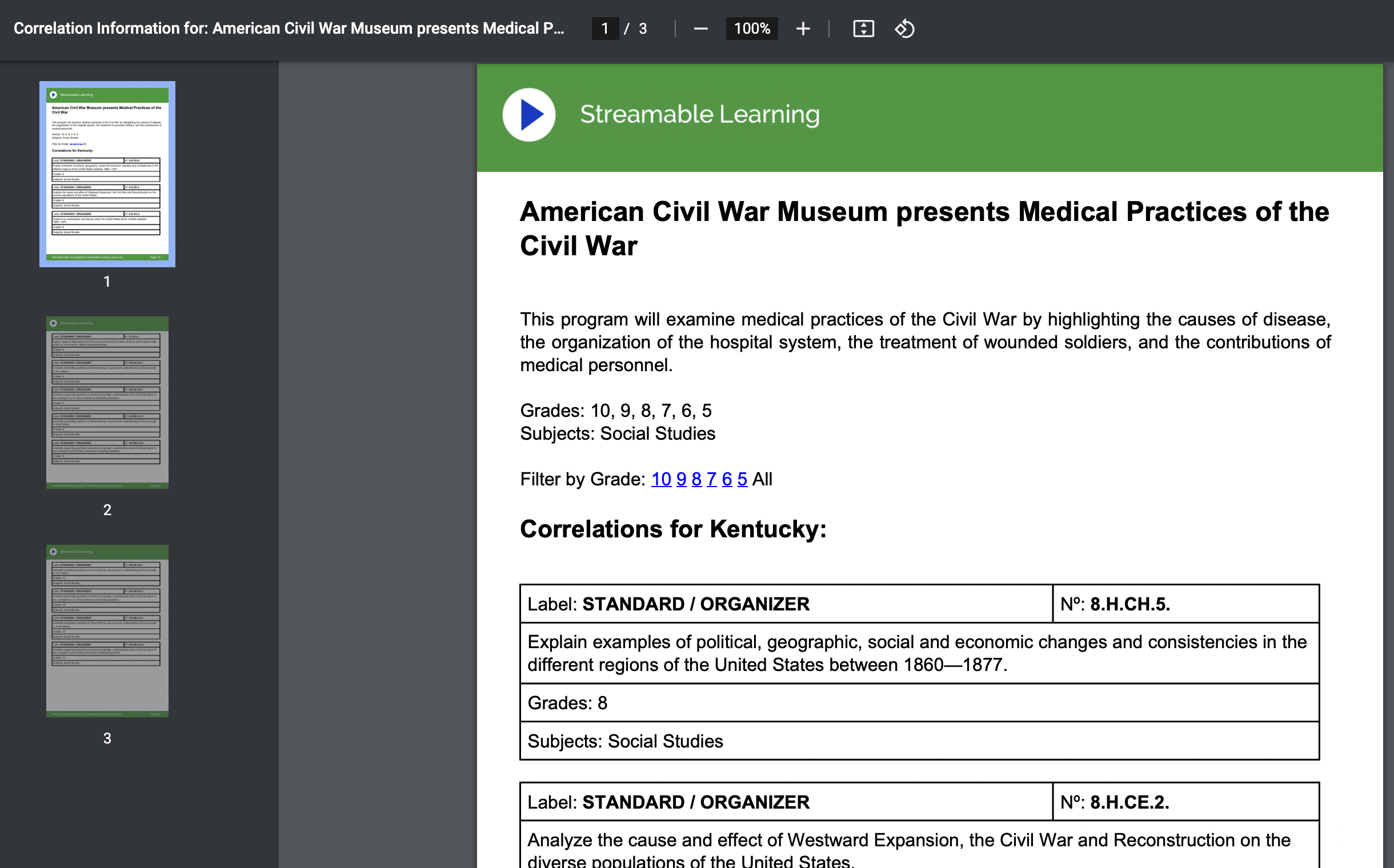
Many of these recordings also have a standards-aligned document to go with them based on a state of your choice.  However, once opened, some of these alignment documents say "Coming Soon" or there is no link at all because no standards doc has yet been made available.

The standard alignment document for the above recording.


A final feature worth noting is that a URL to a recording can be shared with a student directly.  In order to do so, the student will need your district's "code."  (A teacher can look up the code for their district.) Once a student clicks on the link, they will need to type in the district code or they can't watch the recording.  Again, Zoom is only necessary to participate in a livestream; no Zoom is required to watch a recording.

For a video overview of Streamable Learning, here's a screencast I made (11:00):


How could you use it?

Teachers have always loved bringing in a guest speaker, but that might not always be easy or convenient; similar issues with logistics hamper just jumping on a bus with 30 students and going to a museum.  (Especially if it's in Alaska or Australia!)  Streamable Learning gives a convenient, cost effective, interactive, safe way of bringing outside expertise into your own four walls.  Additionally, it's a great way to show authenticity around the content being learned in your classroom, by seeing more vivid examples of its use, impact and application.

Streamable Learning can also address equity issues and give some students virtual opportunities that they may have little to no chance to do in person.  An affluent suburban district may have parents that can easily afford supplementing the cost for that annual class trip to Washington, D.C. or Chicago, but for high poverty schools or rural districts already far away from their own local cities, this may not be an option.   Streamable Learning can potentially level that playing field.  

The ability to potentially share a recorded webinar with students via your district code opens up other options.   A student may get pushed a certain video that fits their personalized learning needs and passions.  Another may use a recording as a way of vicariously exploring a career path.  Or a group of students might benefit from a video to build schema for the focus of their project-based learning.


Downsides?

I wish that search results for recorded webinars were more logically organized, such as the most recent event at top and then going back in time, or perhaps have a few filtering options (alphabetically by partner, for example).   Also, it would be helpful if the standard alignment documentation was more consistent. While I understand this may possibly be uploaded sometime after the archived video is put online, several that I randomly found were missing this information even months later.  


While the platform costs, the number and variety of content partners and the ability to access previous webinars can make Streamable Learning a valuable instructional resource for students!


Have you used Streamable Learning or another "virtual field trip" platform?  Share in the Comments below.

Sunday, July 3, 2022

Torches in the Night

On July 3, 2022, I led a service at All Peoples, my Unitarian Universalist church in Louisville.   Based on the date, I had to negotiate riding the fence of a sermon that was both timeless and timely -- recognizing eternal values while also addressing the week that was.  

And it's been a tumultuous couple of weeks in America.

While I usually keep within the educational lanes for Edtech Elixirs, I do occasionally stretch the focus when I feel particularly passionate about circumstances, and this is one of those times.  I was very flattered that my sermon, titled "Torches in the Night," were well received to those attending in person and on Zoom, and several people asked for a copy of my text, so I thought it best to share it here. If it provides any comfort or insight to others, I'm grateful.

Saturday, June 6, 2020

For Breonna (Equitable Outrage for Change)

I.

On Friday, June 5, 2020, Breonna Taylor would have turned 27.

She shouldn't be a hashtag, or a news story.  Breonna should be celebrating today in our shared hometown of Louisville, Kentucky, laughing with friends and family, opening presents.  Instead, three months ago in March, she was killed by Louisville Metro police officers who obtained a dubious no-knock warrant, decided not to wear body cameras, and shot without warning into her house.  As of today, the officers involved still have their jobs and have not been charged with a crime.

If anyone was still naive enough to think Ms. Taylor was an isolated incident -- do we really need to remind people of the long history of police brutality and injustice against African-Americans that goes back decades before her death? -- the recent murder of George Floyd should have destroyed the ability to keep your eyes closed.   We, who have enjoyed an unfair proportion of power for four centuries, need to do better loving, listening, and acting.  Transformation toward equity must occur now -- in our workplaces, in our schools, in our neighborhoods, and in our homes.


II. 

Some are offended at the phrase "black lives matter."  We say "black lives matter" because the mattering of the lives of the status quo (Caucasian, Christian, male, heterosexual) has always been a given, and "all lives matter" is often used as a literal whitewashing of that fact.   The notion that we should consider those of a different race, ethnicity, religion, gender, sexual orientation and so on as not just created but treated as equal is, in historical context, a very recent phenomenon in America.    However, of all of those groups, only one -- black Americans -- came to this country in chains as slaves.  It should therefore not be a controversial statement to declare that the four hundred years of violence and oppression against African-Americans is particularly wide, deep, and still pervasive.   (Of course, no amount of suffering is just, nor should suffering be treated as a contest that pits the pain of one American group against the agony of another.  To take just one example, Native Americans also endured egregious amounts of government-sponsored prejudice and genocidal treatment, and still face prejudice.  But to dismissively take a purely relativist position that "everyone is discriminated against" is almost always an attempt to not uplift all the oppressed but to excuse the oppressor.)

To be clear: I believe in non-violent protest.  I am thankful for the courage of selfless people who carry a badge, who are willing to sacrifice even their own lives in order to protect and serve us.  (Our belief that the police should be our protectors and our servants is particularly poignant, especially in the current context.)  But I also believe in equitable outrage. Note the term is equitable, not equal.  One should have outrage that is placed in its proper proportion, given the legacy and context of the history and situation at hand.  I completely support and agree with a person's outrage over a broken window or a brick thrown at a police officer, so long as they are more outraged over a police officer grinding his knee into a black man's neck as he screamed he could not breathe.  For more than eight minutes.  In broad daylight.  With three other officers helping.  Until that man was dead.  If you are willing to judge a protest movement that has tens of thousands of activists on the unlawful behavior of a small percentage of "rioters" and "looters," then how shall we judge America's police force, with its percentage of unpunished officers that have a long history of murdering blacks with disturbing disproportionality?  Which of the two groups -- the police or the citizens -- are entrusted to not just follow the law but to uphold it, to be the ideal and exemplary model of ethics and justice for others to emulate?  Which group has been given the automatic assumption of innocence and legal superiority for more than a hundred years, before film cameras, camcorders and cell phones finally punctuated that myth of infallibility?  Should the relationship between these two groups be built on respect, or out of fear?

Do we fault the students of the classroom if the teacher is not practicing what the teacher teaches?

The classroom of America has asked the teacher a question.  What is our answer?


III.

In a world still reeling in the face of a pandemic, hope to change systems of racism in America that goes back centuries is beyond daunting.  Hope is a scarce commodity.

But hope is not just something you can find.  It can be something you make. Hope and change starts with us.  By "us" I mean those of us with privilege and power that is both seen and subtle.   We need to learn how to be more effective allies, to be willing to get uncomfortable as we explore our biases.  We need to better love, listen and act.  But the greatest of all of these, to paraphrase a social activist from a few thousand years ago, is to act.  We can love from the safety of our homes, yet not change anything.  Even Jesus got angry enough to justifiably overturn some tables here and there.  (I am glad we didn't judge his disciples too harshly for his riotous behavior.)

For the last few weeks, my family has watched YouTube, Twitter, and the news with an almost paralyzed sense of sadness and anger.  I may have been tweeting and posting on Facebook and immersing myself in documentaries about the black experience, but that is not enough to qualify as real action.   Passivity is complacency, and complacency becomes complicity.  And I have a vocational duty to do better. I became an educator to empower our young people, so they can make the world more just than our generation left it.

So my wife April and I did some research and listened to those we trusted.  We picked five charities who could use donations, and made a slideshow highlighting each one.  We grabbed some fake money from a board game, my two daughters (age 8 and 15) and my laptop, then headed to the living room.

Everyone got an equal amount of fake money, then I Chromecasted my slides to our television. Slide by slide on the TV, side by side on the couch, I briefly talked about the motivation, purpose and the recipient of each charity.  There was necessary dialogue, sometimes painful and awkward.  Next, we used our fake dollars to decide how much money each of us would pledge to each group.  Two things emerged. First, we each felt a sense of agency we hadn't had in days; we created some hope.  Even my eight year old was glowing, knowing that by "voting" via her fake dollar bills, she would actually positively impact the lives of others.  Secondly, when a certain group got more of a donation from one family member, it would organically be balanced by the generosity of another family member toward another group.   So while there was no "rule" that every group had to get a donation, they all did in the end.  Fake game board money in hand, I went online to transform our pledges into payments.

It was a first act and a small one.  Our modest collective family dollars spread among five recipients may seem almost negligible. Of course, simply giving a donation is not enough, and there is more work to be done.

But it's the best we felt in what seemed an eternity.

While I encourage you to research these groups for yourself before deciding to give a donation, as well as exploring other deserving recipients, here are the five our family chose:

Justice for Breonna Taylor

Official George Floyd Memorial Fund

Louisville Community Bail Fund

Know Your Rights Camp**

Black Lives Matter**

**These are 501(c) charities. 


IV.

This is an educational technology blog, not a political platform.  I will turn Edtech Elixirs back to educational technology soon enough.  But there are times when we must make it clear, regardless of profession or our day to day station in life, what side of history we are on.  It is a question of humanity, not politics.  Over the last few weeks, I have watched with dismay how some so-called '"edu-celebs" have blithely autoposted their tips and tools on the hour every hour on social media without a single word about our current crisis.  If there was ever a time for them to use their influence on their thousands of followers for the greater good, now would be it.   My reach pales to theirs, but here I am with a blog entry, taking a stand.  Compared to the actual tragedy and suffering of others, not to mention those marching in the street, it is the very least I can do -- to share my feelings, and make a public promise to continually contribute to the work of "a more perfect Union" both in my educational and personal spheres of life.

Friday, June 5 is Breonna Taylor's birthday. She is black, and her life matters.

Honor her life with a gift of yourself.  Make the world today better than the world she was forced to leave.