Showing posts with label artificial intelligence. Show all posts

Tuesday, August 11, 2026

My Recent Intersections with the University of Louisville

The University of Louisville has always held a special place in my life.  In my youth (and currently as an adult!), I rooted for the Cardinals in sports.  My wife and I were married on campus at its Rauch Planetarium in 2003.   (Sadly, the university's plan for the planetarium -- not open since the pandemic -- is to remain permanently closed.)  It was at U of L where I earned my Bachelors (2005) and Masters (2007) degrees and began my teaching career through its Alternate Certification program.  

This year, I've had three intersections with U of L that I wanted to share.

In spring 2025, I taught my first online, asynchronous, graduate-level course for U of L.  At the end of last year, the College of Education and Human Development reached out.  A series of blended learning classes had been shuttered when the original instructor retired.  CEHD leadership asked: Would I be willing to teach additional courses, in order to revive the blended learning track?  I enthusiastically said yes.   The fourth and final course of my current commitment begins next week, and I'm thankful to give back to my alma mater as well as help future and early career educators!   I plan to begin the cycle again in 2027, so if you're interested in enrolling (you can still try to register for the upcoming fall term!), here are the titles of my online classes:

  • EDAP 688 Designing a Technology Integrated Curriculum (last taught spring term 2026)
  • EDAP 585 Digital Methods for Teachers to Design and Deliver Instruction (last taught summer term 2026) 
  • EDAP 587 Digital Methods for Students to Demonstrate Learning (last taught summer term 2026)
  • EDAP 690 Teaching with AI (begins August 17, 2026)

When I was a U of L student, I always enjoyed the Ekstrom Library as a place for study, collaboration, and research.  When I was recently on campus, I discovered to my delight that my book was part of its third floor collection!  

Bookshelf with a stack of books at Ekstrom Library, with my book in the middle of the shelf.


My book, held by my hand showing the spine, in front of a bookshelf at Ekstrom Library.


When I looked up the book's entry in Ekstrom's database,  I also found out that Tabletop Role-Playing Games in the Classroom is located at several other university libraries, including Vanderbilt, University of Illinois (Urbana-Champaign), University of Mary Washington, SUNY Geneseo, University of Southern Maine, University of Nevada (Las Vegas), Loyola Marymount, The King's University (Edmonton, CN) and the University of Saskatchewan.  I'm humbled that my book sits on so many shelves.

My book leads to my last University of Louisville connection.   For its recent Spring and Summer issue of U of L Magazine, I was featured in a two page spread!  The photo shoot was particularly fun -- members of the magazine staff came to our OVEC Middletown office, and in one of the setups, I lay on a table surrounded by my personal TTRPG materials as a photographer stood above and over me and took the picture.

U of L Magazine on the hardwood floor, open to the two page spread of my feature article.


Special thanks to Audrie Lamb and the rest of the U of L Magazine staff for the feature article!  

As I wrap up this entry, I want to share a heartfelt moment of my gratitude to many people -- some of which I haven't met, but left replies on my social media -- for showing their love my way.  I mentioned at the beginning that my wedding was held on the U of L campus.  The person I married was April Lynn Watson, another Cardinal graduate.   April was a beautiful, beloved, brilliant wife and my best friend.  I talked about her original battle with cancer here in my blog in 2019.  Tragically, the cancer came back after several years of remission, and April passed away on July 1.   Writing her obituary and eulogy was incredibly hard, but I was honored and privileged to share how wonderful she was to me and so many others.   Thank you to every single person who has expressed their condolences.  I will repeat what I said in a LinkedIn post: "It seems strange to breathe without [April], much less eat, laugh, or post online about work or writing accomplishments. I ask for two things. Firstly, your warm thoughts and support for myself and my family in the painful journey ahead. Secondly, for your grace and understanding as I post in the days and weeks to come. I know April wanted me to thrive, not just subsist, even as I now struggle in the tilted frame of my new 'normal.' I hope to continue to use my social media voice to uplift the topics I love: education, technology, game-based learning. Doing so helps me live, and endure, and honor April's life by trying to make a difference in others."

April and I sitting in the seats of the Rauch Planetarium, for our wedding in 2003.

April and I standing in front of the screen of the Rauch Planetarium, for our wedding in 2003.


Saturday, April 4, 2026

Creativity, AI, Utopias, and the Cultivation of "Guild-Like" Powers

Yesterday, I was part of a recording session for the Fueling Creativity in Education podcast, co-hosted and produced by Dr. Matthew Worwood and Dr. Cyndi Burnett.  (Special thanks to both of them for having me as a guest, and please consider a subscription!)  It was an invigorating conversation, and a topical one, as valuing human creativity in a world of artificial intelligence seems to be something that has a particular urgency in the here and now.   Let's examine AI and creativity separately first.

Dr. Cyndi Burnett, pointing to a collage photo poster in the shape of the number 5, where Adam Watson's picture is located.
Dr. Cyndi Burnett, right before the recording began.  I was part of the photo collage of guests, celebrating the podcast's recent fifth anniversary!

When we examine a snapshot of artificial intelligence today, it seems necessary to pull out the quote marks.  We may take some comfort that for all of AI's remarkable speed and agility to "write" or "draw" or "ideate," it is essentially a highly efficient pattern-maker and builds its product-making programmatic skill on the backs of human ingenuity, and a fair share of its generated images and videos still fall into the AI slop category of questionable quality.  (Whether those platforms fairly compensated or even appropriately cited the human ingenuity that trained it, or whether AI is worth the environmental impact, is a whole other ball of wax I'll set aside for the moment.) However, people have also argued what products humans have made are deemed worthy of the label "art" for thousands of years, and here begins a deluge of debates as we consider AI's output alongside humanity's.  Are we as humans not also a product of our times, influenced (subconsciously or not) by all that came before us?  How do we define the purity of a so-called "original thought"?  Can a first-grader be called a writer, even if their handwriting is uneven and their thoughts are fairly trite?  Does a text qualify as a literary novel if it is self-published, full of typos and cliches, but has a million downloads?  When do the air-quotes end and the scepter is deigned by some credentialed institution to bestow someone or something as a true writer, writing, art or artist?  If Chaucer is a rulestick with which we should judge Western literature, how do we evaluate the writing output of a human child, or a popular hack, or a machine in comparison?  

Of course, wherever you may land on the spectrum of philosophical debate on the ethics of artificial intelligence (and to be clear, I have concerns about AI on several levels even as I use it and see its potential strengths), we all must agree that AI today is the worst it will ever be, performance-wise.  We have to remind ourselves that ChatGPT -- or at least the version 3.5 that was born on November 30, 2022 -- is not even four years old.  Even if you think all it does is connect pre-existing dots and wave a wand dispensing ephemeral digital parlor tricks, ChatGPT (and its various LLM siblings) is already pretty impressive for an immature digital child-bot not old enough to be in kindergarten yet.   (For the record, my anthropomorphism -- and other juxtapositions of human and machine above -- are meant to provoke thoughtful debate that will only grow more heated as lines blur while AI capability grows.  With that said, in a world where people talk with machines that are often sycophantic and merely mimic human feelings, we need to be repeatedly reminded that artificial intelligence is not a person. It's refreshing to hear a company like SchoolAI decide to make their chatbot Dot no longer have a cute face, because "[s]tudents need to know when they're talking with AI.")

We can now move on to another question that requires air quotes: what do we mean by "creativity"? In the world of education, we sometime suffer for want of common nomenclature in defining creativity, in the same way we struggle in agreeing on the same definitions of "engagement" or "collaboration."  There often is a shoulder-shrug of you know it when you see it level of understanding, and that applies to most of us when we try to define something as squishy as creativity.  Perhaps more problematic is the onerous task of recognizing creativity in students, or even more difficult, cultivating it.  A beleaguered teacher might ask, What gives me the right to judge or teach others about creativity, when I may not consider myself creative in the first place?  To put it mildly, it's a big challenge.  And yet, I believe most of us agree that if public education is to endure and thrive, it must do a better job for its learners at nourishing the human-centered notions we value, such as joy, relationships, and yes, creativity.

The scholarship behind creativity, particularly in education, is huge, and I would not pretend I could encompass or summarize all of that brilliance in a single blog entry.  But luckily, we have a good start with my recent podcast hosts!  Dr. Burnett is the director of Creativity and Education, which offers a "Five-Point Star model" on how to pragmatically bring creativity into your classroom:  Understanding Creativity, Recognize Your Own Creativity, Support a Creative Environment, Bring Creativity Into Your Lessons, and Teach Creativity as Its Own Skill.  Dr. Worwood, along with Dr. James C. Kaufman, designed the CAUSE Model of Creative Languages (Connect, Apply, Understand, Share, and Express), and they "consider how an individual’s varying levels across these five Creativity Languages (innate, proficient, independent, basic, or dormant) may influence creative behavior, choice of domains to pursue, and potential eventual success."  Until their article, I hadn't heard of the Four C Model of Creativity (designed by Dr. Kaufman and Dr. Ronald Beghetto).  What I found useful in that Four C Model was the idea that creativity doesn't have to always be equated with genius, which makes being creative feel elitist and impossible to reach or teach.  Instead, Kaufman and Beghetto describe a continuum of creativity:

  • "mini-c": anything "new and meaningful," although perhaps limited to only personal value
  • "little-c": "[w]ith appropriate feedback, advancements are made and what was created might be of value to others"
  • ,"Pro-c": "the ability to be creative at a professional level and in a professional venue"
  • "Big-C":  something that "will be remembered in the history books"

As an educator, that already gives me relief; not every act of creation must have a "Big-C" level of impact.   At minimum, we are all capable of "mini-c" and "little-c" moments and can recognize and encourage them in others.  

But how do we foster creativity in a world where AI threatens to simplify (or, perhaps more apt, sloppify) inventive human thinking?  The theme of the April 2026 issue of Educational Leadership is "Igniting Curiosity in Schools," invoking another "c" word strongly related to creativity.  In the article "Sparking Curiosity with Applied Intelligence" by Elizabeth Agro Radday and Matt Mervis, the title draws the distinction between students passively using AI and actually applying it to solve authentic questions and problems:  "When students use AI, they rely on it to provide an answer, often bypassing productive cognitive struggle. When students apply AI, they expand their curiosity and creativity and become creators. In these cases, AI is part of the solution to a larger, messier problem that cannot be solved or answered with a simple prompt."  While they point out a study where college graduates are struggling to find entry-level positions thanks to AI phasing out such jobs, they also rightfully put some of the blame on traditional school systems. "The automation of low-level tasks," warns Agro Radday and Mervis, "the very 'clerk work' we often assign in schools, is already having a disproportionate impact on young people entering the workforce."  We need instructional environments that encourage students to be creative, not compliant cogs mindlessly completing transactional tasks.  If we keep treating students like machines, they will be replaced by them.

Naturally, this connects to late 19th century utopian novels and William Morris.  But hear me out, I can explain.

Back in 2001, I wrote a "hyperessay" for an English undergraduate University of Louisville course on Mark Twain's A Connecticut Yankee in King Arthur's Court.  I want to emphasize this was created in HTML when hyperlinking text felt almost transgressive, barely three years after I had gotten my first personal computer (Windows 98!).  My thesis was that you gained a deeper understanding of Twain's novel if you contextualized it within the utopian fiction written in the same time period (1871-1891) as Yankee's publication (1889).  As part of my research, I read several utopian novels, one being William Morris's News from Nowhere (1891). 

The 1800's was the Industrial Age.  For most people of the era -- like Yankee's protagonist Hank Morgan -- technology was welcomed, inspiring, and unquestionably viewed as progress.  It therefore should be no surprise that tech was not only foregrounded in many of the utopian novels of the 19th century, but that two-thirds of all utopian novels were written in the 1800's (Lewis Mumford, The Story of Utopias, 1962).

News from Nowhere, however, was different.  William Morris is a fascinating Britain whose influence continues into the present, even if his name may not be well known in the United States. A Romanticist, artist, socialist, political activist, and prolific multi-genre writer, Morris was a close friend of poet-painter Dante Gabriel Rossetti (Morris's wife was his muse, and likely more) and a lover of architecture, medieval times, Icelandic sagas and Arthurian legends.  He was also a founder of the Arts and Crafts movement, eschewing manufactured goods for handmade ones.  These passions were clear in Morris's utopia, situated in a London of the future, but with a de-emphasis on impersonal tech replaced by a strongly pastoral, bucolic setting of artisans.  That said, these utopians were not total Luddites -- they simply put technology in proper perspective. As one character puts it, "[W]hatever is made is good, and thoroughly fit for its purpose. Nothing can be made except for genuine use; therefore no inferior goods are made. Moreover, as aforesaid, we have now found out what we want; and as we are not driven to make a vast quantity of useless things, we have time and resources enough to consider our pleasure in making them. All work which would be irksome to do by hand is done by immensely improved machinery; and in all work which it is a pleasure to do by hand machinery is done without."  (A fun aside:  Morris also wrote high fantasy stories such as the novel The Well at the World's End [1896], inspired by Grail quests and Arthurian knights.  If Morris's resistance to the Industrial Age and love of Nordic sagas aren't enough clues that J.R.R. Tolkien was influenced by him, consider The Well at the World's End also has a "King Gandolf" and a horse named "Silverfax.")

Surrounded by the belching smokestacks of British industry, Morris turned toward the pleasures of the tactile and handcrafted.  One hundred and thirty-five years after News From Nowhere was published, we see Morris's aesthetic play out today.  We seek vintage forms of pleasure ourselves. Vinyl record sales have never been higher, and wired headphones are making a comeback, part of a larger "analog lifestyle" movement.  In education, many schools are banning cell phones during classtime and are having, as a recent The New York Times article put it in its title, "Chromebook remorse."  Fear and/or frustration over AI is fueling analog over digital instruction. I have strong opinions on both sides of this divide.  As a Digital Learning Consultant, I often see this as overreaction and a problem resulting from mis- or overused tools during the pandemic that have created lingering and triggering fatigue of edtech, and lament that technology isn't being implemented with the intentionality it needs to leverage student learning.  As an author who recently wrote a book encouraging tabletop role-playing games in the classroom, I also appreciate the appeal of face-to-face student interaction using old-fashioned paper and pencil (and dice!).  As a social media consumer who is inundated with AI slop videos in my feed, I can certainly sympathize with those who want a return to quaint times where we did not have such a "vast quantity of useless [digital] things," produced quickly, amazingly, pointlessly, and soullessly.  

So, in the face of such a morass, what do we do and how can we move forward? As we ultimately return to the notion of creativity, I'd like to offer one possible answer on the subject as I complete threading the multiple topics of this blog entry together (from the seemingly random Chaucer reference in the beginning to the Middle Ages to Morris to Tolkien to TTRPGs like the world's most famous fantasy-themed game).  But first, a quick flashback to our podcast recording.  Matthew and Cyndi discussed how barriers and boundaries increase creativity, even as logic presumes that it should constrain it.  I couldn't agree more.  It's the same thing that powers the best of games.  Take chess, for example.  Despite what superficially seems to be the limitation of rules that you can learn in minutes (how each chess piece moves differently on the board), the creative possibilities and strategies of playing chess are nearly endless, and it can take a lifetime to master.  We cannot think outside of the box without the box in the first place.  

Here is where artificial intelligence steps in, for good or ill. It may have its place, but we must be careful that it does not wipe away all constraints and with it, the chance for complex thinking.  AI can potentially give us god-like abilities with a keystroke, but creativity will suffer if such synthetic omnipotence is used without a greater purpose. Also, omnipotence is boring.  If a "problem" can be answered with AI that easily, what kind of problem was it really?  There is a quantum difference between solving a linear equation on a worksheet and an authentic challenge that needs mathematical thinking to be solved.  The former just needs a machine (and perhaps not even AI, but a pocket calculator).  The latter needs us.

And this is where looking back to the medieval age may give us a way through. In the spirit of William Morris, perhaps we can start an Analog Artisanal movement.  In the urgency of our present circumstances, we do not need god-like powers, but guild-like powers.  We need teams of humans, talking through our differences of opinions, working collaboratively, holding each other to the highest standards, looking for ways to apprentice the next generation to build our future world with care.  Digital tools may certainly help, and AI may become a collaborative partner of that neo-guild.  However, inspired by Morris's utopian outlook of technology, we should keep a proper perspective on how our analog and digital worlds blend, and who's in charge.

We need to celebrate and cultivate the creativity that lives within each of us, knowing that we will only hone our craftsmanship after mentorship, practice and failure.  We may still need a forge or an anvil to get there.  But we should never mistake the anvil for the blacksmith.

Update 4/29/26:  The podcast episode is now released (Season 12, Episode 10)!  Find it on your favorite podcast platform, or click here for more information.

An image of Adam throwing an oversize green foam d20 in the air, framed in a template promoting the "Fueling Creativity in Education" podcast episode that Adam was a guest.


Friday, February 27, 2026

Google Gems (and EduGems)

While Google's NotebookLM has taken much of the acclaim and headlines for how Gemini AI can transform learning, another free tool over the past year has been shaping up to be its contender:  Google Gems.   While Notebooks can offer audio and video overviews, infographics, slide decks, and seemingly new beta Studio tools every fortnight, Gems can offer a more nuanced kind of support.  Gems are customizable AI chatbots you can load up with your own vetted documents, which you then can easily share.

For a short (12:08) overview on Gems, watch this video by Eric Curts (and more on Curts in a moment):


Recently, Google for Education provided a wonderful deep slide deck of resources titled "100+ ways to use Gemini in K-12 Education."  One of the slides gives a short comparison of Gems versus NotebookLM:

A labeled screenshot of Google Classroom, labelled with the differences between Gems and NotebookLM. (Unless otherwise indicated, all screenshots are from this slide deck.)

As another way of comparing the two, here are some pertinent details:

  • Purposes.  NotebookLM is usually for larger, deeper synthesis needs with multiple output opportunities, while Gems are more for specific, single outputs.
  • Amount of files.  NotebookLM can have up to 50 sources uploaded; Gems can have up to 10.  However, a possible workaround for Gems is below.
  • Kinds of files.  Both can use many of the usual suspects: PDFs, Google Docs and Sheets, Word and Excel, images and videos.  However, NotebookLM also allows website URLs, YouTube videos, and "copy and paste" sources, while Gems does not.  Interestingly, however, Gems will always recognize and use the latest version of a Google Doc or Sheet attached; NotebookLM only knows the "instance" version of the Doc/Sheet when first uploaded.
  • Kinds of outputs.  As mentioned before, NotebookLM has a wide (and growing) set of Studio tools, starting with Audio and Video Overviews.  A Gem is more of a monotask outputter, only doing what it is set up to do.  These do not have to simply be text-based lesson plans or an email, however!  To take just two examples, a Gem could create coloring pages or a graphic novel.
  • Use both!  A Gem can now have a NotebookLM added as a source file, thereby increasing a Gem's capacity of sources beyond its normal "10 files maximum."

Gems are great if you want to take the burden of prompt engineering off of the end user by writing a guiding "script," yet ensure a guard rail experience where the source of knowledge is based only on the documents of your choosing.   In effect, you are being a light programmer creating a new app, but without worrying about having to write actual code. 

Gems sit inside of Gemini itself, in its "Gem Manager" dashboard.   You can see Gems you made and saved (which you can always edit and customize further), Gems shared with you (as you can receive or give sharing rights like any other Google Doc), and of course, create a new Gem.


Writing an excellent prompt is the heart of a Gem.  For many an AI PD, I've shared Google's PARTS strategy on how to compose a more effective script (taken from this free course) by thinking of how to be more specific and detailed when thinking of each, um, part of PARTS.  However, the original handout I've used considers PARTS from the first person perspective of the prompter ("I am a third grade teacher..").   For a Gem, it may be more helpful to consider a second person perspective, like the example below.  In a meta moment, with a push of the "magic wand" button in Gems, you can also use "Gemini to rewrite [the] instructions" for you.


As I mentioned before, Gems can be shared with specific people, or made usable by all via its hyperlink.  Indeed, Gems could theoretically be shared inside a Google Classroom with students. However, the use of Gems by students in your educational domain may or may not be allowed, depending on the settings determined by your Google admin.  (For more, read this help article.)  Dr. Jim Masters, superintendent of Henry County Public Schools (KY), launched a specific Gem math tutor "grounded in learning science" with students.  Afterwards, over 250 of them answered a survey, and the results were noteworthy: "57% can now solve a similar problem independently" and "72% said [how the Gem demonstrated] breaking the problem into steps helped them most."  While some students admitted they wished the Gem would have just given them the answer (therefore admitting the Gem kept productive struggle and didn't minimize their cognitive load), many also said they still appreciated, or even preferred, the way their teachers helped them work through a problem.  The humans still matter in the loop.  "Technology can scale feedback," said Dr. Masters, but "teachers develop thinkers.  Student voice is now driving the next iteration — the same way a product team studies user experience."

When learning how to create a well-engineered Gem, a model can be helpful so you can peek "behind the curtain" and analyze its script.  (They tend to be more complicated and "code-like" than a typical genAI prompt.) There are also moments when you want to save time and simply utilize a well designed Gem made by someone else.  With that, we return to Eric Curts and his EduGems website:


The site is a collection of curated Gems, most made by Curts himself.   The Gems run the gamet  -- some educator-facing, some for students to use directly, and for various contents and needs.  There's a category that really caught my attention (for obvious reasons) called Engagement and Games, with Gems such as "CYOA Story" and "Historical What If."  Let's look at one called "Gamified Learning":


Along with a short description of each Gem, you have two choices.  You can interact directly ("Use the Gem") or "Make Your Own Copy"; the link is a force copy that will automatically save it into your own Gem Manager.   Note that once you have your copy, you can preview its prompt and potentially customize it.


Here is the Gamified Learning Gem "ready to use." Note that you have to give a Gem some kind of indication that you want to start -- typing "Hi" or "Begin" is fine.


When interacting with a copy of "Gamified Learning," you can see the Gem in editing mode.  Note the full prompt on the left and the chance to preview the Gem on the right.

EduGems also offers tutorials, and a Google Form where you can submit your own Gem for potential inclusion on the site.

Google Gems offer a handy way of reusing an excellent prompt over and over and easily make a sharable chatbot based on key sources you trust.   Even if you don't use Gems often, deconstructing a well-made one can teach you a lot about AI and prompt engineering.   Thanks to Google for making another highly useful free tool.  And special thanks to Eric Curts for curating an educational Infinity Gauntlet website of inspiring Gems!

Sunday, October 26, 2025

The Nature of Expertise in the Age of AI

For several years, I've been providing content and student support for the University of Kentucky's Changemakers program, designed and managed by the Center for Next Generation Leadership. It's an online one year continuing education option where Kentucky educators can get a rank change for successful completion.  I appreciate that Next Gen believes in "parallel pedagogy"; while it provides valuable resources and materials to be read, viewed, and reflected on, it also requires the program's students to complete meaningful transfer tasks, pursue an action research project, and participate in a final defense of learning that demonstrates how transformative practices are happening in the Changemaker's own classroom. 

This professional learning pathway to rank change involves mostly asynchronous work through online modules focused on the awareness and implementation of what Kentucky calls "vibrant learning" in the classroom, with module topics such as Learner Agency and Inquiry Based Learning.  It's my contribution to the latter module where the content below originally began, but I've expanded and added more detail for this blog entry.

Inquiry-based learning is a powerful pedagogy.  For students, it can be as extensive as working on a multi-week project-based learning unit, or as simple as asking more high-quality questions in class.  Inquiry comes from curiosity, and the attempt to answer challenging questions and solve problems that have no obvious solution.

Complicated problems requires help.  Two heads are better than one, after all.  With this in mind, seeking community partners can make perfect sense.  (As an aside, this teacher guide can help shape your conversations when you attempt to bring the community into your classroom; while it mentions PBL, the strategies can help for any scale project or problem you want your students to tackle.)   

Screenshot of the community guidance doc linked above as "teacher guide" in the text.

These community partners or "outside experts" can authenticate what may seem abstract into real world problems, and even motivate students to "dig in" when the work gets difficult, to echo the title of this excellent Next Generation Learning Challenges article.  But before we consider how bringing in experts from outside of your classroom can increase vibrant learning, let’s first discuss inside experts, and even the idea of “expertise.”

Keep in mind that traditionally, and for decades (centuries!), you have been considered to be the expert in the room – of your content, of your pedagogy, of your ability to manage your classroom.  The professionalism required of the vocation, much less the idea of professional standards boards that grant, review, and in some cases revoke certification to teach, adds to the foundational belief that a teacher has earned their well-deserved “expert” credentials.

But you are usually one human in a room of thirty.  Leaning into the expertise of your students can be at its most basic level a strategy of smartly leveraging your numbers.  Viewing your classroom through an asset mindset, we can see students as learners that bring their own powerful POVs which can enrich your culture and community.  For example, with the right scaffolding, structures, and practice, your students are capable of providing peer-to-peer feedback.

However, some of our stumbling blocks in education are self-induced, born out of a desire to remain humble.  For example, calling yourself or anyone else an “expert” can sound or feel lofty and divisive.  Educators are sometimes their own worst critic, and may wonder aloud what right they have to declare themselves the expert on such-and-such.  As for students, they may view their own bountiful and beautiful knowledge with a shrug of their shoulders.  If someone in middle school knows how to disassemble and reassemble a car engine, it simply reflects their personal interests, or the fact that their mother loves hot rods.  They are told early and often in traditional school that such knowledge isn’t “book learnin’.”  Loving hot rods or diesel mechanics doesn’t matter, thinks the student, because it’s not a part of my third period class, and it won't show up on my multiple choice test on Friday.

Therefore, let’s consider a broadening of our definition of “expert,” and look more at the first five letters of the word.  What we really hope to provide, increase, articulate and bring into a classroom is experience.  From another person’s POV, your experience may be long and traveled (which can make you “more experienced”), or simply a road I’ve never traveled upon (which makes your experience a novel one, compared to mine).   Viewing expertise in this kind of inclusive light opens up what an “expert” is.  We can see an expert as simply (but powerfully!) a person with a different, valued perspective.   The key word is “valued.”  You may have a different POV, you may have twelve degrees on the wall, but if I don’t care about you and especially if you don’t care about me, your “expertise” won’t matter much.  We can also see an expert as a person who is recognized as skillfully applying knowledge.  The key word is “applying.” Remember that old chestnut that answers the question, “What’s the difference between intelligence and wisdom?”  Intelligence is knowing that a tomato is a fruit, but wisdom is knowing you would never put a tomato in a fruit salad.  Expertise that feels too detached and theoretical, or a bunch of random facts you can Google anyway, won’t personally matter very much to your learners.

With our new, more expansive definition of “expert” behind us, how do these experts from outside of a classroom still have potential to help?  Vibrant learning is memorable and authentic, and community partners can be both.  A parent who is a car mechanic might come in to demonstrate the torque caused by automobile engines.  Not only does that make abstract laws of motion and physics seem more relevant to students, it also has a far greater chance of making tonight’s dinner conversation when the student is asked “What did you do at school today?”  By permitting alternative voices into your learning space, you open up different perspectives and bring the outside community inside of your classroom community. Outside partners could also provide feedback to students as they ideate and prototype a solution in a PBL, or serve as a panel audience for defenses of learning. Of course, in a world full of wondrous technology, we are not limited to in-person guest speakers.  Someone from a European museum might Zoom in for a mini-lecture and a Q & A.  There are over twenty billion uploaded YouTube videos, so with the right discernment and curation skills, an expert is just a click away.

You might have noticed that artificial intelligence wasn’t mentioned above as a potential “outside expert.”  Going back to our expanded definition, it certainly can seem to checkmark the same boxes.  AI can offer a different perspective, powered by code and fueled by billions of artifacts from our culture and knowledge.  Is that perspective valued, or valuable?  It might, although AI is not always accurate, unbiased, or trustworthy; however, the same can be said of Wikipedia entries created by humans, or the theory from a popular scientist of the past which has been discredited in the present.  Discernment and critical thinking is key, particularly from the teacher who should be monitoring, filtering, and observing the AI usage (and teaching students to be critical AI users as well).  AI can also certainly apply its knowledge scraped across the terabytes of the Internet within (milli)seconds of being prompted.  Is that knowledge skillfully applied?  Based on the uploaded rubric of a teacher alongside the first draft of a student’s essay (being mindful of your platform's privacy protections, of course), or the public domain text of an author, AI could provide nuanced feedback on student writing or pretend to be a character in a book for a fascinating interactive conversation.  But some of the proficiency of AI’s application will depend on qualitative measures: of the rigor of the rubric you uploaded, or the veracity and bias of the knowledge it grabbed from its database, or the depth of skills the AI has been taught to emulate. And again, AI hallucinations can happen.  

What will hopefully emerge, as we become more skilled and critical users of AI, is that our ethical priorities will shape the machines instead of letting the machines shape us.  A promising example is the “Dimensions in Testimony” website, a partnership between the University of Southern California and the Shoah Foundation.  The site began by digitizing recorded interviews of actual survivors of the Holocaust and the Nanjing Massacre.   Next, an interviewee has a separate page where, via a looping video, they seem to sit and wait for your questions.  

Screenshot from the website "Dimensions in Testimony," featuring an older woman sitting in chair with a black background on the left and the interface for questions on the right.


When prompted, a short video plays where the interviewee “answers” your question, creating a virtual conversation.  You can do this via your microphone or by typing.  What may seem miraculous is really just clever programming – the interviews were transcripted and time-coded, so AI simply takes your prompt, scans the text, finds a corresponding clip that seems to best answer your question, and plays from that particular time-stamped portion of the interview. Still, you can see the power of providing such “expertise” to students, giving them a chance to be both empathetic as well as practicing their questioning/prompting skills.  (It should also be noticed the dignity and care given to the subject matter by USC and Shoah.  The interviews were real, using genuine survivors of genocide and the Holocaust, not actors.  While you technically could have AI “pretend” to be a survivor of a war crime as a customized chatbot, or have students interact with some kind of digital fictionalized Holocaust survivor avatar, there are many reasons why this would be an unethical and inappropriate use of such technology.)
As you ponder ways to increase and improve inquiry, reflect on the nature of “expertise,” both inside and outside of your own four walls.  As you do so, you can cautiously consider how AI can be one of many types of “outside experts” you can bring into your classroom.
For more information on Changemakers, be sure to check out this page for the latest links to sign up for updates and apply to join the next cohort.

Saturday, August 9, 2025

Google Vids (and other Google updates for Summer 2025)

Google has had a busy summer with plenty of updates, including a new product that I've finally had some time to play with: Google Vids.  But before we get to Vids, let's briefly cover some other territory that educators will find important to know.


If you're a teacher who has logged into Google Classroom lately, you've probably noticed that your workspace now includes Gemini baked in, and more specifically, has multiple tools at your fingertips to help you more effectively complete tasks.  It's clear that the popularity of the "custom bot dashboards" prevalent in several other AI learning platforms has encouraged Google Classroom to do the same. 

[Update 10/14/25:  Eric Curts created a deep dive video on the various pre-made AI tools inside Google Classroom, linked here (19:03)].


While the built-in capability of Gemini is currently only available for the teacher side of Google Classroom, Gemini itself is now available for students of all ages.  Additionally, Google NotebookLM (perhaps the most pragmatic AI tool I currently use) will also be available for "all ages in the coming months" (per a Google Workplace Team email sent June 17, 2025).  You can read more in Google's June 2025 blog announcement.  Of course, your Google Admin may choose to keep this toggled off for certain age groups (or for all of your students!) and/or for one or both tools; it's worth asking what your district's plan might be.  Remember that for educational accounts only, Google has made assurances that AI data and usage will remain private to the domain itself, usage will not train Google's AI machine, and inputs/outputs will not be human reviewed, as they first announced back in May 2024. 

Speaking of NotebookLM, it's perhaps no surprise that it continues to upgrade.  The output language can now be changed, and that can include the (in)famous "Audio Overviews."  You've likely been wowed by the Audio Overviews feature (and if you're like me, also a bit disturbed by its capacity for human mimicry); customization can now allow you to make them shorter or longer in length, or give the Overview specific topics to focus upon.  But perhaps the most dramatic leap for NotebookLM is the beginning of Video Overviews:


I was able to try this out on a personal free gmail account (upgraded features usually tend to chronologically lag behind for educational domains, so be patient if you don't see the feature yet).  I picked a Notebook with two sources that were focused on the topic of flexible learning spaces: a Google Slide conference presentation I did back in 2021 about the then just opened K-8 school Marnel C. Moorman in Shelby County, and a 2018 article in Edutopia. Despite only having those relatively short sources, the generation for what turned out to be a seven minute Video Overview took at least ten minutes on a Friday night.  While it's likely this will get better, or possibly be another incentive to go Pro (for faster generations?), I would caution you from expecting a Video Overview to load in the same short time it currently takes to generate an Audio Overview.  Yes, yes, you might be asking, but what was the quality?  Well...I was blown away, just like I was about Audio Overviews only a year ago.  As I'm still impressed and mulling over the possibilities of what an Audio Overview can bring to the table for learners, the Video Overview comes along. It basically creates your very own short documentary of your uploaded sources.  And like Audio Overviews, you can share or download the videos.  (In order to watch the video via a shared hyperlink, you have to share viewing rights to the entire Notebook.)  As always, the AI was not perfect, but I'll take some of the blame too. For example, my presentation had a quote from a different Edutopia article spoken by a teacher in a California school (attributed by the article name and hyperlink on the slide), but the video narrator mistakenly stated "as one of the MCM teachers Stacey Lamb said..," which, given the slide scanned superficially as is, seems a fair misunderstanding.  Watching the whole seven minutes, I found very little else to nitpick, especially considering if my goal was to create a sophisticated summarization of my sources.  Here's the Video Overview it generated for me, also downloaded and saved to my Google Drive:

Staying on the topic of videos: one of Google's tools getting some considerable press recently is Veo 3. This is another example of the continual evolution of text-to-video genAI in the marketplace; the outputs are longer, more sophisticated, and can now include AI-generated sound and dialogue.  It's impressive, and brings more ethical concerns, but I mainly passed it by for practical reasons -- it's not cheap, and therefore not likely to be in a typical K-12 teacher's classroom anytime soon.  (However, Google is offering a free year of their AI Pro plan to college students, if they redeem the offer by October 6.)

But if you are looking for a practical Google video tool for teachers and students, it's now finally time to discuss Google Vids.  In a nice flip, this is currently available for all educational users at no charge, but is not available for free/personal Google accounts.  Here's a quick elevator pitch to describe the tool: "An online video editor that's as easy to use as Google Slides."

Creating a new Google Vid is like creating most products in the Google Suite: it's an option for the New button in your Drive, or a choice on your waffle, or simply typing vids.new in your address bar.  There are templates you can choose from if you want to create your project more quickly.  


You can import media (such as Google Slide decks, audio files, and screencasts), make everything from scratch, or do a bit of both.  A tip: I think it's easier to "compose" the skeleton of your video by starting in Google Slides, then importing it into Vids. However, note that anything animated, or clickable, will simply "flatten" once it gets into Vids (after all, you can't hyperlink inside a video), much in the same way that Slides downloaded as a PDF may lose the same features.


Once in editor mode, you can easily add transitions between "scenes," or lengthen/shorten a scene by dragging it by the end.  You can also record a video or audio file to insert into your project, making choices like doing a voiceover a breeze.  One of my favorite features of Vids is Script, located in the sidebar.  You can type what you want to say and it will scroll like a teleprompter while you record your audio or video.  If recording a video, this also means you can look directly into the webcam while you speak.

This screenshot of creating a Script is courtesy of a Google for Learning course.


This screenshot of using a Script as a teleprompter while recording video is courtesy of a Google for Learning course.

Collaboration in Vids happens like a typical Google doc -- you can share viewing, commenting or editing rights to your project. If it's viewing only, the viewer will actually only be able to play the video from your project.  This deserves a bit of emphasis, because in a practical sense it means your Vid becomes a real-time living artifact just like a Doc or a Sheet; you could share a link just once and the viewer will always see the most recent updates, as opposed to having to delete an old video and resharing a new link to the latest uploaded version.  This alone can save significant time and increase workflow.  That capability aside, you can also download the final video as a MP4.

You can create Vids as an assignment in Google Classroom for your students!  First, create a template that you want students to customize and add their own text and materials. (One of the fun Inserts to consider is a "Video Placeholder," available in various cutout frames; when an editor comes across one of these icons, they can click on it to record their own video that will be automatically matted to the chosen shape.)  You can then assign it in Classroom, making sure it "force copies" for each student.  Students can open the assignment, edit it and turn in the Vid like any other Google doc.  Here's a short video about creating Vids assignments in Classroom, from a free Google for Learning course:


There is admittedly a cookie-cutter aspect that could occur when students are creating videos within the templated perimeters of Vids.  However, the intuitive ease of editing in Vids "in the cloud," as well as the ability to quickly share and collaborate, means that students should be able to spend more time on the content than on the clicking.  The bottom line: you can make polished videos in a fraction of the time it took before, and for free.  

This screenshot is courtesy of a Google for Learning course.

It's worth noting that if you pay for an upgraded AI license, you can also use Gemini inside of Vids to create genAI video content or voiceovers.  Here's a video (7:59) showing how Gemini integration with Vids works:


It used to be that improvements or new tools in Google were incremental -- you might be lucky to see something new every few years.  As with all edtech nowadays, that speed of change has rapidly increased.  By the time we hit spring 2026, I will expect new Google features that will likely make even the amazing ones in this blog entry seem quaint and "sooooo 2025."


Saturday, July 19, 2025

Rollin' Down to Richmond for The Twenty Sided Tavern (and +2 on Keynotes)


Summer for a professional development facilitator and digital learning consultant is a busy time. I've also found time for play!  As we cross the mid-point of the season, I wanted to highlight some of my summer adventures so far.

Let's go chronological.

Soon before kickoff at the Cave City Conference Center on June 18.

On June 18 (right before I left for a family vacation), I was both the morning and afternoon keynote for an artificial intelligence conference held by the Green River Regional Educational Cooperative (GRREC). (I also squeezed in a breakout session on AI and PLCs.)  In a packed ballroom at the Cave City Conference Center, more than 250 educators from across Kentucky learned, collaborated, and shared.  One teacher from Allen County came up afterward to tell me it was the best keynote she's ever attended -- a high compliment I'm not sure I deserved, but I humbly thanked her for it.  And speaking of thanks, I'm very grateful to GRREC's Jessica Turner (who I congratulate for just taking a principal position at Meade County!) and Merissa Waddy for asking me to keynote their conference.

As soon as vacation ended, I was off to Washington Community High School (Illinois).  My old friends Dan Reem and Tom Gross (Teachers in the Dungeon) are WCHS's head of social studies and librarian/game club sponsor, respectively.  For years, they have run an annual student RPG summer camp, with multiple breakout session options and two different strands (a player and "Dungeon Master" [DM] track).  Community partners lead sessions or facilitate games; for example, d20 Dinner show students how to make homemade dice.  This year (with the help of Stefanie Crawford of Illinois Digital Educators Alliance), Dan and Tom arranged a precursor to the student camp with a teacher "express conference" on July 7 and invited me to kick it off with a keynote on tabletop role-playing games (TTRPGs) in education.  On July 8, attendees were able to shadow students on the first day of their camp.  (Chris Tatum of NerdLouisville also came up to talk to the educators and ran some breakout sessions for students.) 


Dan Reem (left) and Tom Gross.


Students rolling up their D&D characters on the first day of camp.


There was such great enthusiasm from attendees eager to bring TTRPGs back to their own schools, and the adults encouraging them to do so.  (Special nod to Dan Crawford of Cabbages and Kings Games for donating dice to the teachers as well as DM'ing a student D&D game!)  I was particularly inspired by the students at the camp, who were positive, polite, excited, and focused.  I had the chance to teach students by running a breakout camp session for budding DMs on building an adventure, but more importantly,  I was taught how to better DM from a D&D one-shot led by a just-graduated WCHS senior.  The summer camp isn't just for fun -- it creates leaders.  

As always, I'm grateful for the chance to learn from others, and of course special thanks to Dan and Tom for inviting me up!  As they shared on a recent episode, they seem committed to having the conference again next year, so stay tuned to their podcast for updates.


As a final share, my wife and I were fortunate to attend the kickoff of the world tour for Dungeons & Dragons: The Twenty Sided Tavern in Richmond, Kentucky on July 18.   While the EKU Center for the Arts might seem a inauspicious site for such an endeavor, it's a beautiful theater, and it was full of raucous fans.  The traveling company could not have picked a better place to preview their show.


For more pictures, visit this Instagram post.


Note the "Hit Point" bars at the top of the screen, representing the real-time health of the three "player characters."

With a sly sense of humor, the story is infinitely changeable (no two shows on this tour will be exactly the same!), as one would expect from a theatrical experience based on D&D.  In a sense, the show is a liveplay of a D&D adventure, and my wife -- who has never played -- began quickly catching on to the basic mechanics.  The embedded improvisation is not only hectic (the actors often asked for shouted out answers to feed the story, such as names for monsters), but haptic; it's also powered by audience interaction via our mobile phones and a browser-based platform from Gamiotics.  We were involved from the start, voting on which kind of characters each of the three "players" would take on; choosing whether they should go left or right, which shop to visit, or which spell to use; and even valiantly mashing a screen button to give characters enough "oomph" to accomplish goals.  Kudos not only to the actors portraying the DMs and players, but to the production crew -- the stage sets, lighting and backdrop screen effects keep you perpetually delighted and immersed.

The Twenty Sided Tavern definitely had my mental wheels turning (and mental dice rolling?) for applicability to a classroom.  While you might need a DM to rule set and give players a sandbox to play in, a true D&D adventure needs everyone to participate in order to complete a journey, much as a cohesive classroom is one made up of learners, not just "teacher and students."  A community of learners is a community of trust, with room to both fail and play.  Speaking of play, I wonder how the kinds of interactive polling that makes The Twenty Sided Tavern so much fun can also be an innovative strategy for teaching?  For years, we have used such real-time tools for judging comprehension (i.e. pushing out a question, seeing if students get the right answer), but what if teachers similarly used them to transform direct instruction into a story with agentic student control, provided we are prepared to quickly pivot? Imagine a social studies class learning about ancient Egypt:  

Okay, the archaeologist goes inside the pyramid's inner chamber and finds...a sarcophagus!  Does she look closely at the sarcophagus, or at the various objects placed around it inside the chamber? [class voting on their devices] Looks like...you want to see the sarcophagus!  You notice the intricate hieroglyphics....

Lastly, the story that binds the discrete parts is key in both D&D and in teaching -- and narrative is what makes learning memorable.  Indeed, all TTRPG stories are co-created, and truly vibrant learning is similarly an act of a co-created classroom.

I'll wrap up this blog entry by wishing you all the rest and rejuvenation you need and deserve this summer, while realizing that even in your most playful moments, you are likely still plotting for the school year ahead! 

For more resources on TTRPGs in the classroom, visit Kentucky Educators for Role Playing Games.


Saturday, May 17, 2025

Flint

Flint enters a crowded market of AI tools pitched toward teachers and students.  However, it offers some compelling features and detailed transparency of how it stands out.  In particular, Flint is one of a handful of AI tools that is GDPR and COPPA-compliant, and FERPA-aligned.  That means that Flint can potentially be used by students under 13.  

While Flint can definitely make teaching easier, it clearly believes not only in the importance of students using AI, but doing so in a non-passive, critical way.

Flint argues how they are different than other AI tools.

Flint does not get pulled off topic, nor does it lower the cognitive work of your students  -- although this is adjustable (see below).

Let's dig into Flint and see what learning campfires we can kindle!

How does it work?

As shared on its website, "Flint is powered by Claude 3.7 Sonnet."  Flint also offers a point-by-point comparision between itself and other AI tools such as ChatGPT,  Toddle, Brisk, Khanmigo, SchoolAI, and MagicSchoolAI.

A teacher can sign up with Google or their Microsoft account.  (Student spaces and "accounts" are handled inside the teacher account -- they don't need to create separate accounts.)


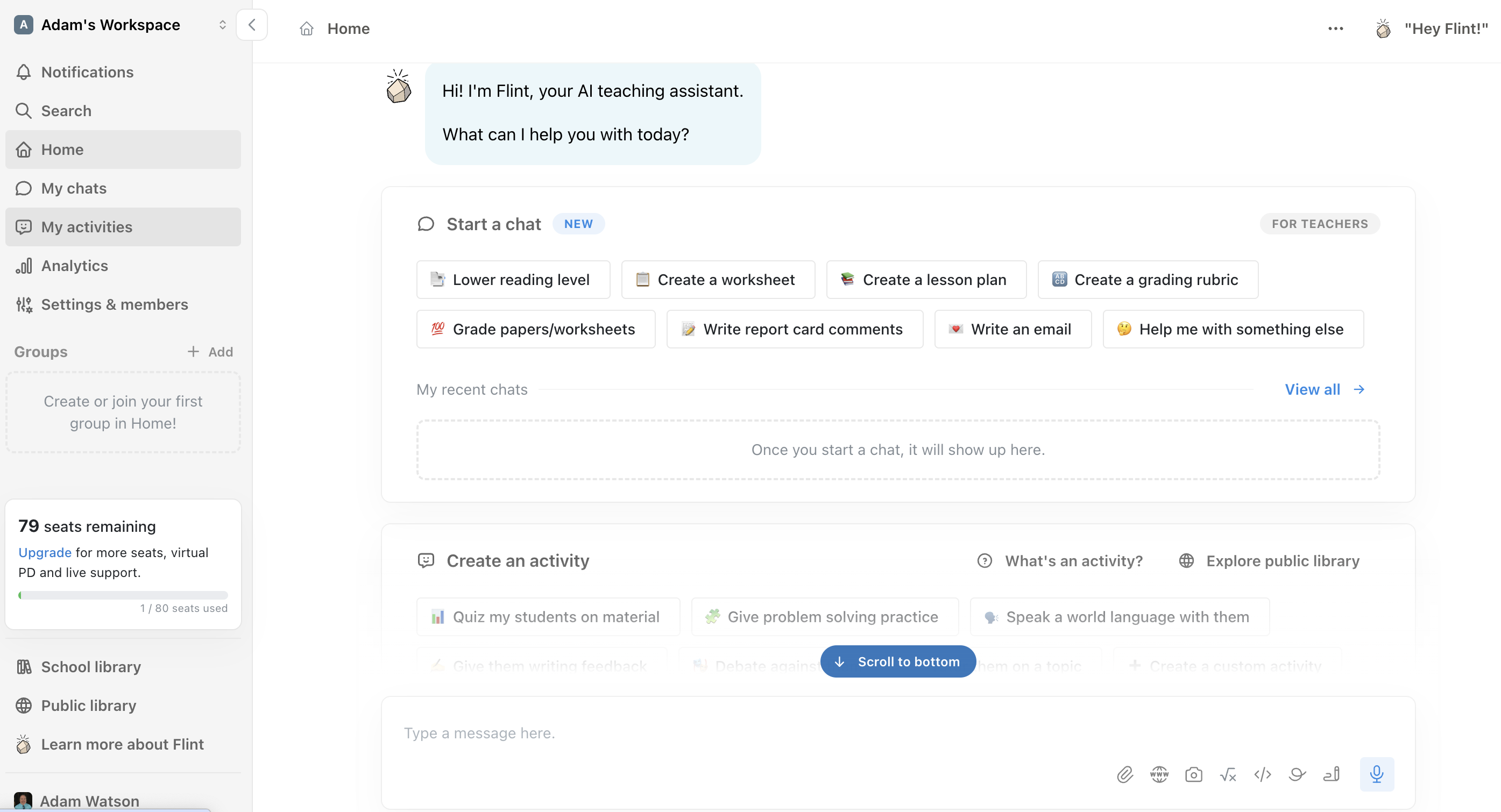
Once logged in, Flint offers itself as your "AI Teaching Assistant."  For the upper section of the home screen, it suggests several ways it can help your instruction, such as lowering the reading level of a text, creating a lesson plan or rubric, and writing an email.  In the lower section, you can create an activity published to an online space made accessible to students by a URL.  Teachers can also save time by using an activity from a public library of pre-made content. 


"Activities" are broadly defined here.  It could be "problem solving practice," "speak a world language" (50+ are available!), provide writing feedback, or create a "quiz."  Here, however, is an example of Flint using an antiquated term of expectations when compared to what students would really experience.

A quiz in Flint is really a conversation between the student and the AI.  Once you give it objectives, potential material to utilize via uploads, and/or standards, Flint begins an assessment by probing what students know, coaxing them when they struggle.  The results of this or any other activity are provided as "Analytics" that look at both how the class did overall as well as an individual's strengths and areas for growth.

Building an activity is a conversation between teacher and Flint.  Here, I asked if I could upload a standards-based rubric to make a quiz.


You could also just provide the standard you are wanting to assess.

Safety seems essential to Flint, given several different features it has to protect students.  Student and teacher data is not shared to third parties and data is not used to train AI models; the data stays secure in the school/district's domain.  Additionally, you can export any student-AI conversation to PDF, inappropriate messages are flagged, and every user exchange can be viewed by admin.  

Educators can make Flint "more or less flexible" with how it helps students.

Flint offers a depth of support for new users, from professional development resources to an onboarding guide for teachers.  They even have an AI Literacy Course for students, which includes lesson materials such as videos, slide decks, and Flint activities you can push out.

Here is Flint's most recent overview video on the platform posted on Loom (1:43).

How could you use it?

Flint offers specific, targeted opportunities for both instructional design and student demonstration of understanding.  Its offerings of World Language activities is unique.  Flint provides students a first tier of tutoring support, particularly with its integration of a whiteboard that could improve math practice and review.  A quiz's use of naturalistic language changes the game for what it means for a teacher to assess.   Last but not least, Flint's ability to discover class data trends as well as drill down to individual student performance makes the potential action pivot from assessment analysis to adjusted instruction much quicker and easier.

Downsides?

One must always be cautious with the accuracy and veracity of artificial intelligence tools, as well as verifiable impact on student learning.  To Flint's credit, they mention several times in their list of features their efforts to be as accurate and transparent as possible, and they share several detailed case studies of partnerships with schools where student learning has improved.


"In-line citations" is one of several ways Flint attempts transparency in its AI results.

Elementary teachers will likely be just fine with the limit of 80 students in the free account, although secondary teachers may rightfully fret.  However, secondary instructors can delete and reassign the seats every few periods to get through a typical day, sacrificing historic data for extending the free usage.  That would hopefully give enough of an opportunity for a teacher to try out Flint to see if a premium account would be worth it.


Flint is not the only tool to promote itself as "AI for personalized learning," but its suite of features make it a contender for honoring that vaulted claim.  Come to it as a skeptic and see if it sparks some innovation for your instruction.

Have you used Flint?  If you are a heavy user of another AI platform, how does Flint compare?  Comment below!

Full disclosure: Flint is in talks with my employer OVEC for potential offers and opportunities for its members.