Showing posts with label profile of a graduate. Show all posts

Sunday, November 17, 2024

Aurora Institute Symposium 2024


A few weeks ago, I was fortunate to have the opportunity to be in New Orleans attending the annual Aurora Institute Symposium.   It was my fourth time over the last decade, and my second time presenting!  I discussed tabletop roleplaying games in the classroom, particularly from the perspective of personalized competency-based education (CBE) and equity.


Special thanks to my colleague Kathy House for taking photos of my session.

Besides my gratitude at being able to lead a session, there were plenty of memorable learning experiences, from keynotes to breakout sessions to chance encounters in the hallway.  Here are a handful of highlights:

  • Rhonda Broussard was a keynote speaker. (Later, I purchased her book One Good Question and was excited to get it signed!) She helped me think differently about classroom inquiry by posing the following three characteristics of what makes a good question for students: 
    • It's not about the teacher (don't reveal your own teacher bias).
    • Anticipates multiple perspectives.
    • Requires mixed-methods reflection (needs sources outside of yourself).
  • There was a student panel (led by Broussard) which generated some great quotes.  Samarah Bentley, a freshman at LSU, pointed out that when looking at what we value in school, an educator's "investments reveal your intentions," and when including students in your learning space, it should be beyond tokenistic representation in your curriculum or just asking survey questions, but a true dialogue: "Not just input, but an exchange!"  When Broussard asked the students to pose one good question for us in the audience, David Ramirez (a student at New Orleans Charter Science and Mathematics High School) gave a powerful plea: "Will you listen?"
  • Representatives from CAST -- Melissa Sanjeh (Senior Professional Learning and Implementation Specialist) and Sherann Jackson-Alkins (Head of ABCD University HS, an alternative school in Boston) -- shared some wonderfully pragmatic and effective tools when universally designing for learning (UDL).    I particularly liked the website's interactive guidelines, as well as the idea of "journey mapping" to see the lesson/unit from the perspective of different students to determine barriers and plan for scaffolding.
  • Another keynote by Sabba Quidwai on artificial intelligence reminded us that our concern that AI is producing the work and not the human doesn't quite fit how we treat assistive, collaborative writing in other contexts: "Politicians have speechwriters. Authors have ghostwriters. Musicians have songwriters. Entrepreneurs have investors."
  • A panel on "Advancing Equity Through Grading Reform in K-12 Education" was led by Starr Sackstein (Mastery Portfolio), Bryanna Hanson (Learner Centered Collaborative), and Sierra Holtzheuser (SpacesEDU).   Among many good points and shared resources, I particularly appreciated Mastery Portfolio's glossary of equitable grading terms, Learner Centered Collaborative's CBE Reporting Playbook site, and Holtzheuser's reminder that digital portfolios should avoid a "scrapbook mentality." 
  • Finally, it was good to run into old friends. Laurie Gagnon and Chris Sturgis reminded us where we've been and where we are going with CBE.  Karin Hess, Jonathan Vander Els, and Brian Stack have recently published a wonderful new book Elevating Competency-Based Learning in a PLC at Work (full disclosure: I'm quoted in the introduction and first chapter!) and ran a helpful session about effective professional learning communities.  With an introduction from David Cook (former Kentucky Department of Education Director of Innovation), Adrienne Usher, Jesse Bacon, and Michael Ekbundit shared how strategically and intentionally they have involved the Bullitt County community with implementing their Graduate Profile.  Sarah Snipes (the current KDE Director of Innovation), along with members of the University of Kentucky's Center for Next Generation Leadership (Susan Dugle, Karen Perry) and the Center for Innovation in Education (Gretchen Morgan), discussed Kentucky's journey toward a local assessment accountability system.  Last but not least, my OVEC colleagues Carmen Coleman, Lacey Eckels, and Rachel Albright presented on their portrait of a learner work with Kentucky's Fayette County Dixie Magnet Elementary School.

My embedded Wakelet collection below has an expanded story of my Symposium experience with additional resources and links.   Be sure to also check out social media posts from the event using the hashtag #Aurora24.


Wednesday, December 21, 2022

How AI Will Save Education

A decade ago, I was a high school English teacher blissfully naive to what radical changes were coming thanks to edtech.  How innocent the days of 2012 seem now, when a teacher only had to worry about the ways Google Search posed a threat to cheating on multiple choice assessments (which began my questioning of the value of assessing regurgitated facts in the first place), or how I had to participate in the ever escalating "arms race" of combating students stealing online essays and quoting other people's words without citation by deploying the latest upgraded anti-plagiarism programs. 

Recently I wrote "What If Your Co-Teacher is a Computer?"  While I mainly addressed taking classic co-teaching strategies and applying them to scenarios that integrated in-person teaching with an online course or adaptive learning platform, I intentionally titled the blog entry with my tongue firmly in cheek, implying a day when a human would seriously have to wrangle with how best to work with an artificial intelligence (AI) educational partner.   I imagined such a day was far, far into the future.  

That was back in October.  But like a Christmas miracle a few months later, ChatGPT exploded into our zeitgeist seemingly out of nowhere, and it feels like something foundational has rapidly and irreversibly shifted in education...indeed, the world.

It should be noted, however, that ChatGPT did not arrive on the scene in one fell swoop, and is merely the steady evolution of AI over the last several years.  Consider the following developments in artificial intelligence:

  • In 2016, the Associated Press began outsourcing its minor-league baseball dispatches to a company called Automated Insights.  By merely taking boxscore data, the company's AI can write simple stories about the key facts of the game, which are then published in newspapers and websites nationally.  AP has expanded its use of Automated Insights into other sport dispatches, quarterly business financial reports, and more.*
  • In February 2019, an IBM AI supercomputer named "Project Debater" was pitted in a competition against a human national debate champion Harish Natarajan.  A journalist was impressed not just at Debater's ability to speak, but to listen: "It sort of took [the audience's] breath away to see that the computer, in its rebuttal, had actually listened to some of what Hari had said, digested it, and was formatting a response in real time to it...I think there was a sense from the audience that there was almost really a personality there."  While officials ultimately judged Harish the winner, the audience voted that Debater was more informative.**
  • While rough "deepfake" videos have been around for several years, the proliferation of video manipulation that appear real enough to fool viewers really shifted into high gear in 2019 with the launch of multiple AI open-source software and mobile apps.  (On a side note: I highly recommend sharing with students The Washington Post's website "The Fact-Checker's Guide to Manipulated Video"; this may require a free account to access.)
  • In 2021, as part of a project called "The Lost Tapes of the 27 Club," AI was used to create new music and lyrics in the stylings of several artists that died tragically young, such as Kurt Cobain, Jimi Hendrix, and Amy Winehouse.  Human soundalike vocalists were then utilized to actually record the compositions.  The organization behind these "new" songs, Over the Bridge, did the project to raise awareness of mental illness among musicians. 
  • In the last year, AI such as Midjourney and DALL-E that creates art based on user suggestions have soared in popularity while also raising the question of the ethics of such programs; for example, it has been discovered that some AI will find art already on the Internet to potentially blend into a new piece without proper attribution or compensation for the artists, or the more basic fear that artificial intelligence apps will do for free what you used to pay and commission artists to create.  

In this context, ChatGPT -- a free online program that, in essence, takes your prompts and questions in order to produce original writing -- can be seen as the natural next step for AI.  In some ways it's like a sophisticated search engine giving you a highly specialized, curated text (without, it should be noted, any citation of the primary sources or facts that led to such an answer).  It relies on the huge database of the Internet, and like much of AI, is learning how to be more effective every time we use it.  What fascinates and disturbs many people is not only the human-like style of ChatGPT's writing, but its ability to generate original and even artistic pieces. 

I thought I could easily stump ChatGPT.  But I was wrong.

My wife wrote an essay back in high school where she compared Bob Dylan's "All Along the Watchtower" to Shakespeare's Hamlet.  A quick Google search resulted in no immediate hits of others writing such an essay.  Yet, when I gave the prompt to ChatGPT, I got the following within a few seconds:
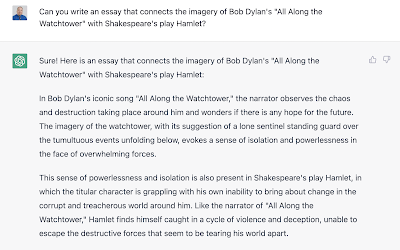
An excerpt (about two-thirds) of ChatGPT's original essay.

Next, I asked it to write a 12 line poem about dachshunds and Jedi Knights.  While it ignored my directions and wrote four extra lines, I was shocked to get a poem that dutifully blended both subjects in non-rhyming, narratively consistent verse:


Not Shakespearean, and certainly missing some compelling imagery, but I would have considered it okay if one of my freshmen had submitted it.  Still, I'm nitpicking about something game-changing here: ChatGPT wrote an original poem in seconds.  Even more amazing, ChatGPT made some independent artistic choices.  I didn't tell it to make the doxie a Jedi Knight, but by deciding to do so, it created a sense of whimsy.  Can a robot be whimsical?

The last example I will share goes to the heart of instruction.   I had heard of teachers using ChatGPT to write a lesson plan.  This will be kludgy and awful, I thought.  Especially if I load up my prompt with detailed specifics.  The generation of the text took longer than the other two examples -- maybe an entire ten seconds -- but once again, I could not stump the bot.


Again, far from perfect, and ignoring some of what I asked for in my prompt, but I was pretty much astounded that AI could earn its keep as my instructional collaborator. (For the entire text of this example lesson plan, click here to view as a Google Doc.). 

The implications of all of this seems clear if not outright ominous: if an AI tool today can now write essays and poems, how must that change how we teach and assess student writing?  If a bot today can write a lesson plan, how does that change or even threaten the teacher's job in the future (in both the metaphysical and literal sense of the word "job")?

It should be no surprise that much of the reaction to ChatGPT is somewhere between existential dread and anxiety.  This has already resulted in some traditional "arms race" approaches, such as fighting potential student (mis)use of ChatGPT with a tool to determine the potential that a submitted text was created by AI.  But is this sidestepping a bigger question? Recently in The Atlantic, Isabel Fattal and Derek Thompson discussed our potentially "wild future."  If an AI can write a college essay, maybe we should re-evaluate the purpose of a formulaic college essay in the first place. As Thompson posits, "Some people argue that ChatGPT could replace the college essay, and Ian [Bogust, another staff writer] is saying: That’s only because the college essay is dumb to begin with. It’s possible that lots of things in the economy are dumb in the way that the college essay is dumb. If that’s true, then GPT can still be revolutionary. What it does might be dumb, but it’s also incredibly useful." An AI that can write a lesson plan might be better seen not as a threat to what an educator can create, but instead be an "inspiration stimulant" (Thompson's phrase) that serves to improve what a final lesson plan might be.  

Earlier this fall, Corey Mohn, President and Executive Director of CAPS Network, had recommended to our Deeper Learning Team a book that was just published in 2021 --- Running with Robots: The American High School's Third Century by Greg Toppo and Jim Tracy.  (Corey had me at "Greg Toppo," as I've been a fan of his since 2018 when I first read one of his earlier books.)  When ChatGPT hit the headlines, I binge read the book, as it seemed eerily prescient to the current hot topic question of AI's impact on education.  At this highly charged inflection moment, where the need for transforming school is critical, I could not more highly recommend this book.  It's a fascinating and engaging blend of four narrative strands: an American public education history from the 1800's to the present; the impact and ramifications of recent AI developments with predictions on what is to come; a spotlight on four high schools operating today which serve as models on how school can and should be; and last but not least, a novelistic Rip Van Winkle utopian story where a principal falls asleep in 2020 and wakes up twenty years later visiting his radically changed school. 


For Toppo and Tracy, future AI should not be seen as the bleak robotic replacement of teachers and humanity itself, but instead a challenge we must acknowledge and address: "As a society, we need a 'pre-AI moment' -- that is, a systemic anticipatory response on a scale commensurate with a previous generation's 'post-Sputnik moment.' And, like the response after the fact of Sputnik in the 1950s, this should transpire as much in the realm of educational as in policy initiatives" (190).  But our "systemic anticipatory response" must recognize why prior educational initiatives have failed in the past:
[D]ecades of failed revolutions, of the "next big thing," of teaching machines and expensive technical marvels, have failed to transform a hidebound, nearly intractable system.  Revolutionizing education is neither wise nor feasible.  Rather, we must evolutionize education, seeking to forge the optimal synthesis of the best and most germane from the received tradition with the most promising of emergent pedagogical practice.  After all, the received traditions have been honed over millennia and have much that is fine and still relevant, while new educational paradigms are often faddish and ill-considered.  The careful sifting and selection is essential. (37, authors' italics)

We don't have to throw the traditional pedagogical baby out completely with the "hidebound" bathwater, but we certainly have to evolve our educational practices in light of our near-future technology and needs.

Toppo and Tracy point out an illustrative example that involves math instruction. By the 1970's, pocket calculators became cheap and commonplace enough that an average student could easily own one.   Technology offered us a chance to be a partner. This should have been a watershed moment for instruction, when math teachers began focusing at least as much (if not more!) time on mathematical practices -- on authentic practical application, on conceptional knowledge, on experiencing the aesthetic beauty of mathematical thinking -- rather than having students spend their time mindlessly plugging and chugging through memorized but ill-understood formulas.  However, even a half century later with the latest smartphones and laptops and AI apps, we still spend a disproportionate amount of time asking students to compute like, and compete with, a computer instead of thinking math like a human and collaborating math solutions with humans.   As the authors' fictional future principal puts it, "We humans are still pretty unique in our ability to make creative connections across apparently disparate knowledge areas....That's the value of omnidisciplinary literacy. The time that is freed up by not bringing every student to content fluency can be devoted instead to imbuing them with process fluency" (16, my italics).   In other words, have students spend less time regurgitating facts that you can Google and on skills rapidly being augmented or replaced by AI, and instead spend more time learning the critical human applications that truly matter that can't be easily supplanted by a robot.***

The idea that AI can actually be the savior of educators, education, learners, and learning and not its destroyer really goes to the heart of our current Deeper Learning work.  We pose questions such as "How might we reimagine the student experience to become more meaningful, relevant, and inspiring so that every learner is equipped for a successful future?" We know the answer is not more regurgitation of facts, more formulaic writing, more solving of inauthentic scenarios of two trains running toward each other on the same track.   We cannot have students spend years learning the "hidebound" traditions of the so-called fundamentals before they get a chance to "play the whole game," to use Jal Mehta's excellent Little League analogy.  We need more lessons that emphasize Profile of a Graduate competencies that lead to application of durable skills, which will likely be the last bastion of uniquely human cognition left in the decades to come.  If we hesitate to transform teaching now, AI may truly become humanity's rival instead of our partner in the future.

To take us back to our present ChatGPT dilemma for student writing, I offer three possibilities for teachers.

  • Lean into ChatGPT as an opportunity for a student to generate a first draft, provided the understanding is that the student revises that draft to further enrich and enlarge her/his thinking with additional detail and complexity.  The student should also do "reverse engineering research" to find, validate, and cite any facts or quotes given in ChatGPT's text. As a student requires feedback and shows examples of their subsequent drafts,  the student is responsible for being transparent about their writing process and is asked to reflect on how the paper evolved from ChatGPT's initial text to their own final product.
  • Create "mini-dissertation defense" opportunities where students must orally explain their writing to the teacher and/or peers.  A student that can metacognitively talk through their thinking is a person who can demonstrate how they, and not a computer, have demonstrated mastery.  Pose questions and inquiries like, "Where are you personally connected in the work?" or "Explain your use of metaphor here."  Of course, such oral opportunities also provide practice and proof of those Profile of a Graduate competencies such as effective communication. 
  • "Where's the epiphany?" If the expectation of the writing is to simply synthesize known facts into a narrative, tools like ChatGPT will continue to put the human 3.5 essay out of business.  Let's instead make the expectation of the writing be the creation of a new insight or invention, instead of a regurgitation of bullet points.  Consider ways to refine what your writing is asking for, such as the performance assessment criteria tool in my blog entry "From Good to Great, Initial to Ideal: A Way to Improve Exhibitions and Other Performance Assessments."

I'll end with a rallying cry from Toppo and Tracy:
So, if we want to help our young people thrive in a world of miraculous technology, we must forget the nouns -- the AI and robots and intelligence systems -- for these will always be changing.  We must focus instead on the verbs: What it is we trust our young people to do that we don't trust technology to do?  And how can we prepare them for this future?   
For starters, let's not give them robots' work.  Let's trust them to do better, harder, more rigorous, more interdisciplinary, high-stakes work -- and not just for the 10 percent, but for everyone.  We must expect more of young people, not only because the world will expect it of them but because they are begging us to do so. (70)
Let's teach our students to run with the robots, and not against them.


Some footnotes:
  
* Toppo and Tracy, pages 82-83.

** Toppo and Tracy, pages 201-203.

*** "For so many students, school is simply not demanding enough - and the dilemma, of course, doesn't begin in high school. When the Education Trust, a civil rights group that advocates for low-income and minority students, examined more than 1,800 math assignments given to middle school students in six urban, suburban, and rural school districts in 2018, it found that most of the assignments featured 'low cognitive demand,' overemphasized procedural skills and fluency, and provided little opportunity for students to communicate their mathematical thinking.  The problem was often worse in high-poverty schools" (Toppo and Tracy, page 70).  

Saturday, October 15, 2022

What If Your Co-Teacher is a Computer?

I was speaking to a principal who had what at first sounded like a fairly unique problem of practice. The principal's students were in an alternative setting and the main delivery and assessment of content came from an online course platform.   The staff fully recognized the need to provide the students with a richer learning environment than simply watching videos that led to multiple choice quizzes and eventual unit tests.  However, attempting to insert in-person instruction and implement a hybrid solution created struggles. When teachers leaned in with mini-lessons or other activities, students were inevitably knocked "off pace" from their time away from the online course platform.  Additionally, some of the staff were not experienced teachers, so even deciding how or when to lean in was a problem.  All of this created a spiral of stress for both the educators and students.  How could they resolve this tension?

As I sat in the office, I had an epiphany.  The situation wasn't entirely unique.  At its core, solving the issue takes trying to achieve one of the toughest goals in education: effective co-teaching.   

Before continuing, a digression.   Likely seeing a lack of pragmatic support for co-teaching in teacher prep and in practice, Marilyn Friend and Lynne Cook wrote Interactions: Collaboration Skills for School Professionals, first published in 1991 and now in its ninth edition.  It's interesting to point out that the authors came from special education backgrounds, and for most classroom teachers, that is usually their co-teaching situation: a gen ed teacher is the one "in charge," while an ECE teacher pushes in because several children with IEP needs are on the roster.  Of course, the potential of two professional adults in the room to lead instruction often is unrealized, for reasons practical (lack of time to collaborate and plan together) and pedagogical (lack of training and practice on co-teaching structures).   One of the more enduring and cited aspects of Friend and Cook's work is how they framed the six models of co-teaching:

  • One Teach, One Observe
  • One Teach, One Assist
  • Parallel Teaching (students are split into two groups; teachers simultaneously teach the same content)
  • Station Teaching (students rotate through two or more "stations," with each teacher at a station teaching different content)
  • Alternative Teaching (one teacher teaches the main content to a main group, while the other teacher teaches different content to a smaller group for a specialized basis, such as academic gap recovery)
  • Team Teaching ("tag team teaching" where teachers both teach the whole class at the same time)
Sean Cassel, in his article "How to Choose a Co-Teaching Model" (Edutopia, 10/8/19), succinctly points out pros and cons for each model to consider.  For example, "One Teach, One Observe" could be a powerful strategy if the observing teacher was capturing learning evidence and taking detailed notes of all student moves, rich data that is analyzed by both teachers later.  It also requires little if any pre-planning time...which is why this co-teaching model (along with "one teach, one assist") is often chosen by pragmatic default.   However, lack of time ends up also being the weakness of both "One Teach, One Observe" and "One Teach, One Assist":  without instructional intentionality before a lesson, and without valuable debriefing after a lesson, there is little to show for the effort except an underutilized educator and a lack of student learning improvement beyond what one instructor could have achieved alone.   Besides these pros and cons, teachers may switch these models up based on the needs of the given instructional day, and of course the personalities and experience levels of the teachers will influence the effectiveness of their model choices as well.  (For more quick tips on effective co-teaching, I also recommend "Co-Teaching Strategies: Dos, Don'ts, and Do Betters" by Wendy Murawski and Toby Karten, ASCD, 7/1/20.)

All of this can be helpful when attempting to intentionally plan how to co-teach with another human. But what do you do if your co-teacher is a computer?

It first should be noted that relying on a computer to help your instruction is not a bad thing.  If I thought it was bad, I would have shut down Edtech Elixirs a long time ago!  The issue is effectively working alongside a platform that is delivering instruction and assessing students.  As I see it, such platforms fall on a spectrum, and for our purposes, can analogously be compared to in-the-flesh educators:

  • Platform as Specialist:   This is an adaptive learning platform (like Lexia Core5 or DreamBox) that teaches discrete skills, usually in response to pre-assessed learning gaps.  "Lessons" tend to be short and are much more experiential, often with a game-based learning angle; they also tend to be in shorter time increments (perhaps, say, twenty minutes, and completing 2-4 of such lessons a week is the average expectation).  Students are limited in both their ability to choose what lesson to take next (as the system decides their pathway) as well as their ability to see a sequence (as the lessons may address gaps across grade levels, as opposed to curricular "units").  The platform can also just "work" with little management from the teacher, although one hopes he/she looks at the data periodically to personalize future instruction!   While students may "level up" as they successfully complete lessons, there is no real individual assessment grades to report. These platforms are analogous to literacy/numeracy/ECE specialists that may push in or pull out for a handful of students, usually only one or two times a week, and by the nature of their work is not necessarily connected to the lesson of the day.   As such, they are the least intrusive and hardly factor into most teachers' general weekly planning of lessons, besides perhaps deliberately setting aside in-class time to get on the platforms. 
  • Platform as Instructional Aide:  This is a learning platform that has full lessons (likely driven by a video or screencast), organized in units and with at least self-check assessments that give some kind of grade to help determine how well the student is comprehending the material.  Alignment to academic standards is usually more prominent and obvious.  However, these platforms are very flexible and modular in nature, so a teacher can manage its integration into daily instruction as they see fit; for example, the teacher may use the platform for "flipped learning" on delivering certain content videos several times a week as "homework" while face-to-face time is used for practicing math problems.  An example of this kind of platform is Khan Academy. These platforms are analogous to an instructional aide that is significant to the classroom, may even be present daily, and might do some light instruction and formative assessment, but the "teacher of record" who is truly in charge of instruction and summative assessment is still clear. 
  • Platform as Teacher:  This is an online course platform where the system both delivers all of the content and can formatively and summatively assess student performance.  Such platforms, like Edgenuity and Apex Learning, could conceivably be done fully virtual even outside of a brick and mortar school, with little interaction from an educator unless the student needs tutoring help with content or to unlock a quiz or test.  Pacing is usually established by the platform, with either activity due dates or another metric, providing feedback for a student ("You are two lessons behind") to ensure they complete the course in a prescribed timeline.  Here, you can see how the situation is the inverse of the "Platform as Specialist":  with an online course platform, the human teacher often serves a backseat role. ** 
It is in this last category, Platform as Teacher, where we can circle back to the issue that began the entry.  If you are using an online course platform as the primary driver of instruction and assessment, all of the struggles you may have are exactly the same as one might have with a human co-teacher.  Therefore, you need to first determine what co-teaching model will work best for you.  Let's look at the models again adapted for this new "co-teacher is a computer" angle.

  • Platform Teaches, Educator Observes:  The online course platform is the full driver of instruction and assessment for all students (which also implies that only autoscored assessments are kept in the course).  However, the educator is constantly looking at two things.  First, the educator is analyzing the data behind the scenes.  How much are they logging on?  Is the student barely passing the quizzes or taking too many attempts?  Does the student make notes in Google Docs that can be shared and seen and Commented? Secondly, when the student is working on the platform in person, the educator is assessing the behavior of the student.  Is the student bored? Frustrated?  Either the educator helps the student with the academic or SEL struggles, or they are reported to those that can help, in a way that is least intrusive to the pacing of the online coursework.  This model is most common with students in 100% virtual academies.
  • Platform Teaches, Educator Assists:  The online course platform remains the full driver of instruction and most if not all of the assessment for all students.   However, the educator moves from merely being a data collector to more of an active role.  This may include times where a student needs to be pulled off of the platform so the educator can teach a mini-lesson, help the student get on track, or serve other needs.  These moments are usually brief and handled one-on-one only as needed.  Potentially, the educator could also be assessing some of the online course activities that are not auto-scored, such as essays or lab reports.  Another idea: the platform takes care of at least most academic standard assessments, but the educator assesses for durable skills via projects or capstones (think graduate profiles or portraits of learning) that are done in a way that does not intrude too heavily on a student's academic workload.  Better still, such projects/capstones might serve as a performance-based assessment for both academic standards and durable skills, providing opportunities like accelerating credit recovery, or replacing a unit or even a whole course that would have otherwise had to have been digitally delivered.++
  • Parallel Teaching: One part of the class is taught and assessed by the online course platform, while the other part of the class is taught and assessed by the educator.   It is relatively the same content and pacing for both. In a typical "two humans" Parallel Teaching model, you are encouraged to swap teachers and groupings for variety or as needed.   However, for the sake of clarity, ownership, and pacing, I would recommend in this model example to keep this arrangement of "which student to which online/human teacher" as permanent as possible, except for small push-ins as detailed in "Platform Teaches, Educator Assists,"  This also requires the educator to know the online coursework very well, so they can parallel their instruction with the platform.
  • Station Teaching:  All of the students rotate through stations; a student is always working at one station at any given time.  One of them is the online course platform, while the educator teaches and assesses at another.  This fosters some independence and agency, as students always have something to do yet are given more trust to do so. You may want to consider adding a third or fourth station of independent work, whether it is additional blended learning different than the online course platform, or some other engaging analog work.  In this model, the online course's default system-directed pacing and full grading is nearly impossible -- pacing likely requires due dates to be turned off or ignored, and the course needs customization as not all of its lessons/assessments/units will be completed if the educator is starting to do a significant part of the teaching and assessing. 
  • Alternative Teaching:   The educator takes on the role of specialist that routinely pulls out a small group in order to fill in academic gaps and fulfill potential high-needs.  The online course platform is still the main instructor/assessor for all students, which means there will be a constant tension of the pulled students falling behind pace because of their intervention time.  (In a "two humans" alternative teaching co-model, a pulled out student missing crucial content teaching is also a concern.)  If this results in a student being off-pace, this is either ignored or fixed via a customization of the platform/course. Note the difference from this model and "Platform Teaches, Educator Assists" is the grouping of students, the routine timing (as opposed to irregular and only as needed), and the significant length of pull out from the main instruction. 
  • Team Teaching:  For nearly all online course platforms, a teacher can preview a course in "student mode," playing videos and interacting on some activities -- however, it knows you are a teacher and therefore doesn't march you through quizzes or grades your performance.  With that assumption in mind, in this model, no student is technically "on" the platform.  Instead, the educator (through a projector, shared Zoom screen, etc.) goes through the online course in front of the class.  The educator may play content videos, possibly pausing them to pose questions to the class and supplementing the video content with their own instruction. When the online course arrives at an assessment or activity, they may be adapted or fully replaced with the educator's own.  It is "team teaching" because you are depending on the platform to hold up at least some of the instruction in a back and forth way.  However, since students are not technically on the platform, the educator must be the assessor.  Clearly, an experienced teacher with prepared curriculum would not need this model (or an uncustomized online course in the first place!), but this model could be excellent for a teacher that needs "training wheels" to teach the content of a course. 
As you examine the models and start deciding which is best, I'll leave you with some general advice when working with online course platforms.

  1. When the going gets tough, remember your why.  In the scenario that began and inspired this entry, the teachers knew that their students needed something more enriching than a video/quiz/video/quiz/unit test instructional sequence. Let's state the obvious: an online course platform, especially when stripped down to only multiple choice assessments and traditional points/percentages grading, is nowhere near mastery or deeper learning.  Most of the co-models above can be difficult to implement, as any hybrid model of instruction often is.   So remember your why when the going gets tough.
  2. Stick to one model.   With humans, swapping co-teaching models may be helpful instructionally or to establish variety.  However, online course platforms run on algorithms and meticulous programming.  They are designed to fully teach and assess a student, from first lesson to final end-of-course exam, from August to May...and most importantly, do all of this by itself.   The more you customize the experience (especially with some in-person instruction), the more you mess with that programming and potentially cause yourself and your students some frustration.  Therefore, pick one of the models above, make platform adjustments as needed, and stick with it for the duration of the students' courses.  And speaking of frustration...
  3. Let pacing go.  The more the educator steps in with instruction and assessment to customize the experience, the more that pacing will be "off" for some or all of your students.  So when considering a hybrid model of online coursework and in person instruction, you might need to be an Elsa and just let it go...have students ignore the pacing, or deactivate it if possible.  Remember, before online course platforms, teachers were the pacemaker.
  4. Start small.   Some of the models above are clearly more complicated than others.  Know your strengths and give yourself time to grow.  Find a place to put your toe in the door. If you want to lean in more than an observer but not ready for the other models yet, consider a smaller way to be involved, which may take customizing the coursework.  For example, bring back those essays or lab reports so you can be involved in assessing the student alongside the computer.  Another idea: be fully in charge of one full unit in the course, in both instruction and assessment; the online course can keep its pacing, teaching and assessment for the rest of the units.  The key with any customization is to be careful that whatever content you remove from an online platform course is replaced in person.
  5. The assessor wears the crown.   One of the biggest classroom culture issues with co-teaching is that the students want to determine who is really in charge, and pick up on cues far more than you think.   You may say, "We are like two parents and we are equally in charge!" but that is being Pollyannish, if your actions aren't consistent with that belief.   Whose name is on the classroom door?  Who has a desk and is there every day, and who comes and goes?  Who talks the most?  Last but not least, who assesses?  The person who gives the grade is the one truly in charge in most students' eyes.  If the online course platform is seen as the person passing or failing the student, and you reinforce this with statements like "Platform X says you are off pace," then you are abdicating your control to a computer.  Which brings us to....
  6. You determine the credit.  Ultimately, it is your signature that determines if a student passes or fails a course.  You are the teacher of record, not the computer.  Use your well-earned and well-learned professional judgment at all times.  You should be kind to your colleagues and human co-teachers, but never be afraid to tell the computer who's the boss.
Postscript: Sadly, Dr. Cook passed away in 2015, after a long and remarkable career.  Dr. Friend continues adding to the scholarship and strategies of co-teaching, which includes her own website of services and resources.

**10/16/22: For the category of "Platform as Teacher," I feel it is important to clarify this definitional use of an online course platform being so autonomous is based on the main way I have seen it implemented in multiple school districts.  It is true that such a platform could be used for personalized learning as a smaller part of an in-person instructional plan (assigning, say, only one unit of the course to a student who needs an opportunity for asynchronous practice). It is also true that courses of nearly all such platforms have by default a variety of activities/assessments such as essay assignments, lab reports, etc. that would require human grading.  However, its most popular use is to make the platform as autonomous as possible by eliminating all but the self- or computer-scored assessments such as quizzes and tests.  I should also add that I am not judging such use as "good" or "bad," since the needs of the student and situation should drive such decisions.  To take just one example that underscores the need for autonomous online coursework, imagine a virtual advisor trying to manage 40 students...across seven grade levels 6-12...taking six online courses each.

++11/13/25:  An idea was added to the "Platform Teaches, Educator Assists," discussing the possibility of an educator assigning and assessing a project or capstone for durable skills while the platform still takes care of most academic standards.

Wednesday, September 14, 2022

KyEdRPG, Part Two: The Power of a D & D Club

 This is Part Two of a three part series to kick off a new website, KyEdRPG, and how role playing games can positively impact student learning.  In Part One, we celebrated the launch of the website itself. In this entry, we prove how a D & D club can be a wonderful extracurricular opportunity...before or after school, in person or virtual!

File image from https://commons.wikimedia.org/wiki/File:Gaming_Dice_%284434184961%29.jpg.


Justin Gadd is a Kentucky social studies middle school teacher who recognizes the multiple ways that a Dungeons & Dragons extracurricular club can improve student learning, both socially-emotionally as well as academic.  After hearing his story, I asked Justin if he would agree to an interview, which I'm happy to share below (slightly edited for clarity).


Justin, welcome to Edtech Elixirs!  Share your educator story. 

Hello, My name is Justin Gadd. I am currently a Social Studies teacher at Marnel C. Moorman K-8 School. This is my 4th year of teaching and my second year in Shelby County Public Schools. I have taught both ELA and Social Studies for 8th, 7th, and now 6th grade.

When did you start playing role playing games?  What got you started?

I got started playing role playing games when I was first introduced to D&D in college by a friend. I had only heard of it in pop culture prior to that, and when he invited me to play, I gave it a shot. We played the Curse of Strahd story and it was so much fun. My first character was a Mountain Dwarf Barbarian named Tor'uk. I have played as a Bard, Warlock, and my current character is a Ranger, and I have been involved with my current campaign as a player for almost 3 years now!

What RPGs do you personally play today?

Currently I am only playing D&D but I have played some different one shots from friends that were set in different time periods but same rules as D&D. My favorite was a holiday themed one shot I played that a friend ran where we all played as different holiday movie characters to try and save Santa! I think it goes to show the versatility of tabletop RPGs.

You've shared with me that you started a virtual D & D afterschool club at your previous school when the pandemic began, which is equally impressive and awesome given the obvious challenges.  Tell us more about that experience.  

I worked in Oldham County Public Schools from 2019-2021.  I began a DnD club with a co-worker at the start of virtual learning in 2020. We created it because we wanted something that was engaging, free, and something we could do safely from home at a very stressful time.

In the first year of the club, in the spring of 2020, we had about 5 students and it was pretty fun, although we didn’t use many manipulatives, maps, or dice rolling.  It was more description and imaginary story telling.

In year two (2020-2021), we were teaching part virtual, part in-person and this time we were able to get a consistent group of about 8-10 students every week. The club itself was still virtual but it was from 6-8pm every Tuesday as that was a time that worked for everyone’s schedule but wasn’t terribly late.

We were able to use some funding to give each student their own set of dice but virtual rollers were utilized as well as virtual apps such as dndbeyond.com which is also free, and it can be used for effortless character sheet creations and managing a character's inventory.  But really, the start up cost for a club was not terrible as there’s so many free online sources now for D&D and other RPG games.

I should point out that in Shelby County, we have a Profile of a Graduate, and what they do in D&D definitely authentically applies several of our PoG competencies: Effective Communicator, Responsible Collaborator, Critical Thinker.  

The best part of the experience was we were able to build a really great community with these kids and it was such a stressful time where we were still part virtual and Covid was still looming. I had one student tell me after a game that “D&D nights are so great because it’s one of the times I laugh the most all week” and parents emailed us telling us how much fun it brought them and they wanted to start playing with their kids too!

Parents playing with their students, that's fantastic!  I also love how playing D & D ties into your district's Profile of a Graduate, and clearly there is some great social emotional learning going on, too.  Can you elaborate further on the academic benefits of students playing role playing games?

The academic benefits of tabletop games is pretty broad if you come into it with an open mind. There is creative writing when crafting a backstory for your characters and their motivations. For those who run a game as GM (Game Master) or DM (Dungeon Master), there is planning involved in preparing the story, and how they decide if one thing happens, what happens next? There is math and probability in the dice rolling, and making those calculated risks based on their character statistics is vital to success. In Shelby County, playing D&D definitely applies to several of our PoG competencies.

  • Effective Communicator: Students have to be able to communicate their actions with the players and DM running the game. 
  • Responsible Collaborator: Team work! It is so important to success in the game as well as the choices you make can have ripple effects in the story and world of the game! 
  • Critical Thinker: Thinking about your actions and the affect they have on others and the success of your mission.

Now that students are fully back in person, what are you thinking of doing differently with a D & D club this school year? 

This year I hope to start a D&D club with the Quest program in October, which is an in-school club or area of interest for students to participate in for 9 weeks.  It would be Monday, Wednesday, and Friday mornings for 45 minutes and could be a fun experience to introduce the game to others and be able to play some D&D consistently.  

What advice would you give to someone trying to start up a club like this in their own school, especially if they have little or no experience with playing D & D? 

The advice I would give to someone wanting to start a D&D or tabletop gaming club is to first just ask around and do some research! See who's interested in your school community in playing or helping run it. There are so many resources on the official Dungeons and Dragons website for beginners wanting to start and even some beginner book sets with all the rules and stories written out for you. For my beginner players I give them a pre-made character (available from the website) and then have them come up with the back story for their characters. Knowing how to play without having to stress about the whole character creation process gives you more time to focus on the play time!

I have found that overall, the D&D community on Facebook groups and Reddit can be very helpful resources for asking beginners. Just searching "D&D for beginners" brings up loads of helpful links. The next thing I would say is don't go too big your first time around. 8-10 is about the maximum size of a group I would run if you were the only DM because that way every player can feel included. If you have students who know how to play, encourage them to DM and then you can have more players in your club and smaller player-to-DM ratios. And feel free to reach out to me via email to ask questions!

Last question, and for this one forgive me if I geek out with you a bit.  D & D has some changes and expansions coming up, such as the Spelljammer sourcebook which allows your characters to play in outer space, and a playtest of a new backwards-compatible edition that will be launched in 2024.  What are some things about D & D that keep you excited about the game?  

 I love to geek out about stuff! I think taking D&D into space could be a lot of fun. The beauty of Dungeons and Dragons is it is quite literally limitless what stories you can tell and "Homebrewed" spells and items you can use. For example, my DM, whose campaign I have been in for almost three years, mixed Call of Cthulhu stories with the regular D&D world and it's so cool! Teachers could make a story with any content or book they are reading with a bit of time and effort. I am grateful for shows like Stranger Things making Dungeons and Dragons "cool" for kids because it makes it that much more engaging when we bring it into schools.


A huge thank you to Justin for taking the time to share his insights!

Be sure to check out Part Three, where you'll hear how a Kentucky teacher uses a custom-created role playing game as part of his lesson plans.

Tuesday, March 15, 2022

Vodcast Series Highlighted in Next Generation Learning Challenges Report!

Education during COVID-19 -- and COVID's lingering impact on learning post-pandemic -- will likely be researched and studied for years to come.  One such study was conducted recently by Next Generation Learning Challenges, which surveyed 70 schools and districts in 2020 and 2021 who, despite genuine challenges, were having some successes.  The key question was: how and why were these schools and districts succeeding despite distance learning issues and other pandemic obstacles?  This is reflected in the final report's title, "What Made Them So Prepared?"

The full report was released today and it's a fascinating study.  From NGLC's press release, I'll quote three big themes that emerged from their findings:

  • The common-sense assertion: To help students become capable, caring, self-directed learners and creative problem-solvers, our schools should model those same attributes for them – in their design of learning, but also in our adult working culture and operating habits. 
  • The research finding: Schools and districts that had made this commitment pre-COVID strongly benefited from it during the pandemic, enabling our communities (including students) to respond adaptively and creatively. Agentic learning and operating approaches, efforts to create a healthy culture supported by strong relationships, and resilient, flexible systems made districts feel prepared to face the pandemic’s many challenges.
  • The value to ALL schools and districts: Ed leaders seeking positive ways to move past Omicron and rebuild forward momentum can use this project’s findings and resources to build on their own school or district’s examples of resilient, adaptive innovation during the pandemic. This research offers a productive way forward at a time of urgent need.


One of these 70 schools and districts that NGLC picked to interview was Shelby County Public Schools, and we are highlighted in their report!  SCPS is mentioned briefly on page 9 (PDF page 5) as one of several districts that have a Profile of a Graduate, but more prominently, we are featured on page 7 (PDF page 4) for our two "Shelby Speaks" vodcast series that we uploaded to our YouTube channel in May 2020 and January 2021.  I was proud to co-create and facilitate these interviews with our fantastic SCPS educators from many different role groups -- general education, ECE, English Language, librarians and more -- who shared their reflections on tips, tricks, strategies, successes and challenges of distance and hybrid learning.  (For more on these vodcasts, please read my blog entries here and here.)

We are thankful to NGLC for the chance to contribute to such a historical project, and I encourage you to read their full report.


Wednesday, January 26, 2022

From Good to Great, Initial to Ideal: A Way to Improve Exhibitions and Other Performance Assessments

When our district began its journey into competency-based education (CBE), one of the significant early steps was the publication of our Profile of a Graduate (PoG) in 2017.  The Profile was crucial in developing our current Strategic Leadership Plan for 2018-2022, where Personalized Learning is the top strand.  "Embedded Performance Assessments" -- demonstrated applications of student knowledge intentionally timed at key points of a student's learning path -- is a feature mentioned throughout that strand, and one of our frequent examples of such an assessment is student exhibitions: a culminating celebratory event where they can "show what they know," often with the attendance of parents and community members as an audience.

From a certain perspective, student exhibitions are not new.  Indeed, if the phrase conjures up images of a junior high science fair with trifold presentation boards, homemade dioramas and solar system mobiles, or perhaps cute elementary students dressed up as famous people for a living wax museum, you would be forgiven. But there is a difference when defining exhibitions in the context of CBE or as a high quality performance assessment.  Features of such an exhibition would include the instructional intentionality in how they are designed and assigned by teachers, the agency of the students behind them, and the depth of the mastery of learning the exhibition can demonstrate.  Furthermore, if your objectives from student exhibitions include students producing rich artifacts of learning and having some practice runs leading up to a rigorous Defense of Learning performance summative assessment -- more on both of these later -- it is imperative that students exhibit and exhibit often.  

For a further exploration and explanation of the power of student exhibitions, watch this short video (2:14) from High Tech High:


Our district was not naive about what it would take to achieve these richer and deeper exhibition experiences.  Teachers needed to learn strategies and see good models for student-centered learning; students could not become empowered, confident, and self-directed overnight.   However, one of the wisest moves from our leadership was to encourage our teachers, and by extension students, to just try.   We knew that some of our earliest exhibitions would be rough and wouldn't look much different than those old fashioned science expos with the trifold presentation boards, but we had to start somewhere, so we could baseline, learn, and improve.  While we are still (and should always be!) "becoming" and improving, we can use the integration of our Profile of a Graduate as an example of how exhibitions have deepened and gotten better.  At first, students may have been asked to reflect on a Profile competency or two at the very end of the process, if at all, perhaps as an afterthought ("Reflect on which PoG competency you think this exhibition best exemplifies").  But then we developed single-point rubrics to measure whether the student met the competency . . . teachers began developing exhibitions with an intentional focus on a PoG competency made clear to the student from the start . . . and we are in the process of launching four point mastery scales on the PoG competencies to better assess the student's "performance."

The launch of the Profile of a Graduate five years ago certainly gave us a new "why" for student exhibitions and a way to deepen and better measure student learning. But looking back and looking forward, what if we had a tool or a more insightful lens to look at performance assessment more effectively?  

This is where an excellent book enters stage left: Deeper Competency-Based Learning: Making Equitable, Student-Centered, Sustainable Shifts by Karin Hess, Rose Colby, and Daniel Joseph (Corwin, 2020).  I'm halfway through reading it as an anchor text for my chosen SCPS PD strand this year, and in full disclosure (and to my delight), Rose Colby also joins Shelby County periodically to virtually lead workshop sessions on CBE for myself and other CBE strand learners.**   Deeper Competency-Based Learning is dense in the best sense of the term, full of CBE shift strategies, rubrics, and metrics to measure where you are in competency-based education and where you want to be.

In their chapter "Making Shifts in Teaching and Learning Structures," the authors share a table of criteria types to plan performance assessments (Table 3.6, page 94).  The criterion types, example questions typically answered by each type, and the Depth of Knowledge (DOK) one would usually expect for each type, are as follows:

  • Process: "Will the student follow particular processes (e.g. procedures for a science investigation; data collection; validating credibility of sources)?" [DOK 2]
  • Form: "Are there formats or rules to be applied (e.g. correct citation format, organize parts of lab report; use camera shots/visuals; edit for grammar and usage)?" [DOK 1]
  • Accuracy of Content: "List essential domain-specific terms, calculations, concepts, or principles to be applied." [DOK 1 or 2]
  • Construction of New Knowledge: "How will the student go beyond the accurate solution and correct processes to gain new insights and raise new questions? Are there any personal success skills that might also be employed?" [DOK 3 or 4]
  • Impact:  "How will the final product achieve its intended purpose (e.g. solve a complex problem; persuade the audience; synthesize information to create a new product/performance)?" [DOK 3 or 4]

The authors point out that "[a]ll rubric criteria do not need to be included for every summative assessment, but they should [all] be considered during the design phase," with a particular emphasis on Construction of New Knowledge and Impact for performance assessments that are to truly assess deeper learning (94).  Furthermore, these criteria are an excellent first step for either designing a new performance assessment or analyzing an existing one. Additional steps include considering an authentic context for application, identifying a proper format for such a demonstration, determining how much students will have voice and choice in the process or product, and last but not least, identifying and aligning success criteria to the task (94-95).

All of this brings us back to student exhibitions.  Even as many exhibition examples in our district often had a "good" quality to them, I struggled to articulate feedback in what could make them "great."  One thing I realized early on was the need to present an original idea, rather than just a regurgitation of what others have said or done, no matter how well it is packaged or communicated.  Put another way when I was discussing project-based learning in a previous blog entry: "It is not transformative learning if the end result...is merely a well presented aggregation of researched bullet points instead of a new idea or creation that shows real reflection and growth of student thinking."  (Note also that the word choice of the criterion Impact, as well as its definition, can strongly suggest how a well designed PBL can end in a high DOK performance assessment that "impacts" the community outside of the four walls of a school.)

It was this insightful criteria from Deeper Competency-Based Learning that illuminated how I could improve the way I evaluate and give feedback on performance assessment.   Firstly, as the authors point out, there is nothing inherently wrong with a performance assessment that only remains at the level of Process, Form, and/or Accuracy of Content (and by extension, at DOK 1 or 2).  I will label these as Initial performance assessments. Depending on the intentionality of the lesson/unit design, this might very well be instructionally sound -- for example, perhaps the competency is only being introduced and full mastery would not be expected.  The issue is when a teacher either stays at the Initial level for all such assessments for the entire course, or worse, misinterprets a performance assessment best designed only for these lower levels as a demonstration of mastery.   For a performance assessment to truly apply a student's knowledge with depth, the student should "gain new insights," "raise new questions," "employ personal skills" (like the ones from our Profile of a Graduate!), "solve a complex problem," "persuade an audience," and/or "synthesize information to create a new product or performance."  I would label these Construction of New Knowledge and Impact performance assessments as Ideal, especially if a student's mastery of learning (with a task at DOK of 3 or 4) is your goal.

This concept of Initial and Ideal can be further applied to other semantic aspects of teaching and assessment, as we transition from the traditional to the transformational.  For example, an Initial "folder" might contain artifacts selected by the student, but the wording shows a limited goal; it may be more concerned with being a container of student work, rather than with the depth of the work contained, and an emphasis on an end product rather than an ongoing process.  An Ideal "portfolio," on the other hand, can suggest a living collection ever changing, expanding, and improving over time; a perpetual artifact curation that should spur a student on to continually reflect on their growth academically and personally.   While this process of a portfolio may eventually culminate in a Defense of Learning -- a type of performance assessment where the student draws on their body of work to present as evidence of mastery (say, once a student is ready to complete their senior year) -- the day of the defense where a student stands in front of an audience should "Ideally" not overshadow the months and years leading up to the event.  Conversely, if the day of defense is a performance assessment that consists only of a student compliantly marching through a showcase of past work ---  in the parlance of the Process/Form/Accuracy of Content criteria, the student is merely following a process, applying formulas and rules, or listing definitions  --  this "Initial" kind of performance could silently be replaced by a single slide with a bulleted inventory or a one page table of contents and not skip a beat.

From Initial to Ideal (whether it be exhibitions specifically or performance assessments in general) and from good to great is not just a straightforward journey but a non-linear learning path that may circle back and then turn forward again over time.  The secret, as it is with many things in competency-based learning, is to do the journey with as much intentionality, reflection and metacognition as possible, with the aspiration to always go deeper. 


** For further reading on Shelby County's professional development personalized learning plan led by our Staff Developer Tracy Huelsman, please read Eliot Levine's CompetencyWorks 11/4/21 blog entry profiling her work

Tuesday, March 20, 2018

From Soil to the Sun: CBE as a Blended Pedagogy Journey

Since arriving at Shelby County four years ago, I have been challenged in ways I did not expect.  Naturally, my role requires knowledge of blended learning best practices, and to keep up with the constantly changing world of edtech.  However, I have also learned about other pedagogies that may be enabled by technology but also exist outside of it: personalized learning, project based learning, and standards based grading, to name just three.

In the spring of 2017, Shelby County created its Profile of a Graduate with the input of our community stakeholders (parents, business owners, students, admin, and teachers).  It answers a simple sounding question:  What do we want a Shelby County graduate to be?   In short, we want them to be (clockwise from top) Critical Thinkers, Responsible Collaborators,   Lifelong Learners, Effective Communicators, Global Citizens, and Inspired Innovators.

More information about our six major competency domains is here.

By thinking through the lens of "life readiness" (which includes but goes beyond "college and career readiness"), we realized that students should demonstrate mastery of key competencies, not merely mastery of academic standards.  That's not to say academic standards are unimportant!  Rather, Core Content becomes the means to an end instead of an end in itself; true mastery can be demonstrated when the application of learned standards are effectively achieved.

Allow me a tangental metaphor.  Soon we will talk trees, but for now, let's talk cars.

Think of tires as standards.  As educators in a traditional teacher-centered system, we have become excellent tire salespeople.  We bring our customer-students into the store-school, describing the various tires in detail.  We implore to the students: Memorize the sizes!  Take note of the thread depth!   (Not very deep, truth be told.)  We obsess over the PSI as if numbers tell the entire story -- a 32 (or 100%, or an A+) is likely ideal, but truth be told, a 25 (70%, a passing grade of D-) will likely get you from point A to B, so long as you stay on the smooth roads...assuming the tires ever hit the roads, of course.

Our students may know tons of facts about tires -- and yet, because they haven't had to use the tires in any meaningful way, the knowledge is void of context or validity.  Meaningful application of knowledge is key.  When standards matter is when the rubber meets the road.  We really need all four (ELA, math, social studies, science) to make a car go -- thinking of content in silos is as useful in real life as driving with one tire.

In order to move students past being tire consumers, we need alignment.  Competencies provide this sense of purpose, a context for the standards to function inside.  Without alignment to competencies, the tires may pull the car in random directions.   If you have no standards, alignment matters little if you're sitting on just your hubcaps.  The synergy between the tires and the alignment -- the transformational relationship of standards and competencies -- is what can make competency-based education (CBE) so impactful, and therefore makes learning an act of creation instead of consumption.  Now the only thing left to do before embarking on our road trip is to have a destination.  And here is where the Profile of a Graduate's necessity emerges.  It becomes the goal we want our academic system to aspire towards.

But who is driving the car in competency based education?  The student should be, of course!  Certainly there are moments when a teacher-instructor gives tips from the shotgun seat or talks about the rules of the road, but if the student isn't ultimately driving the car, we can never truly say they have demonstrated mastery.

And now, back to our regularly scheduled blog entry!  With the Profile of the Graduate as our true north, our newest Strategic Leadership Plan (planned last fall, and goes into effect next school year) will focus on transforming Shelby County into a CBE system.   Luckily, we have made good learning partnerships, both outside of the state (such as Envision and EdLeader21) and within. In fact, one key Kentucky partner is Trigg County.  Trigg and Shelby County are the only two districts in the state that were recently approved for a CBE pilot:

I name dropped Envision earlier, and here is a good segue into discussing a book many leaders in Shelby are currently reading: Transforming Schools by Bob Lenz, with Justin Wells and Sally Kingston.  (Lenz is the cofounder of Envision Education and Wells was the first English teacher of its first school.)  The book, along with other professional development, is certainly helping me see how CBE is the natural culmination of our various initiatives from the last several years.  At a recent Shelby admin "lead and learn," we read the book's opening chapters and gathered in teams to ponder the question of how all of our endeavors fit together.  My group included principals Jennifer Cox and Susie Burkhardt.  Each group was handed slips of paper with various educational pedagogies, initiatives and terms.  Our goal was to organize this in a way we thought best, while also considering an analogy that creatively addressed their relationship.  Once the three of us collaborated on a hierarchal design, I suggested we called it "From Soil to the Sun."


As you can see from the image above, we started with the roots: the essentials that educators needed to learn in order for our system-tree to live.  Without a solid foundation in competency, CBE, mastery learning and personalized learning, it would be very difficult for our tree to grow!  Borrowing from the Transforming Schools book, we believe the center trunk is Envision's "Know-Do-Reflect" triangle, from where three major branches jut out:
  • "The prepared graduate knows the content and the discrete skills of her academic subjects" [acquired via self-paced learning, mastery scales that define accomplishment, and backward designed units].  
  • "She can do what typical college courses demand...using her intellectual, interpersonal, and executive skills to make things happen"  [applied knowledge via workplace learning, project based learning, performance based assessment, exhibitions, and portfolios].
  • Lastly, "she has the ability to reflect, a habit of self-awareness and revision that sets her on the path of continued growth" [as done on, or through, the 4 C's, Defense of Learning, portfolio Artifacts, and various Rubrics] (page 24).   
But at least as important as the roots, trunk and branches is where the tree is growing towards, and this ideal goal -- our system's sun -- is our Profile of a Graduate.   Note that the tree can't quite hit the sun. What makes the competencies of a Profile of a Graduate so powerful is this: while mastery of these competencies may designate completion and validity for a SCPS diploma, the competencies should continually be applied throughout the lifetime of the graduate.  We hope not only to grow graduates, but grow perpetual learners who (to quote a favorite phrase of our superintendent Dr. Neihof) are always in the act of becoming.

Certainly our group's organization and tree analogy are not meant to be the final word.  Indeed, as other groups shared their visual representations, we had some healthy debate and discussion on how they saw things differently.  What was most important to me and others was the process of reflecting on several seemingly disparate pedagogies and educational terms and seeing how well they blend into a CBE system.   Seen in this (sun)light, competency-based education becomes a natural, organic evolution of what came before, not a tree separate from the rest of the educational forest.