Showing posts with label books to recommend. Show all posts

Sunday, August 24, 2025

Serious Play Conference 2025


Ever since the first time I discovered the Serious Play Conference, I was eager to attend.  However, for several years it was at the University of Toronto and therefore didn't seem to be an affordable option for a work trip.  This year, however, it was at St. John Fisher University in Rochester, New York.  I was thankful to have the conference approved by OVEC as my annual out-of-town professional learning, and doubly grateful when I was asked (along with my TTRPG educator colleague Kalli Colley) to speak on a panel!  On a side note, I've been curious about the Erie Canal ever since I sang a folk tune in pre-school, so I was also glad for the chance to see it in person, as it ran just outside of our hotel.  (On a side note to my side note, the Del Monte Lodge was a beautiful place to stay, run by an incredibly friendly staff.)  While in Rochester, I even ate a version of their local delicacy: a "garbage plate" (it was delicious).

Canals and garbage plates aside, how was the three day conference?  In a word: illuminating.   Like the Play Make Learn conference in Wisconsin I attended last year, it was energizing to be around hundreds of educators and game designers who enthusiastically believe in the power of play- and game-based learning.  While I created an extensive Wakelet covering the depth and breadth of the sessions I attended and the resources I gained (also embedded at the end of this blog entry), here I will share a dozen highlights:

  • Michelle King, our keynote for the first day of conference, inspired us with the notion that "words create worlds," and told us a paraphrase of Brian Eno's difference between the solitary genius (an "egosystem") and the collective innovation from a scenius (a vibrant and healthy "ecosystem").  What kind of playful and positive world will we create together?
  • Stephen Reid, our second day keynote, implored us to not forget that "play matters."  We are often limited by anti-play policies and taught to be suspicious of adults who engage in what is perceived as frivolous activity; as a particularly evocative example, he showed us the difference between what you find when you google "man in a tree" and "child in a tree."  Reid also shared anecdotes of using Command and Conquer and Minecraft in his classrooms.
  • Deb Fuller and Luigi Guarniccio discussed the need for accessibility in games.  As Fuller reminded us, things like curb cuts are not just niceties for those permanently in wheelchairs, as "we are just temporarily abled" and, with age or an accident, will eventually need such supports.  How can we design better for those that are (among many other examples Fuller and Guarniccio provided) left-handed, or have vision challenges?
  • Meghan Gardner discussed what makes a game truly "transformative" versus merely "remarkable."  Additionally, Gardner is the founder of Guardian Adventures, a treasure trove of educational gaming resources and examples.
  • Kelly McNeil, a Learning Experience Designer with Digital Promise, shared her journey in bringing play into professional development.  She reminded us that while fun can help in engagement, we still need to construct adult learning around evidence-based practices, such as Darling-Hammond, Hyler and (Madelyn) Gardner's "Seven Models of Effective Professional Development."
  • I first read about Dr. Megan Connell's work using Dungeons & Dragons as a part of her therapeutic pedagogy in Shelly Mazzanoble and Greg Tito's book Welcome to Dragon TalkSo I was particularly excited to hear her speak, alongside learning what teacher Greg Gordon has done in his own classroom.
  • MagiKids is a charitable foundation that donates Magic: The Gathering kits to learning spaces.  From that session, I was also blessed to meet Lyla Ross, the head of the Washington State-based 501(c)(3) Gamers Engaged, one of the many "backbone organizations" that help fund MagiKids.
  • Sharon Peck demonstrated multiple examples of how games can improve literacy.  (Also, check out Professors at Play!) 
  • Speaking of professors...University of Toronto professors Leslie Stewart Rose (Ontario Institute for Studies in Education) and Quinn Jacobs (Department of Arts, Culture, and Media) shared "How Play Solves Problems of Practice in Classrooms."  One of the examples indicated was the use of Dungeons & Dragons!  I appreciated their ample research references throughout their presentation, and how we better appreciated play in a learning setting by actually playing a game.
  • Lt. Col. James "Pigeon" Fielder (ret.) uses a semester-long simulation game for one of his political science courses at Colorado State University.  He was candid about what worked, and what he would do differently in the future.
  • I picked up two books while at the conference:  Becky Keene's AI Optimism and Tracy Fullerton and Matthew Farber's The Well-Read Game: On Playing Thoughtfully.  I can't wait to dive into both!
  • Last but not least, I visited The Strong National Museum of Play twice for after-hours conference events.  It was a charming and delightful institution, and it alone would make planning a trip to Rochester worthwhile.  (For a plethora of pictures, check out my Facebook post from my KyEdRPG Page.)


As I mentioned at the beginning, Kalli Colley and I were asked to speak on a session panel: "Adventures in TTRPG: Building Learning Worlds with Dice, Devices, and Dialogue."  It was wonderfully moderated by Sana Alimohamed, and we were joined by an impressive group of educators: Sharon Lee De La Cruz, Phill Cameron, and Huaidian (Daniel) Hou.  Thank you to the 50+ attendees of the session, who leaned in with great interest and questions!  A special thanks to Sana, who in addition to her moderation duties took the time to curate and share several resources discussed in the panel in a LinkedIn post.


From left to right: Sana, Phill, Kalli, me, and Huaidian.

Besides the learning gained at the Serious Play Conference, I am grateful for the chance to have met so many admirable people in person.   A final shoutout needs to be given to Paul Darvasi and Elisa Navarro for putting together the event (and for Dr. Darvasi's personal reach out that led to Kalli and I submitting proposals).  If you have a chance to attend a future Serious Play Conference, I highly recommend it.

Speaking of Kalli Colley, our "Dungeons & Desks" FREE regional PD series returns this fall to two Kentucky locations:  London (October 20) and Hazard (November 3).  Come play and learn with us!


Wednesday, April 2, 2025

BOOK RELEASE ANNOUNCEMENT: Three titles -- including my own!

I've been fortunate to have my writing published over the years, starting of course with this blog, and continuing with other wonderful institutions.  I've also been quoted in a few books over the years as well (such as here and here). Recently, however, I've been a contributing writer to a few titles:

I didn't plan on the release schedule above to be a ramp-up of sorts -- or a thematic refrain on the topic of TTRPGs in schools -- but serendipitously, that's what it now appears to be. I'm excited to announce that my first education book will be published by McFarland, with a tentative release date of late 2025!

For more on the design of the cover art, click here.

Tabletop Role-Playing Games in the Classroom: Infusing Gameplay into K-12 Instruction will be part of McFarland's "Studies in Gaming" series.  For more details about the book's content, you can visit here.  To keep up to date on release information, including when the pre-order link goes live, please sign up here.

I will have plenty of thanks for many people that helped me get to this point of my educational journey where a published book was possible -- my Acknowledgements section will be lengthy! -- but for now, I'll just say that I'm humbled to have this opportunity to share my passion on how TTRPGs can positively impact student learning.

Note 4/15/25:  With the release of the official cover art, I've updated this post accordingly!

Wednesday, December 21, 2022

How AI Will Save Education

A decade ago, I was a high school English teacher blissfully naive to what radical changes were coming thanks to edtech.  How innocent the days of 2012 seem now, when a teacher only had to worry about the ways Google Search posed a threat to cheating on multiple choice assessments (which began my questioning of the value of assessing regurgitated facts in the first place), or how I had to participate in the ever escalating "arms race" of combating students stealing online essays and quoting other people's words without citation by deploying the latest upgraded anti-plagiarism programs. 

Recently I wrote "What If Your Co-Teacher is a Computer?"  While I mainly addressed taking classic co-teaching strategies and applying them to scenarios that integrated in-person teaching with an online course or adaptive learning platform, I intentionally titled the blog entry with my tongue firmly in cheek, implying a day when a human would seriously have to wrangle with how best to work with an artificial intelligence (AI) educational partner.   I imagined such a day was far, far into the future.  

That was back in October.  But like a Christmas miracle a few months later, ChatGPT exploded into our zeitgeist seemingly out of nowhere, and it feels like something foundational has rapidly and irreversibly shifted in education...indeed, the world.

It should be noted, however, that ChatGPT did not arrive on the scene in one fell swoop, and is merely the steady evolution of AI over the last several years.  Consider the following developments in artificial intelligence:

  • In 2016, the Associated Press began outsourcing its minor-league baseball dispatches to a company called Automated Insights.  By merely taking boxscore data, the company's AI can write simple stories about the key facts of the game, which are then published in newspapers and websites nationally.  AP has expanded its use of Automated Insights into other sport dispatches, quarterly business financial reports, and more.*
  • In February 2019, an IBM AI supercomputer named "Project Debater" was pitted in a competition against a human national debate champion Harish Natarajan.  A journalist was impressed not just at Debater's ability to speak, but to listen: "It sort of took [the audience's] breath away to see that the computer, in its rebuttal, had actually listened to some of what Hari had said, digested it, and was formatting a response in real time to it...I think there was a sense from the audience that there was almost really a personality there."  While officials ultimately judged Harish the winner, the audience voted that Debater was more informative.**
  • While rough "deepfake" videos have been around for several years, the proliferation of video manipulation that appear real enough to fool viewers really shifted into high gear in 2019 with the launch of multiple AI open-source software and mobile apps.  (On a side note: I highly recommend sharing with students The Washington Post's website "The Fact-Checker's Guide to Manipulated Video"; this may require a free account to access.)
  • In 2021, as part of a project called "The Lost Tapes of the 27 Club," AI was used to create new music and lyrics in the stylings of several artists that died tragically young, such as Kurt Cobain, Jimi Hendrix, and Amy Winehouse.  Human soundalike vocalists were then utilized to actually record the compositions.  The organization behind these "new" songs, Over the Bridge, did the project to raise awareness of mental illness among musicians. 
  • In the last year, AI such as Midjourney and DALL-E that creates art based on user suggestions have soared in popularity while also raising the question of the ethics of such programs; for example, it has been discovered that some AI will find art already on the Internet to potentially blend into a new piece without proper attribution or compensation for the artists, or the more basic fear that artificial intelligence apps will do for free what you used to pay and commission artists to create.  

In this context, ChatGPT -- a free online program that, in essence, takes your prompts and questions in order to produce original writing -- can be seen as the natural next step for AI.  In some ways it's like a sophisticated search engine giving you a highly specialized, curated text (without, it should be noted, any citation of the primary sources or facts that led to such an answer).  It relies on the huge database of the Internet, and like much of AI, is learning how to be more effective every time we use it.  What fascinates and disturbs many people is not only the human-like style of ChatGPT's writing, but its ability to generate original and even artistic pieces. 

I thought I could easily stump ChatGPT.  But I was wrong.

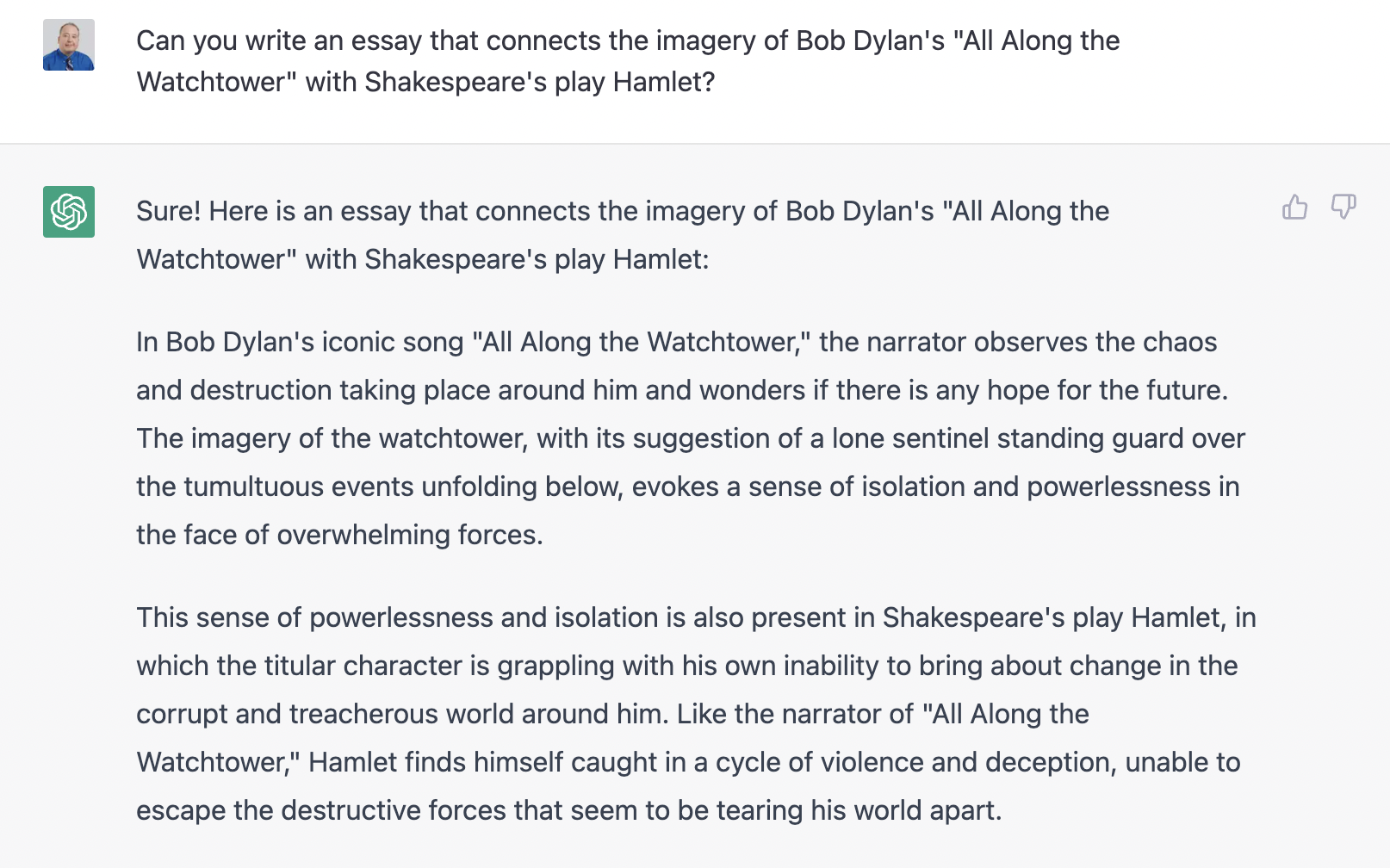
My wife wrote an essay back in high school where she compared Bob Dylan's "All Along the Watchtower" to Shakespeare's Hamlet.  A quick Google search resulted in no immediate hits of others writing such an essay.  Yet, when I gave the prompt to ChatGPT, I got the following within a few seconds:
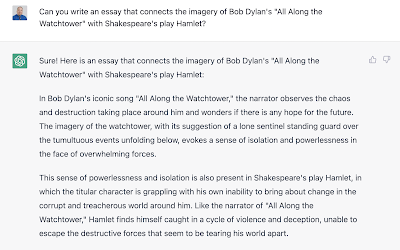
An excerpt (about two-thirds) of ChatGPT's original essay.

Next, I asked it to write a 12 line poem about dachshunds and Jedi Knights.  While it ignored my directions and wrote four extra lines, I was shocked to get a poem that dutifully blended both subjects in non-rhyming, narratively consistent verse:


Not Shakespearean, and certainly missing some compelling imagery, but I would have considered it okay if one of my freshmen had submitted it.  Still, I'm nitpicking about something game-changing here: ChatGPT wrote an original poem in seconds.  Even more amazing, ChatGPT made some independent artistic choices.  I didn't tell it to make the doxie a Jedi Knight, but by deciding to do so, it created a sense of whimsy.  Can a robot be whimsical?

The last example I will share goes to the heart of instruction.   I had heard of teachers using ChatGPT to write a lesson plan.  This will be kludgy and awful, I thought.  Especially if I load up my prompt with detailed specifics.  The generation of the text took longer than the other two examples -- maybe an entire ten seconds -- but once again, I could not stump the bot.


Again, far from perfect, and ignoring some of what I asked for in my prompt, but I was pretty much astounded that AI could earn its keep as my instructional collaborator. (For the entire text of this example lesson plan, click here to view as a Google Doc.). 

The implications of all of this seems clear if not outright ominous: if an AI tool today can now write essays and poems, how must that change how we teach and assess student writing?  If a bot today can write a lesson plan, how does that change or even threaten the teacher's job in the future (in both the metaphysical and literal sense of the word "job")?

It should be no surprise that much of the reaction to ChatGPT is somewhere between existential dread and anxiety.  This has already resulted in some traditional "arms race" approaches, such as fighting potential student (mis)use of ChatGPT with a tool to determine the potential that a submitted text was created by AI.  But is this sidestepping a bigger question? Recently in The Atlantic, Isabel Fattal and Derek Thompson discussed our potentially "wild future."  If an AI can write a college essay, maybe we should re-evaluate the purpose of a formulaic college essay in the first place. As Thompson posits, "Some people argue that ChatGPT could replace the college essay, and Ian [Bogust, another staff writer] is saying: That’s only because the college essay is dumb to begin with. It’s possible that lots of things in the economy are dumb in the way that the college essay is dumb. If that’s true, then GPT can still be revolutionary. What it does might be dumb, but it’s also incredibly useful." An AI that can write a lesson plan might be better seen not as a threat to what an educator can create, but instead be an "inspiration stimulant" (Thompson's phrase) that serves to improve what a final lesson plan might be.  

Earlier this fall, Corey Mohn, President and Executive Director of CAPS Network, had recommended to our Deeper Learning Team a book that was just published in 2021 --- Running with Robots: The American High School's Third Century by Greg Toppo and Jim Tracy.  (Corey had me at "Greg Toppo," as I've been a fan of his since 2018 when I first read one of his earlier books.)  When ChatGPT hit the headlines, I binge read the book, as it seemed eerily prescient to the current hot topic question of AI's impact on education.  At this highly charged inflection moment, where the need for transforming school is critical, I could not more highly recommend this book.  It's a fascinating and engaging blend of four narrative strands: an American public education history from the 1800's to the present; the impact and ramifications of recent AI developments with predictions on what is to come; a spotlight on four high schools operating today which serve as models on how school can and should be; and last but not least, a novelistic Rip Van Winkle utopian story where a principal falls asleep in 2020 and wakes up twenty years later visiting his radically changed school. 


For Toppo and Tracy, future AI should not be seen as the bleak robotic replacement of teachers and humanity itself, but instead a challenge we must acknowledge and address: "As a society, we need a 'pre-AI moment' -- that is, a systemic anticipatory response on a scale commensurate with a previous generation's 'post-Sputnik moment.' And, like the response after the fact of Sputnik in the 1950s, this should transpire as much in the realm of educational as in policy initiatives" (190).  But our "systemic anticipatory response" must recognize why prior educational initiatives have failed in the past:
[D]ecades of failed revolutions, of the "next big thing," of teaching machines and expensive technical marvels, have failed to transform a hidebound, nearly intractable system.  Revolutionizing education is neither wise nor feasible.  Rather, we must evolutionize education, seeking to forge the optimal synthesis of the best and most germane from the received tradition with the most promising of emergent pedagogical practice.  After all, the received traditions have been honed over millennia and have much that is fine and still relevant, while new educational paradigms are often faddish and ill-considered.  The careful sifting and selection is essential. (37, authors' italics)

We don't have to throw the traditional pedagogical baby out completely with the "hidebound" bathwater, but we certainly have to evolve our educational practices in light of our near-future technology and needs.

Toppo and Tracy point out an illustrative example that involves math instruction. By the 1970's, pocket calculators became cheap and commonplace enough that an average student could easily own one.   Technology offered us a chance to be a partner. This should have been a watershed moment for instruction, when math teachers began focusing at least as much (if not more!) time on mathematical practices -- on authentic practical application, on conceptional knowledge, on experiencing the aesthetic beauty of mathematical thinking -- rather than having students spend their time mindlessly plugging and chugging through memorized but ill-understood formulas.  However, even a half century later with the latest smartphones and laptops and AI apps, we still spend a disproportionate amount of time asking students to compute like, and compete with, a computer instead of thinking math like a human and collaborating math solutions with humans.   As the authors' fictional future principal puts it, "We humans are still pretty unique in our ability to make creative connections across apparently disparate knowledge areas....That's the value of omnidisciplinary literacy. The time that is freed up by not bringing every student to content fluency can be devoted instead to imbuing them with process fluency" (16, my italics).   In other words, have students spend less time regurgitating facts that you can Google and on skills rapidly being augmented or replaced by AI, and instead spend more time learning the critical human applications that truly matter that can't be easily supplanted by a robot.***

The idea that AI can actually be the savior of educators, education, learners, and learning and not its destroyer really goes to the heart of our current Deeper Learning work.  We pose questions such as "How might we reimagine the student experience to become more meaningful, relevant, and inspiring so that every learner is equipped for a successful future?" We know the answer is not more regurgitation of facts, more formulaic writing, more solving of inauthentic scenarios of two trains running toward each other on the same track.   We cannot have students spend years learning the "hidebound" traditions of the so-called fundamentals before they get a chance to "play the whole game," to use Jal Mehta's excellent Little League analogy.  We need more lessons that emphasize Profile of a Graduate competencies that lead to application of durable skills, which will likely be the last bastion of uniquely human cognition left in the decades to come.  If we hesitate to transform teaching now, AI may truly become humanity's rival instead of our partner in the future.

To take us back to our present ChatGPT dilemma for student writing, I offer three possibilities for teachers.

  • Lean into ChatGPT as an opportunity for a student to generate a first draft, provided the understanding is that the student revises that draft to further enrich and enlarge her/his thinking with additional detail and complexity.  The student should also do "reverse engineering research" to find, validate, and cite any facts or quotes given in ChatGPT's text. As a student requires feedback and shows examples of their subsequent drafts,  the student is responsible for being transparent about their writing process and is asked to reflect on how the paper evolved from ChatGPT's initial text to their own final product.
  • Create "mini-dissertation defense" opportunities where students must orally explain their writing to the teacher and/or peers.  A student that can metacognitively talk through their thinking is a person who can demonstrate how they, and not a computer, have demonstrated mastery.  Pose questions and inquiries like, "Where are you personally connected in the work?" or "Explain your use of metaphor here."  Of course, such oral opportunities also provide practice and proof of those Profile of a Graduate competencies such as effective communication. 
  • "Where's the epiphany?" If the expectation of the writing is to simply synthesize known facts into a narrative, tools like ChatGPT will continue to put the human 3.5 essay out of business.  Let's instead make the expectation of the writing be the creation of a new insight or invention, instead of a regurgitation of bullet points.  Consider ways to refine what your writing is asking for, such as the performance assessment criteria tool in my blog entry "From Good to Great, Initial to Ideal: A Way to Improve Exhibitions and Other Performance Assessments."

I'll end with a rallying cry from Toppo and Tracy:
So, if we want to help our young people thrive in a world of miraculous technology, we must forget the nouns -- the AI and robots and intelligence systems -- for these will always be changing.  We must focus instead on the verbs: What it is we trust our young people to do that we don't trust technology to do?  And how can we prepare them for this future?   
For starters, let's not give them robots' work.  Let's trust them to do better, harder, more rigorous, more interdisciplinary, high-stakes work -- and not just for the 10 percent, but for everyone.  We must expect more of young people, not only because the world will expect it of them but because they are begging us to do so. (70)
Let's teach our students to run with the robots, and not against them.


Some footnotes:
  
* Toppo and Tracy, pages 82-83.

** Toppo and Tracy, pages 201-203.

*** "For so many students, school is simply not demanding enough - and the dilemma, of course, doesn't begin in high school. When the Education Trust, a civil rights group that advocates for low-income and minority students, examined more than 1,800 math assignments given to middle school students in six urban, suburban, and rural school districts in 2018, it found that most of the assignments featured 'low cognitive demand,' overemphasized procedural skills and fluency, and provided little opportunity for students to communicate their mathematical thinking.  The problem was often worse in high-poverty schools" (Toppo and Tracy, page 70).  

Monday, November 7, 2022

Book Spotlight: Reinventing Project-Based Learning


I mentioned back in the summer that I had purchased Reinventing Project-Based Learning: Your Field Guide to Real-World Projects in the Digital Age by Suzie Boss and Jane Krauss (ISTE, 2018, 3rd Edition), a book I recently finished reading.   The edtech angle implied in the title definitely was my initial hook for buying it (and it is useful providing tools and strategy in this area throughout), but I was quickly thankful for a much bigger picture on PBL; Reinventing Project-Based Learning helps me achieve ways to do just that.  While spending the last few months settling into my role as a Deeper Learning Design Specialist, I was glad to have the text as a companion.  Effective PBL is certainly not the only pathway to deeper learning outcomes, but it is undoubtedly a popular one, so Boss and Krauss's insights are invaluable in how to make project-based learning more impactful and manageable.  While Reinventing Project-Based Learning is highly recommended from stem to stern, I wanted to share some of my personal highlights from the book in this Edtech Elixirs blog entry.

High Quality Project-Based Learning (HQPBL)

While I knew PBLWorks's "Gold Standard" design elements for PBL, I had either not heard of or don't remember the HQPBL Framework until reading this book (pages 18-20).  (I should point out that PBLWorks was one of many partners that helped shape the HQPBL Framework.)

The six criteria for HQPBL are:

  • Intellectual Change and Accomplishment.  "Projects should not just be 'fun activities' or 'hands-on experiences' requiring minimal intellectual effort. ... To complete a project successfully, students need to learn important academic content, concepts, and skills." I appreciate the emphasis on complexity, while also pointing out that PBL should not be just fluffy and devoid of academic rigor.
  • Authenticity.  "[D]o students engage in work that makes an impact on or otherwise connects to the world beyond school, and to their personal interests and concerns?"  The key word here is and:  a good PBL should both impact others outside of the four walls of the classroom while also connecting to student passions.  When asked, a student should be able to answer the question Why does this PBL matter to you?
  • Public Product.  A culminating event where the product is published or presented is an oft-cited hallmark of PBL.  However, the importance of sharing the project not just at the end but throughout is also key: "In a high quality project, students make their work public by sharing it not only with the teacher but also with each other, experts, and other people beyond the classroom. This occurs both during a project, as part of the product development and formative assessment process and at its conclusion, when the product is shared and discussed with an audience." I also discuss the shift in thinking about "experts" as well as the need for continuous formative assessment later in this blog entry.
  • Collaboration.   As the Framework reminds us, collaboration "does not mean simply dividing up project tasks, completing them individually, then putting it all together at the end with no synthesis or discussion." In my early teaching, I often mistook and misassessed the equivalent of "parallel play" as effective student groupwork. Students merely working side by side is not enough to prove evidence of effective collaboration!  Model and scaffold collaboration for students, and help teach the skill if necessary. 
  • Project Management.  While a teacher may initially need to model for, guide and facilitate the students in "manag[ing their] time, tasks and resources efficiently," the goal is that students are eventually doing this for themselves.
  • Reflection.  Again, this is not just something for students to do after the project is published. They should "pause regularly—not just at the end of the project, but throughout the process—to think about what they are doing and learning."

The Framework PDF may only be six pages, but it repeatedly provokes thought on how to improve PBL (as some of the above quotes hopefully attest to), and is well worth the read.   To be honest, I like this Framework more than the Gold Standard of PBLWorks; as it states in the Framework's introduction, while many "models and guidelines have been created" for PBL, they are "typically written from the perspective of the teacher." In contrast, the HQPBL Framework "describes PBL in terms of the student experience."  As a person who is trying to help others envision a better, richer student classroom experience, I appreciate this focus.

Transforming Questions

Another route to deeper learning is Inquiry-Based Learning.  It is not surprising that the idea of asking good questions and a student-centered approach to seeking out content is also a part of transformative PBL.   Boss and Krauss remind us to keep the PBL's outcome in mind, and that asking questions can be part of a great hook to start the PBL.  In the chapter section of the book titled "Promote Inquiry and Deep Learning" (175-178), they use an example of an instructional unit on money to show how to transform closed questions that have a narrow or single answer ("What is money made of?") to more open, driving questions "transformed for deeper inquiry" (such as "How would you analyze coins to learn what they are made of?" or "Is the process of making coins and paper money the same everywhere?").

The Need for Formative Assessments All Along the Way

In my opinion, the biggest difficulty for teachers is how to properly facilitate the long middle portion of the PBL journey.  They may have a great driving question or event to kick it off, and have a solid idea for how to publish and present the end product, but it's the plan to check in on student progress (both in progressing to meet deadlines as well as progress toward mastering the academics) where teachers often get stuck.  Boss and Krauss really shine in this area of support. Table 5.2 "Assessment Options" (131-136), which details formative assessment options during PBL, is alone worth the price of the book.  The table has columns for "Teacher Activities," "Questions," "Assessment Options (means of finding out)," and "Teacher Response"; the rows give examples when to do this, from "During Planning and Preparation" through "Presentation of Project Work." 

Fieldwork versus Field Trips

I've written before about the impact of place-based learning.  Boss and Krauss remind us how place-based learning can be a powerful component of successful PBL as well (212-213).  Firstly, it's a matter of inverting the notion of a class field trip as the "dessert" that may happen at the end of a unit or school year (if there's time, and if everyone pays the fee).  Instead, why not make such a field trip a crucial component at the start or middle of a PBL?  This allows students to do authentic field work, gathering data and ideas.  For example, a visit to a museum may elicit inquiry beyond content and fact collection (149).  How does the docent talk? How are exhibits constructed? How can an unplanned event or discovery trigger a new inquiry?  If you can let go and have the students be the ones to drive learning, you can create a great start to personally driven PBL: "[S]ome of the best learning experiences unfold when teachers are comfortable asking, 'Where will the environment take us on this particular day?' "  (149)

Be Creative in Finding "Experts"

Teachers may consider experts as panel members to make up the audience that students will present their final project to, but Boss and Krauss remind us that it is equally important to consider experts during the PBL as well, in order to provide formative assessment feedback as well as content resources.  But we also must make the idea of "experts" more elastic.  The potential expertise of parents also has to be considered and included (146-148).   How might a teacher, at the start of the year, survey parents to determine their professions, hobbies, availability, willingness to help? (Of course, this should be done with the utmost respect and dignity, with a clear asset mindset that any parent can bring value to the classroom.)  We should also utilize school or district work-based coaches, internship coordinators, and CTE pathway directors who have connections to the community workforce to help create not only partnership for PBL expertise, but potential place-based learning opportunities, or panelists for Defenses of Learning.  


One final humorous note.  As I neared the end of the book, I almost fell off of my couch when I read Carmen Coleman's name (page 246)!  Boss and Krauss quote her from a PBS NewsHour story in 2013, when she was the Superintendent of Danville Independent Schools and an early proponent of PBL.  (It turns out that Carmen was equally surprised and unaware of the mention!) There's nothing like seeing your OVEC Deeper Learning Team leader show up in a best seller to make you proud of your opportunity to work alongside such educational innovators.    


What other PBL books have you found helpful in your educational journey?  Share in the Comments below!


Thursday, July 7, 2022

ISTE 2022

 My first trip to an ISTE (International Society for Technology in Education) conference was to San Diego a decade ago.   I was still a classroom teacher at the time, hungry for digital tools and strategies; to put the trip in historical edtech context, iPads were only two years old when I went to that first ISTE!  Unfortunately, I haven’t been to an ISTE conference since then…so I was extremely grateful for the opportunity to go (along with some SCPS teachers, and 14,000 others!) to this year’s ISTE conference in New Orleans.  It did not disappoint!  


Briefly, here are some of my personal highlights.

EEEASE into an “Explore Board”

Holly Clark may promise a lot with a session name like “The Perfect Blended Lesson,” but if anyone can come close to that ideal, it’s likely her.  One aspect I found particularly illuminating was her distinction between a “Choice Board” and what she felt was a better branded “Explore Board.”  An Explore Board is a hyperdoc carefully constructed with a pedagogical purpose, infusing digital tools; a Choice Board is often only a “tic tac toe”-style worksheet that asks the student to complete tasks that are digital or analog.  (The presentation Slides linked above have some templates and examples of Explore Boards.)

After the session, I reflected on Clark’s defined features of an Explore Board along with what I already knew about effective digital pedagogy.  I then made an acronym (because we all agree that education needs another one!):  EEEASE.  While this list of key characteristics certainly can specifically apply to essential aspects of an Explore Board, they could also apply to a well made blended learning lesson in general:

  • Engage the audience (the “hook”).
  • The students should Explore the topic to build schema, within a digital resource framework of “bumper rails” provided by the teacher. 
  • Explain what you want the students to do: the directions and step-by-step of the task(s), the desired outcomes, and possibly a rubric.
  • Students should Apply what they have learned or what they can do.  Optimally, the type of final product that demonstrates the learning is the choice of the student.
  • Students should digitally Share or publish their work (outside of the classroom when possible) or reflect/self-assess on what they have done; ideally, they will do both!
  • Offer a way to meaningfully Extend the learning for those that need more help or complete the work early.


STLP Gets a Shoutout! 

On the second day’s opening session, a panel of students shared their insights….and Luke from Trimble County was one of them!   He particularly praised Kentucky’s STLP Program as a crucial learning opportunity that he personally enjoyed and benefited from.  


LeVar Burton

Whether you know him from Roots or Star Trek: The Next Generation or Reading Rainbow, LeVar Burton has been at the forefront of culture and education for decades.  Recently, he’s joined forces with BYJU'S (the parent company of Osmo) as their new Chief Reading Officer in order to create a new literacy app that’s about to launch, so ISTE became an opportunity to talk edtech and his life journey in an hour-long interview conducted by Donnie Piercey.   To sit in the front row of Burton’s talk will be a wonderful lifelong memory for me.


Learning and Practicing SEL in Virtual Reality

I found out about Project VOISS, a combination VR platform and lesson resource site where students can interact in a virtual school, practicing their choice of responses in various social emotional learning scenarios and seeing the consequences of those choices.  I’ve been intrigued by virtual reality learning for years, but admittedly the hardware requirements can sometimes be limiting (for example, the need for headsets); I was impressed that VOISS will work on Chromebooks.  They are currently seeking district and school partners to expand its platform usage. 

New Book

As a fan of PBL, I was excited to pick up a copy of Suzie Boss and Jane Krauss’s Reinventing Project-Based Learning (Third Edition) at ISTE’s onsite conference store.  It already looks promising to provide some insights for my district leadership in the coming school year.


Thank you to ISTE for facilitating such an inspiring and learning-packed conference!


Tuesday, February 22, 2022

Edtech and preK-8 Literacy: A Template to Help with Deeper, Intentional Integration

If you are an educator who is wrestling with improving preK-8 student literacy, you likely are already very familiar with Irene C. Fountas and Gay Su Pinnell.  As their Twitter profile summarizes, they are "authors of books, videos, & websites that are considered standards in the fields of literacy and professional development."  Besides a very helpful website full of resources, they have also created a preK-8 Literacy Continuum published in a popular book, most recently given an expanded edition in 2016.

As a former high school English teacher with limited foundational elementary reading and writing instructional expertise, I have to admit that I did not have a deep knowledge of Fountas and Pinnell until Jill Brookman, our district Literacy Coach, met with me to discuss their Literacy Continuum book -- in particular, an intriguing part of the book that details their "Technological Communication Continuum."  (The entire book and its extensive Literacy Continuum has proven very effective in helping Ms. Brookman coach our teachers in improving their instructional pedagogy.) As the authors explain, the literacy of learners today is much more expansive than just engaging in printed text.  Students must also demonstrate their computer literacy (the use of various devices to "create documents, find information, and communicate with others"), online reading and information literacy (comprehending, as well as critically evaluating, such text), and composing and publishing digital texts (which in a multimedia world is much more complex than simply typing a story in a word processing program!) (pp. 346-347).   With such digital communication in mind, Fountas and Pinnell put their preK-8 Technological Communication in a continuum as a progressive set of standards, or in their parlance, "goals" to select.  These student "behaviors and understandings to notice, teach and support" are organized into two categories for each grade level: Digital and Media Literacy (reading, or the consuming of electronic text) and Communication and Publishing (writing, or the creation of electronic text) (pp. 348-356).

Ms. Brookman knows I am constantly looking for ways to more authentically connect learning objectives to technology integration.  (A recent example: how I crosswalked edtech with competency-based design principles, as featured in Eliot Levine's July 2021 CompetencyWorks blog entry.)   So she posed a challenge.  Using the Technological Communication Continuum standards, could I describe how a specific edtech tool could exemplify high rigor literacy?  Would these standards help me articulate how you can integrate edtech with greater intentionality in a teacher's lessons plans to invoke deeper student learning?

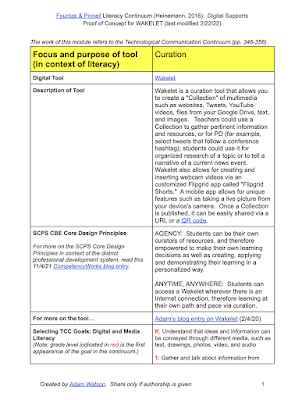
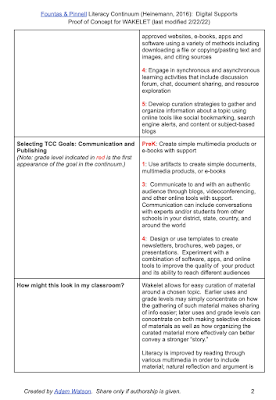
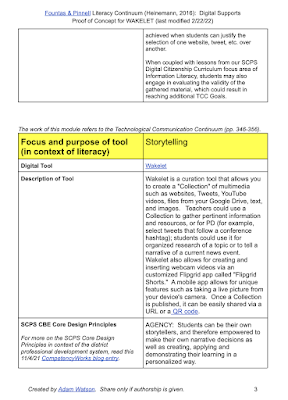
Challenge accepted!  As a proof of concept, I used Wakelet (a wonderful tool I previously discussed here) as my prototype modules; Wakelet is a natural fit for curating resources (reading) as well as storytelling (writing).  These two modules were organized around a template I created with several sections, such as:

  • Description of Tool.  Explaining briefly what the edtech tool is, and how it works.
  • SCPS CBE Core Design Principles.  How does the tool align with our district's competency-based education beliefs what is best for learners, such as supporting student "Agency" or "Anytime, Anywhere" learning?  (These Principles were adapted from Aurora Institute's updated 2019 definition of CBE, explained here.)
  • Selecting TCC [Technological Communication Continuum] Goals: Digital and Media Literacy.  What reading or media consumption Continuum goals does the tool best achieve?  The grade level where the goal is first stated in the continuum is highlighted.
  •  Selecting TCC [Technological Communication Continuum] Goals: Communication and Publishing.  What writing or media creation Continuum goals does the tool best achieve?  Again, the grade level where the goal is first stated in the continuum is highlighted.
  • How might this look in my classroom?  Further detailed explanations and concrete examples of how the intentional usage of the edtech tool helps further literacy. 

Both modules for Wakelet are together and viewable in the PDF linked here. You can also see screenshots of the first three pages of the document below, with the focus on using Wakelet for curation:


Besides Wakelet, there are certainly other worthy edtech tools that can go hand in hand with exemplifying these Fountas and Pinnell Technological Communication Continuum literacy standards.  I encourage others to use the template above to do so, and articulate their own deeper, richer synthesis of intentional edtech with more effective literacy instruction.  And I thank Jill Brookman for introducing me to the highly illuminating Literacy Continuum book!


Wednesday, January 26, 2022

From Good to Great, Initial to Ideal: A Way to Improve Exhibitions and Other Performance Assessments

When our district began its journey into competency-based education (CBE), one of the significant early steps was the publication of our Profile of a Graduate (PoG) in 2017.  The Profile was crucial in developing our current Strategic Leadership Plan for 2018-2022, where Personalized Learning is the top strand.  "Embedded Performance Assessments" -- demonstrated applications of student knowledge intentionally timed at key points of a student's learning path -- is a feature mentioned throughout that strand, and one of our frequent examples of such an assessment is student exhibitions: a culminating celebratory event where they can "show what they know," often with the attendance of parents and community members as an audience.

From a certain perspective, student exhibitions are not new.  Indeed, if the phrase conjures up images of a junior high science fair with trifold presentation boards, homemade dioramas and solar system mobiles, or perhaps cute elementary students dressed up as famous people for a living wax museum, you would be forgiven. But there is a difference when defining exhibitions in the context of CBE or as a high quality performance assessment.  Features of such an exhibition would include the instructional intentionality in how they are designed and assigned by teachers, the agency of the students behind them, and the depth of the mastery of learning the exhibition can demonstrate.  Furthermore, if your objectives from student exhibitions include students producing rich artifacts of learning and having some practice runs leading up to a rigorous Defense of Learning performance summative assessment -- more on both of these later -- it is imperative that students exhibit and exhibit often.  

For a further exploration and explanation of the power of student exhibitions, watch this short video (2:14) from High Tech High:


Our district was not naive about what it would take to achieve these richer and deeper exhibition experiences.  Teachers needed to learn strategies and see good models for student-centered learning; students could not become empowered, confident, and self-directed overnight.   However, one of the wisest moves from our leadership was to encourage our teachers, and by extension students, to just try.   We knew that some of our earliest exhibitions would be rough and wouldn't look much different than those old fashioned science expos with the trifold presentation boards, but we had to start somewhere, so we could baseline, learn, and improve.  While we are still (and should always be!) "becoming" and improving, we can use the integration of our Profile of a Graduate as an example of how exhibitions have deepened and gotten better.  At first, students may have been asked to reflect on a Profile competency or two at the very end of the process, if at all, perhaps as an afterthought ("Reflect on which PoG competency you think this exhibition best exemplifies").  But then we developed single-point rubrics to measure whether the student met the competency . . . teachers began developing exhibitions with an intentional focus on a PoG competency made clear to the student from the start . . . and we are in the process of launching four point mastery scales on the PoG competencies to better assess the student's "performance."

The launch of the Profile of a Graduate five years ago certainly gave us a new "why" for student exhibitions and a way to deepen and better measure student learning. But looking back and looking forward, what if we had a tool or a more insightful lens to look at performance assessment more effectively?  

This is where an excellent book enters stage left: Deeper Competency-Based Learning: Making Equitable, Student-Centered, Sustainable Shifts by Karin Hess, Rose Colby, and Daniel Joseph (Corwin, 2020).  I'm halfway through reading it as an anchor text for my chosen SCPS PD strand this year, and in full disclosure (and to my delight), Rose Colby also joins Shelby County periodically to virtually lead workshop sessions on CBE for myself and other CBE strand learners.**   Deeper Competency-Based Learning is dense in the best sense of the term, full of CBE shift strategies, rubrics, and metrics to measure where you are in competency-based education and where you want to be.

In their chapter "Making Shifts in Teaching and Learning Structures," the authors share a table of criteria types to plan performance assessments (Table 3.6, page 94).  The criterion types, example questions typically answered by each type, and the Depth of Knowledge (DOK) one would usually expect for each type, are as follows:

  • Process: "Will the student follow particular processes (e.g. procedures for a science investigation; data collection; validating credibility of sources)?" [DOK 2]
  • Form: "Are there formats or rules to be applied (e.g. correct citation format, organize parts of lab report; use camera shots/visuals; edit for grammar and usage)?" [DOK 1]
  • Accuracy of Content: "List essential domain-specific terms, calculations, concepts, or principles to be applied." [DOK 1 or 2]
  • Construction of New Knowledge: "How will the student go beyond the accurate solution and correct processes to gain new insights and raise new questions? Are there any personal success skills that might also be employed?" [DOK 3 or 4]
  • Impact:  "How will the final product achieve its intended purpose (e.g. solve a complex problem; persuade the audience; synthesize information to create a new product/performance)?" [DOK 3 or 4]

The authors point out that "[a]ll rubric criteria do not need to be included for every summative assessment, but they should [all] be considered during the design phase," with a particular emphasis on Construction of New Knowledge and Impact for performance assessments that are to truly assess deeper learning (94).  Furthermore, these criteria are an excellent first step for either designing a new performance assessment or analyzing an existing one. Additional steps include considering an authentic context for application, identifying a proper format for such a demonstration, determining how much students will have voice and choice in the process or product, and last but not least, identifying and aligning success criteria to the task (94-95).

All of this brings us back to student exhibitions.  Even as many exhibition examples in our district often had a "good" quality to them, I struggled to articulate feedback in what could make them "great."  One thing I realized early on was the need to present an original idea, rather than just a regurgitation of what others have said or done, no matter how well it is packaged or communicated.  Put another way when I was discussing project-based learning in a previous blog entry: "It is not transformative learning if the end result...is merely a well presented aggregation of researched bullet points instead of a new idea or creation that shows real reflection and growth of student thinking."  (Note also that the word choice of the criterion Impact, as well as its definition, can strongly suggest how a well designed PBL can end in a high DOK performance assessment that "impacts" the community outside of the four walls of a school.)

It was this insightful criteria from Deeper Competency-Based Learning that illuminated how I could improve the way I evaluate and give feedback on performance assessment.   Firstly, as the authors point out, there is nothing inherently wrong with a performance assessment that only remains at the level of Process, Form, and/or Accuracy of Content (and by extension, at DOK 1 or 2).  I will label these as Initial performance assessments. Depending on the intentionality of the lesson/unit design, this might very well be instructionally sound -- for example, perhaps the competency is only being introduced and full mastery would not be expected.  The issue is when a teacher either stays at the Initial level for all such assessments for the entire course, or worse, misinterprets a performance assessment best designed only for these lower levels as a demonstration of mastery.   For a performance assessment to truly apply a student's knowledge with depth, the student should "gain new insights," "raise new questions," "employ personal skills" (like the ones from our Profile of a Graduate!), "solve a complex problem," "persuade an audience," and/or "synthesize information to create a new product or performance."  I would label these Construction of New Knowledge and Impact performance assessments as Ideal, especially if a student's mastery of learning (with a task at DOK of 3 or 4) is your goal.

This concept of Initial and Ideal can be further applied to other semantic aspects of teaching and assessment, as we transition from the traditional to the transformational.  For example, an Initial "folder" might contain artifacts selected by the student, but the wording shows a limited goal; it may be more concerned with being a container of student work, rather than with the depth of the work contained, and an emphasis on an end product rather than an ongoing process.  An Ideal "portfolio," on the other hand, can suggest a living collection ever changing, expanding, and improving over time; a perpetual artifact curation that should spur a student on to continually reflect on their growth academically and personally.   While this process of a portfolio may eventually culminate in a Defense of Learning -- a type of performance assessment where the student draws on their body of work to present as evidence of mastery (say, once a student is ready to complete their senior year) -- the day of the defense where a student stands in front of an audience should "Ideally" not overshadow the months and years leading up to the event.  Conversely, if the day of defense is a performance assessment that consists only of a student compliantly marching through a showcase of past work ---  in the parlance of the Process/Form/Accuracy of Content criteria, the student is merely following a process, applying formulas and rules, or listing definitions  --  this "Initial" kind of performance could silently be replaced by a single slide with a bulleted inventory or a one page table of contents and not skip a beat.

From Initial to Ideal (whether it be exhibitions specifically or performance assessments in general) and from good to great is not just a straightforward journey but a non-linear learning path that may circle back and then turn forward again over time.  The secret, as it is with many things in competency-based learning, is to do the journey with as much intentionality, reflection and metacognition as possible, with the aspiration to always go deeper. 


** For further reading on Shelby County's professional development personalized learning plan led by our Staff Developer Tracy Huelsman, please read Eliot Levine's CompetencyWorks 11/4/21 blog entry profiling her work

Wednesday, November 18, 2020

Concurrent and NTI Classrooms: Tips and Resources

 Like nearly all districts in the world right now, our instructional classroom model has to remain, to put it mildly, flexible.  We began the school year with non-traditional instruction (NTI) with students at home. We then gave students the option of "@Home" or "@School." In some schools, the numbers of these two categories allowed a teacher to teach only virtual students while another teacher taught only the students in person.  However, the reality is that the proportionality of student numbers often made such binary choices impossible, combined with the fact that a temporary quarantining of an entire classroom or athletic team made such numbers at best a moving target.  More often than not, our staff have had to adapt to a new concurrent model of blended learning, teaching a roster of both @Home and @School students synchronously and asynchronously.  And as of this posting, our state governor has mandated NTI to begin for all secondary Kentucky schools next week and will last until at least the end of the year (and elementary schools until at least December 7).

As educators, we are all leaning on each other to thrive and progress forward in such challenging times.

School leaders have been generous to share their thoughts, advice and expertise about teaching during a pandemic in nearly real time.  The humble purpose of this entry is to throw my own hat into that ring, and to share some of our district resources as well.

Firstly, here are my top 5 tips to consider when planning for edtech in concurrent and NTI classrooms:

1. Reflect on your "learning hub" (Google Classroom, Bitmoji Classroom, learning management system [Edmodo, Schoology, Empower, etc.], website page) through the lens of your student and your parents.  Get feedback from a non-educator spouse, relative, friend.  Is it:

  • easy to find?
  • consistently used?
  • simple to navigate?
2. When using a digital tool, evaluate it through an appropriate lens.  For example:
  • Consider your mission, vision, core values.  How does the digital tool integrate with what you believe is important for student learning? For example, we have recently drafted SCPS CBE Core Design Principles, and our district page with highlighted/recommended edtech now makes concrete linkage to how these tools connect to such principles.
  • Where does its usage fall in the SAMR framework?
  • Think of the tool via functions of engagement, a phrase I learned from the very useful and recently published The Digital Learning Playbook (Fisher, Frey, and Hattie, pages 104-111).  For example, does the tool involve finding, using, creating or sharing information? Will it enable opportunities for self-directed inquiry or for robust peer-to-peer discussions?
3. Avoid digital tool fatigue not only for yourself, but especially your students and parents.
  • Always remember your academic objective. If a student must spend more time learning how to navigate and use the tool rather than learning and applying content, reconsider your choice.
  • Start simple and slow.  Better to use three tools deeply all year long than three dozen superficially in a month.
  • Vet every tool beforehand as much as possible from a student's perspective before implementing it in a lesson plan.  A third grader may use it differently (or have different challenges) than a sophomore in high school.   From the hardware perspective, will it work on the student's device? Is the site unblocked on the district's network?
4.  Always make a backup plan.   At some point, things will inevitably not work for some, if not all, of your students.  How will they ask for help?  What should they do instead if there is an issue or delay?

5.  Concurrent doesn't always have to be digital work.  Analog work is not only okay, but recommended occasionally for a change of pace.  If you can plan a weekly system for students and parents to pick up physical math manipulatives, photocopied work kits, etc. at your school location, do so and communicate accordingly.

Secondly, with the generous help of our Staff Developer Tracy Huelsman, our Instructional Coaches, our technicians, and our teacher leaders, we have created a Shelby County Public Schools "Concurrent Classroom and @Home Dashboard Doc."  This is not only a curation of various outside resources but a collection of internal ones as well, including videos/screencasts made by our staff that highlight their innovation and solutions to make concurrent classrooms effective.   (Note that while most of the hyperlinked resources are open and helpful to all, some doc access may be limited to our SCPS domain or specifically apply to SCPS needs.)

Here is a video I made to briefly highlight the Dashboard Doc (7:05):


Last but not least, here are some other resources I've created.

This is a screencast video about the opportunity for students to take Virtual Field Trips that I made during last spring's NTI (38:16):

Here are some blog entries from the past year that may help:

"Nearpod, SAMR, and Transitional Pedagogy" (9/3/19; may be helpful to put NTI and Concurrent Classrooms in the context of transformational teaching and deeper learning edtech integration)

"NTI Resources, Virtual Field Trips, and a Deep Breath" (3/26/20)

"New Vodcast Series for Educator Reflection During NTI" (5/4/20)

"Google Tips and Tricks: Greatest Hits Collection" (9/8/20)

"Mote and ClassroomQ for Feedback, Discourse, and Classroom Management" (10/12/20)


Keep your heads up, show each other grace, and pace yourself as you persevere through this transformative, innovative work!


Sunday, July 26, 2020

Book Spotlight: Power Up Blended Learning

Digital learning coaching has been weighing heavily on my mind.   I don't think it is controversial to say that last spring has taught all educators the importance of blended learning, so whether it's help in integrating the tools or the actual best practice pedagogy, digital learning coaches are more important than ever for schools and districts.  Kentucky's Digital Learning Coaches had their first official conference last month (virtual of course).  Thanks to Laura Raganas's organization, last school year was the launch of a new cohort opportunity for us to meet and learn, both in person and via our hashtag #KYDLC.   Under the generous sponsorship of KET Education, conference attendees received a fantastic package:
One of the books in the box, and the first I grabbed to read cover to cover, was Catlin R. Tucker's Power Up Blended Learning: A Professional Learning Infrastructure to Support Sustainable Change.   (Tucker also provided a virtual keynote address for our KYDLC conference.) The "sustainable change" part of the subtitle was something that particularly struck me, because that is the hardest part to achieve.  Even if you prioritize the budget to get 1:1 student devices, the act of transforming teaching with technology is a legacy mindset that cannot be accomplished in a "one and done" summer PD.  In a bigger sense, the book is an excellent guide for a person still needing to grow in the role of a  digital learning coach (or in the parlance of Tucker, a "blended learning coach"), and I include myself in that category!

Here are some of my personal key takeaways and highlights from Tucker's book:

  • Start with the Why.  Tucker actually refers to Simon Sinek and his "Golden Circle" here, but her connection to integrating tech for lasting change is important: "If leaders are clear about their why, teachers are more likely to buy in and take risks" (3, author's italics). The why should then drive your how (how do you accomplish your why?) and ultimately your what (what do you produce?).   I have been guilty teaching tech from the opposite direction in the past: I started with the what a tool did, then how to use it, and if I was lucky, glossed over why using the tool mattered in the first place.  This might work for a perfunctory one day PD, but it is not effective for lasting, sustainable tech integration that should parallel your school or district's pedagogical beliefs.  To paraphrase Sinek, if the digital tool does not meet "an organization's purpose," one should reconsider using it.  Why does your district or school's beliefs need blended learning in the first place?  Answer that, and the right tools and digital platforms should naturally follow.
  • Explain It, See It, Discuss It, Try It.  While Tucker details this as a "simple approach to professional learning" (36), I would argue that what seems simple and obvious is not always what is followed by PD facilitators.  "Explaining it" starts, unsurprisingly, with why a teacher would want to use a specific strategy or tool in the first place. Next, you need to model its usage in order to make the abstract into the concrete.  Teachers (like all learners) then must talk about it in order to reflect how the tool or strategy can apply to their own classrooms, changing their pre-lesson/PD schema by making meaningful, relevant connections.  Lastly, knowledge without application is an empty exercise: teachers need to try the tool/strategy out on their own.  This might occur live at the end of the PD (for example, making their own Screencastify video after learning about the tool), but ideally, it would be later with actual students in an actual lesson when a coach or colleagues could observe and/or analyze data, then give feedback.
  • Effective coaching for blended learning must be individualized, intensive, sustained, context-specific, and focused.  Tucker goes into excellent detail on each of these points (45-47), but in particular, I want to highlight how she acknowledges that a "kickoff" PD in a whole-group setting is pragmatically a likely beginning of the coaching process.  It is what happens after the kickoff that makes the difference: "The blended learning coach must take the spark created in the whole group training or all-staff professional development day and keep it alive with individualized, intensive, context-specific, and focused professional learning" (47, my italics).  You need a spark to light a campfire, but you need constant kindling and tending to the flame to keep it going.  No matter how charismatic or inspiring the summer PD facilitator might be, it takes a "boots on the ground" approach with coaching staff over the months and years to make the professional learning meaningful and long-lasting.
  • Coaching must be a partnership.  Tucker highlights Jim Knight's "seven partnership principles":   equality, choice, voice, reflection, dialogue, praxis (application), and reciprocity (coaches must be willing to learn too!) (68-69).   I have to say that I have likely underestimated some of the dialogue necessary for good coaching relationships, especially at the beginning of coaching cycles.  Tucker does a great job of detailing the "power of dialogic interviews" and even provides a useful download template for the process (58-59).
  • When a coach is showcasing a blended learning model, consider your learning purpose.  A blended learning coach may be asked, for the sake of a whole group or on a one-on-one basis, to create a lesson that highlights a blended learning model (station rotation, flipped, etc.).   However, Tucker offers some simple but very illuminating questions that coaches should ask themselves (111):
    • Can I highlight a slightly different approach that will push teachers to expand their approach?
    • Can I use technology to foster collaboration and get kids working together?
    • Do my activities feel like work or play? (This might be my favorite!)
    • Will kids be excited to engage with the concepts and with each other?
  • Virtual coaching will work differently than in-person coaching.  While this may seem obvious, I welcome that Tucker offers her entire Chapter 11 to address this issue.  Considering the uncertainty that awaits us in the upcoming school year, this chapter alone makes the book invaluable!

As I close out my entry on powering up blended learning professional development, I should mention that Monica Wainscott (Beechwood Independent), Stella Pollard (Franklin County) and myself shared some perspective and resources about what student choice and personalization can look like in a post-NTI world at a recent virtual KyGoDigital conference.  (At Shelby and in many districts across the state, we are emphasizing that thanks to planning and reflection time, the fall's blended learning opportunities for students should look different than the "emergency" distance learning educators had to manage last spring.)  As Digital Learning Coaches/Coordinators, we were happy to showcase our roles in helping our districts in the educational frontier ahead of us.  Our half hour session is just after the Day 2 keynote (about 1 hour 6 minutes in), and our Slides are available here: