Tuesday, February 22, 2022

Edtech and preK-8 Literacy: A Template to Help with Deeper, Intentional Integration

If you are an educator who is wrestling with improving preK-8 student literacy, you likely are already very familiar with Irene C. Fountas and Gay Su Pinnell.  As their Twitter profile summarizes, they are "authors of books, videos, & websites that are considered standards in the fields of literacy and professional development."  Besides a very helpful website full of resources, they have also created a preK-8 Literacy Continuum published in a popular book, most recently given an expanded edition in 2016.

As a former high school English teacher with limited foundational elementary reading and writing instructional expertise, I have to admit that I did not have a deep knowledge of Fountas and Pinnell until Jill Brookman, our district Literacy Coach, met with me to discuss their Literacy Continuum book -- in particular, an intriguing part of the book that details their "Technological Communication Continuum."  (The entire book and its extensive Literacy Continuum has proven very effective in helping Ms. Brookman coach our teachers in improving their instructional pedagogy.) As the authors explain, the literacy of learners today is much more expansive than just engaging in printed text.  Students must also demonstrate their computer literacy (the use of various devices to "create documents, find information, and communicate with others"), online reading and information literacy (comprehending, as well as critically evaluating, such text), and composing and publishing digital texts (which in a multimedia world is much more complex than simply typing a story in a word processing program!) (pp. 346-347).   With such digital communication in mind, Fountas and Pinnell put their preK-8 Technological Communication in a continuum as a progressive set of standards, or in their parlance, "goals" to select.  These student "behaviors and understandings to notice, teach and support" are organized into two categories for each grade level: Digital and Media Literacy (reading, or the consuming of electronic text) and Communication and Publishing (writing, or the creation of electronic text) (pp. 348-356).

Ms. Brookman knows I am constantly looking for ways to more authentically connect learning objectives to technology integration.  (A recent example: how I crosswalked edtech with competency-based design principles, as featured in Eliot Levine's July 2021 CompetencyWorks blog entry.)   So she posed a challenge.  Using the Technological Communication Continuum standards, could I describe how a specific edtech tool could exemplify high rigor literacy?  Would these standards help me articulate how you can integrate edtech with greater intentionality in a teacher's lessons plans to invoke deeper student learning?

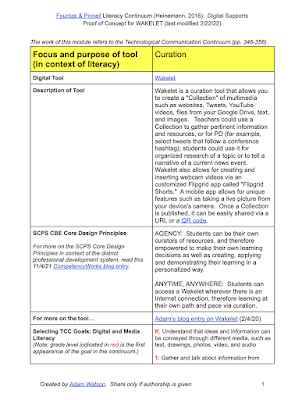
Challenge accepted!  As a proof of concept, I used Wakelet (a wonderful tool I previously discussed here) as my prototype modules; Wakelet is a natural fit for curating resources (reading) as well as storytelling (writing).  These two modules were organized around a template I created with several sections, such as:

  • Description of Tool.  Explaining briefly what the edtech tool is, and how it works.
  • SCPS CBE Core Design Principles.  How does the tool align with our district's competency-based education beliefs what is best for learners, such as supporting student "Agency" or "Anytime, Anywhere" learning?  (These Principles were adapted from Aurora Institute's updated 2019 definition of CBE, explained here.)
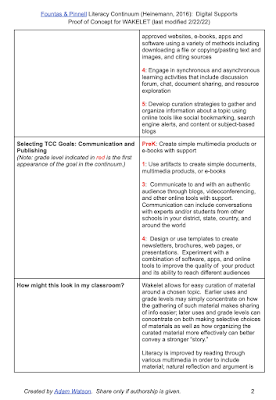
  • Selecting TCC [Technological Communication Continuum] Goals: Digital and Media Literacy.  What reading or media consumption Continuum goals does the tool best achieve?  The grade level where the goal is first stated in the continuum is highlighted.
  •  Selecting TCC [Technological Communication Continuum] Goals: Communication and Publishing.  What writing or media creation Continuum goals does the tool best achieve?  Again, the grade level where the goal is first stated in the continuum is highlighted.
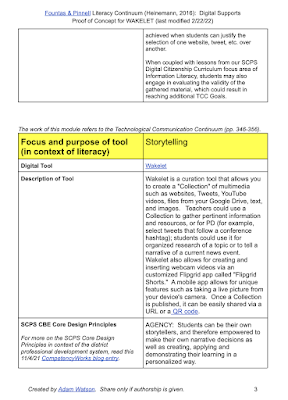
  • How might this look in my classroom?  Further detailed explanations and concrete examples of how the intentional usage of the edtech tool helps further literacy. 

Both modules for Wakelet are together and viewable in the PDF linked here. You can also see screenshots of the first three pages of the document below, with the focus on using Wakelet for curation:

Besides Wakelet, there are certainly other worthy edtech tools that can go hand in hand with exemplifying these Fountas and Pinnell Technological Communication Continuum literacy standards.  I encourage others to use the template above to do so, and articulate their own deeper, richer synthesis of intentional edtech with more effective literacy instruction.  And I thank Jill Brookman for introducing me to the highly illuminating Literacy Continuum book!


Wednesday, January 26, 2022

From Good to Great, Initial to Ideal: A Way to Improve Exhibitions and Other Performance Assessments

When our district began its journey into competency-based education (CBE), one of the significant early steps was the publication of our Profile of a Graduate (PoG) in 2017.  The Profile was crucial in developing our current Strategic Leadership Plan for 2018-2022, where Personalized Learning is the top strand.  "Embedded Performance Assessments" -- demonstrated applications of student knowledge intentionally timed at key points of a student's learning path -- is a feature mentioned throughout that strand, and one of our frequent examples of such an assessment is student exhibitions: a culminating celebratory event where they can "show what they know," often with the attendance of parents and community members as an audience.

From a certain perspective, student exhibitions are not new.  Indeed, if the phrase conjures up images of a junior high science fair with trifold presentation boards, homemade dioramas and solar system mobiles, or perhaps cute elementary students dressed up as famous people for a living wax museum, you would be forgiven. But there is a difference when defining exhibitions in the context of CBE or as a high quality performance assessment.  Features of such an exhibition would include the instructional intentionality in how they are designed and assigned by teachers, the agency of the students behind them, and the depth of the mastery of learning the exhibition can demonstrate.  Furthermore, if your objectives from student exhibitions include students producing rich artifacts of learning and having some practice runs leading up to a rigorous Defense of Learning performance summative assessment -- more on both of these later -- it is imperative that students exhibit and exhibit often.  

For a further exploration and explanation of the power of student exhibitions, watch this short video (2:14) from High Tech High:


Our district was not naive about what it would take to achieve these richer and deeper exhibition experiences.  Teachers needed to learn strategies and see good models for student-centered learning; students could not become empowered, confident, and self-directed overnight.   However, one of the wisest moves from our leadership was to encourage our teachers, and by extension students, to just try.   We knew that some of our earliest exhibitions would be rough and wouldn't look much different than those old fashioned science expos with the trifold presentation boards, but we had to start somewhere, so we could baseline, learn, and improve.  While we are still (and should always be!) "becoming" and improving, we can use the integration of our Profile of a Graduate as an example of how exhibitions have deepened and gotten better.  At first, students may have been asked to reflect on a Profile competency or two at the very end of the process, if at all, perhaps as an afterthought ("Reflect on which PoG competency you think this exhibition best exemplifies").  But then we developed single-point rubrics to measure whether the student met the competency . . . teachers began developing exhibitions with an intentional focus on a PoG competency made clear to the student from the start . . . and we are in the process of launching four point mastery scales on the PoG competencies to better assess the student's "performance."

The launch of the Profile of a Graduate five years ago certainly gave us a new "why" for student exhibitions and a way to deepen and better measure student learning. But looking back and looking forward, what if we had a tool or a more insightful lens to look at performance assessment more effectively?  

This is where an excellent book enters stage left: Deeper Competency-Based Learning: Making Equitable, Student-Centered, Sustainable Shifts by Karin Hess, Rose Colby, and Daniel Joseph (Corwin, 2020).  I'm halfway through reading it as an anchor text for my chosen SCPS PD strand this year, and in full disclosure (and to my delight), Rose Colby also joins Shelby County periodically to virtually lead workshop sessions on CBE for myself and other CBE strand learners.**   Deeper Competency-Based Learning is dense in the best sense of the term, full of CBE shift strategies, rubrics, and metrics to measure where you are in competency-based education and where you want to be.

In their chapter "Making Shifts in Teaching and Learning Structures," the authors share a table of criteria types to plan performance assessments (Table 3.6, page 94).  The criterion types, example questions typically answered by each type, and the Depth of Knowledge (DOK) one would usually expect for each type, are as follows:

  • Process: "Will the student follow particular processes (e.g. procedures for a science investigation; data collection; validating credibility of sources)?" [DOK 2]
  • Form: "Are there formats or rules to be applied (e.g. correct citation format, organize parts of lab report; use camera shots/visuals; edit for grammar and usage)?" [DOK 1]
  • Accuracy of Content: "List essential domain-specific terms, calculations, concepts, or principles to be applied." [DOK 1 or 2]
  • Construction of New Knowledge: "How will the student go beyond the accurate solution and correct processes to gain new insights and raise new questions? Are there any personal success skills that might also be employed?" [DOK 3 or 4]
  • Impact:  "How will the final product achieve its intended purpose (e.g. solve a complex problem; persuade the audience; synthesize information to create a new product/performance)?" [DOK 3 or 4]

The authors point out that "[a]ll rubric criteria do not need to be included for every summative assessment, but they should [all] be considered during the design phase," with a particular emphasis on Construction of New Knowledge and Impact for performance assessments that are to truly assess deeper learning (94).  Furthermore, these criteria are an excellent first step for either designing a new performance assessment or analyzing an existing one. Additional steps include considering an authentic context for application, identifying a proper format for such a demonstration, determining how much students will have voice and choice in the process or product, and last but not least, identifying and aligning success criteria to the task (94-95).

All of this brings us back to student exhibitions.  Even as many exhibition examples in our district often had a "good" quality to them, I struggled to articulate feedback in what could make them "great."  One thing I realized early on was the need to present an original idea, rather than just a regurgitation of what others have said or done, no matter how well it is packaged or communicated.  Put another way when I was discussing project-based learning in a previous blog entry: "It is not transformative learning if the end result...is merely a well presented aggregation of researched bullet points instead of a new idea or creation that shows real reflection and growth of student thinking."  (Note also that the word choice of the criterion Impact, as well as its definition, can strongly suggest how a well designed PBL can end in a high DOK performance assessment that "impacts" the community outside of the four walls of a school.)

It was this insightful criteria from Deeper Competency-Based Learning that illuminated how I could improve the way I evaluate and give feedback on performance assessment.   Firstly, as the authors point out, there is nothing inherently wrong with a performance assessment that only remains at the level of Process, Form, and/or Accuracy of Content (and by extension, at DOK 1 or 2).  I will label these as Initial performance assessments. Depending on the intentionality of the lesson/unit design, this might very well be instructionally sound -- for example, perhaps the competency is only being introduced and full mastery would not be expected.  The issue is when a teacher either stays at the Initial level for all such assessments for the entire course, or worse, misinterprets a performance assessment best designed only for these lower levels as a demonstration of mastery.   For a performance assessment to truly apply a student's knowledge with depth, the student should "gain new insights," "raise new questions," "employ personal skills" (like the ones from our Profile of a Graduate!), "solve a complex problem," "persuade an audience," and/or "synthesize information to create a new product or performance."  I would label these Construction of New Knowledge and Impact performance assessments as Ideal, especially if a student's mastery of learning (with a task at DOK of 3 or 4) is your goal.

This concept of Initial and Ideal can be further applied to other semantic aspects of teaching and assessment, as we transition from the traditional to the transformational.  For example, an Initial "folder" might contain artifacts selected by the student, but the wording shows a limited goal; it may be more concerned with being a container of student work, rather than with the depth of the work contained, and an emphasis on an end product rather than an ongoing process.  An Ideal "portfolio," on the other hand, can suggest a living collection ever changing, expanding, and improving over time; a perpetual artifact curation that should spur a student on to continually reflect on their growth academically and personally.   While this process of a portfolio may eventually culminate in a Defense of Learning -- a type of performance assessment where the student draws on their body of work to present as evidence of mastery (say, once a student is ready to complete their senior year) -- the day of the defense where a student stands in front of an audience should "Ideally" not overshadow the months and years leading up to the event.  Conversely, if the day of defense is a performance assessment that consists only of a student compliantly marching through a showcase of past work ---  in the parlance of the Process/Form/Accuracy of Content criteria, the student is merely following a process, applying formulas and rules, or listing definitions  --  this "Initial" kind of performance could silently be replaced by a single slide with a bulleted inventory or a one page table of contents and not skip a beat.

From Initial to Ideal (whether it be exhibitions specifically or performance assessments in general) and from good to great is not just a straightforward journey but a non-linear learning path that may circle back and then turn forward again over time.  The secret, as it is with many things in competency-based learning, is to do the journey with as much intentionality, reflection and metacognition as possible, with the aspiration to always go deeper. 


** For further reading on Shelby County's professional development personalized learning plan led by our Staff Developer Tracy Huelsman, please read Eliot Levine's CompetencyWorks 11/4/21 blog entry profiling her work

Friday, January 21, 2022

Share Fair 2022 Tickets Now Available!

Our seventh annual Share Fair (#SCsharefair) will be on SATURDAY, February 26, 2022!  (Nope, Saturday is not a typo.) This FREE professional development conference, which is also open to educators outside of Shelby County, will have sessions on edtech as well as competency-based education successes and strategies.


Not familiar with Share Fair, or how it is a unique opportunity to learn and grow?  The Share Fair website  is chock full of resources.   Check out our Frequently Asked Questions (recommended for first-timers in order to understand the conference structure), Multimedia (pictures and video from previous Share Fairs), and an Archive for press clippings and past presenters/sessions.  In order to register for your free tickets, check out the site's Event page


We have a few "firsts" to celebrate!
  • The Share Fair will be on a Saturday morning.  We are hoping this gives attendees an easier time to come instead of at the end of a school day as we've had it in years past.  (Plus, friends in districts who have to drive a little further have a better opportunity to attend.)
  • We will be having some door prizes for those that stay to the end!

Our sessions span multiple contents and include presenters from elementary, middle and high school. For a complete list of sessions and presenters, go to the Share Fair site's Event page or click here; this will be added to and revised as we get closer to February 26.


Mark your calendars, get your tickets, and I will see you in there in February!

Friday, October 15, 2021

The Need for RUE Followers, not Rule Followers: The Difficulty of Change

Educational change -- in structures, in mindsets, in technology -- seems inescapable, but certainly has become even more so in the last two years.   To be frank, during the pandemic, it has often been painful and not necessarily welcome.  To take one example, I know very few teachers that Zoomed and Google Met and Microsoft Teamed with students that would prefer such distance learning over face-to-face teaching, and yet almost all would have to admit how their edtech skill sets have grown immensely through our trial by fire...and that such teleconference tools can still maintain and build relationships in the absence of in person contact.

It was while reflecting on the challenges of change that led me to envisioning the following pairs of competing states of what is current and what is desired in a school or district.  I certainly don't want to suggest an oversimplification of the process of going from traditional to transformative structures as merely a dichotomy or a false either/or dilemma.   Nor do I want to diminish the real pain of teachers just struggling with the daily grind who understandably may be a bit reluctant to take on a project of change that requires significant energy or commitment.   A recent must-read article in Education Week (9/14/21) from Madeline Will points out that "Teachers are Not OK, Even Though We Need Them to Be."   Sixty percent of teachers are always or frequently stressed from their work; only nine percent never or rarely are.  (On the other hand, urgent change in the structures or admin side of education may be just what the doctor ordered to avoid our teachers burning out.)

But in this entry, I humbly suggest that when considering how to move ahead in your organization, these pairs can help you determine where you are and how to get to where you want to be.

Complain versus Come Plan

What is the purpose of your meeting?  Change clearly requires discussion, and such time is valuable.  It is also valuable to seek honest input in order to improve.  However, if members of an organization spend more energy on vetting issues than ideating solutions, it creates two fundamental problems.  The first is obvious: if a meeting ends with no action step(s) to at least attempt a change, you may be just treading water until the next get-together to vent again -- worse, the issue will grow even more malignant in the time between.   The second is more subtle of a problem but in some ways more damaging: stewing in the negativity with no way out, the members will feel further unempowered and victimized (and stressed!) by the challenges around them rather than efficacious with a sense of agency.

If you need to meet to have a venting session or gather critical feedback, do so.  However, when planning your meeting, ask, "Are we coming together to plan a solution, or to complain?"  At least there will not be disappointment or lack of clarity in a "complain meeting" that ends by achieving its stated purpose.

When you ask someone to come plan with you, you are actually saying, "I know you have great skills and knowledge to bring to the table.  I value you and know you can help us solve this problem -- I can't do it alone, and I can't do it without you."  That's a much more empowering and inspiring meeting!

Of course, planning together between admin and teachers must be a genuine collaborative experience with as flat of a hierarchy as possible.  For example, if admin offer solutions, they need to be willing to take feedback from teachers and adjust the (not "their"!) plans accordingly.  The value of each stakeholder's input should be equal when pursuing a solution -- or alternatively, equitable according to each member's experience, wisdom, and the amount each contributor will gain or lose when the decision is made.

Accountability versus Counting on Ability

Accountability is a word bandied about in organizational structures, which often translates into a simple dictum: "Do your job."  It's asking a person to fulfill the description of the position they were hired to do, and without it, responsibilities might not be clear and supervisory evaluations could not be properly done. 

However, "do your job" has its limits.  It certainly is not an inspiring mantra or a rallying cry.  When real change is necessary, it can be a first step toward a better future -- but it is slow and can feel like a mallet instead of a scalpel in its effectiveness.

What if instead of compelling or forcing a person to be accountable, you count on a person's strengths and talents?   "Javier, I know I can count on your ability to dream up edtech strategies for project-based learning.  Once you share those with your school's teachers, I know that the numbers of students involved in PBL will really start accelerating."  Change happens when we have a positive presupposition that our collective abilities can meet our challenges and overcome them -- or at the very least, we have the ability to grow.

Rule Followers versus Rue Followers

When we seek for people to be compliant, we settle for a low bar.  Rules and threats of negative consequences can create compliancy, but that will never create a true culture of transformation.   

Would you rather have rule followers or rue followers?  Rule followers will be safe and maintain the status quo.   They are usually afraid of risk, which makes innovation impossible.  They will see change as a threat ("if I don't learn the new rules, I'll get in trouble") and spend more energy seeking to codify new boundaries in order to stay within the new norms.  Of course, it's important to differentiate between rules that are bureaucratic and are often only justified with the shrug shoulder response of "It's always been done this way" with actual laws and policies that are put in place for the sake of safety and well-being. 

On the other hand, consider that "Rue" is defined as both a verb (to feel sorrow, remorse, regret) and a noun (regret, sorrow).   Difficult change, especially for a traditional-bound system like public education that has stayed virtually the same for more than a century, requires urgency.  Why attempt such an arduous challenge unless you are highly motivated to do so? Personally, I know my own first steps to change my teaching started with regret and remorse.  I felt sadness, even shame, that I had not reached all of my students, that they did not grow in academics or maturity as I had hoped.  I regretted that as a teacher, I had not done a better job.  That left me with a stark choice.  As my next high school year began, I could have either taught the same way and have one hundred and fifty students once again not reach their potential, or try something different.  The urgency to do the latter seemed clear.  That is not to say that change is all doom and gloom!  We transmute remorse into joy when we are efficacious, especially if we consider the classic example of Mihaly Csikszentmihályi's idea of "flow."   The trick for organizations attempting to transform teaching is to tap into that educator's (self) interest as well as provide the proper scaffolding and support (professional development, practice time, models, mentors, etc.) for all to succeed.

By following your regret, you are really following your heart.  Instead of a remote, objective approach to staying within the lines of a compliant culture, you feel an emotionally charged subjective need to be a part of a transformative culture, and to do it now rather than later.  


In closing, I do not want to imply that myself personally or that my district are completely on the perfect side of this change ledger (or fully on the other side, for that matter!).   After all, change is a journey, not a destination, and we are all likely somewhere in the messy middle of the change continuum.  But if we can offer some clarity on where we are at and where we want to arrive, we can take that journey more effectively.   I hope this entry provides leadership some lenses in order to consider those next steps.


Monday, September 13, 2021

Reading QR Codes Inside Your Chromebook Camera

Firstly, a milestone announcement.  As of 9/13/21, my YouTube Channel hit 217,855 views; Edtech Elixirs is at 182,146 views.  That means collectively, I have just crossed over the 400,000 mark! Thanks to everyone who has ever read a blog entry or watched a video of mine. 

Back to the topic at hand!  I wouldn't blame you for thinking that QR codes, particularly in education, may be a ship that already sailed.     However, I think there is still life left in them, and apparently I'm not alone.  The headline of a recent New York Times article (1/21/21) proclaims "Actually, QR Codes Never Went Away," and as Lora Kelley points out, the pandemic actually increased QR Code usage (for example, it's highly likely that at least one restaurant you frequent asks you to scan the QR Code to view its menu).  Kelley finishes the article talking to some educators, including a teacher who (still!) distributes the school newspaper via QR Code.

I've always been a fan of QR Codes.  (You can see some Edtech Elixirs entries highlighting them over the years.) With a snap of a phone camera, you can easily get to a URL (the most common usage), add a contact to your phone, or simply read text "hidden" inside the code.  While the most basic learning management system can do much of the same, there's something to be said for the kinesthetic nature of having students move around a room snapping QR Codes, or the "self-service" function of going to a poster or table sign and getting your digital hands on a popular handout without having to search for it in a LMS.  And the same reasons that a restaurant may have you snap a QR Code with your phone instead of giving you a menu may serve you well in a classroom too: it quickly gets you to what you need, it saves you paper, and is more hygienic. 

Of course, Chromebooks are the ubiquitous device in many classrooms, not mobile phones.  There have been Chrome extensions for years that would allow you to use a Chromebook to read a QR Code, or even websites like The QR Code Generator that give you that functionality without installing anything.  (You can also make QR Codes from the same site.)  Now, a recent upgrade in the ChromeOS has made it even easier.  The QR Code reader is built into the Camera app, in a tiny button in the upper right of the interface.


Clicking this button creates a target box for you to aim at the QR Code, and the Chromebook takes you from there.  This feature should be available on your Chromebook if you have ChromeOS version 89 or higher.  Give it a try!

Be sure to check out the following links for more information:


Sunday, July 18, 2021

Virtual Reality Classrooms: An Interview with Matthew Hodge

Several years ago, I read Ernest Cline's novel Ready Player One.  The book was endlessly entertaining on several levels, but as an educator, I was particularly intrigued by Cline's description of virtual reality school.  It may be a dystopia circa 2045, but these classrooms still set my edtech heart aflame:
Although there are certainly aspects of augmented and virtual reality that are used in present-day education -- 360 degree YouTube videos and Google VR National Parks experiences are but two examples -- a true immersive classroom experience like Cline described still seemed faraway science-fiction.

Flash-forward to this year.  In the middle of the pandemic, most vendors had to resort to webinars and other teleconferencing options to share or discuss their wares.  However, I received an invite to a unique opportunity from Tierney.   It required downloading a software from Virbela, then joining a virtual campus ran by Douglas Stewart.   On the "island" was an expo hall where Tierney held their showcase:
I was even more intrigued when I found out that Douglas Stewart had allotted some space for teachers to hold classes on the campus.  After a talk with Daylon Reifsteck (Emerging Technology Specialist at Douglas Stewart), I was introduced to one such teacher: Matthew Hodge, from the Center for Advanced Research and Technology (CART), located in Clovis, California.  So I decided to do a first for Edtech Elixirs and screencasted a 38 minute video interview while our avatars met on the Douglas Stewart Edu Campus!  "Hodge," as he prefers to be called, discusses his path to teaching, what CART is, the successes and challenges of his virtual reality classroom, why teacher lounges should have track lighting and live music, and the prediction for the future of both his own upcoming classes and education itself. 


Special thanks to Daylon for the introduction, and of course Hodge for the illuminating conversation!  


Wednesday, June 23, 2021

Putting Edtech in Pedagogical Context, and the Chromebook App Hub

After a long, arduous and challenging school year, I hope you are finding ways to relax and recharge!  Before I slip off myself to my own vacation, I wanted to slip in one more Edtech Elixirs entry before the work of next school year begins.

As I look back on my first days as an edtech cheerleader (as a classroom teacher, and then as a digital learning coach), one of my biggest regrets was being too caught up in sharing the latest fancy, flashy tool.   God help me, I actually enjoyed attending, or even sometimes presenting, those auctioneer-style "60 Sites in 60 Minutes" marathon conference sessions.  I was eager to capture ooo's and ahhh's from teachers by introducing a just-discovered app.  As a new staff member who wanted to prove my usefulness to a district, I was glad to at least get an audience engaged by showing them something novel and new.   Don't get me wrong -- I always knew that you should never use edtech for edtech's sake.  But before edtech has a chance to transform your teaching, you have to agree to use it first, right?

One of my earliest edtech successes in Shelby County involved Kahoot.  As part of my traveling roadshow presentations to faculty -- probably titled something like "10 Digital Ways to Assess!" or something equally cringeworthy -- I shared Kahoot, and boy, did it make an impact.  Every single time after I had a schoolful of staff demo Kahoot, I would get stopped in the hallway the next day.  A teacher would be nearly giddy.  "My students loved Kahoot!" the teacher would rave.   "They were so engaged and excited! Thank you for sharing!" And I would smile, and pat myself on the back, and practically levitate.  

I regret to inform you, reader, that it took a good year or two for my self-congratulations to turn into disquiet.   Teachers and students were beginning to use edtech, so the first hurdle was cleared, yes.  But eventually, I had to take a hard look at whether the usage was superficial.  (Of course, this is an age-old problem with teaching.  To paraphrase Precious Boyle from the title of her excellent October 2020 article, don't mistake engagement for learning.)

So one day, when a brand new convert to Kahoot came bounding out of her classroom thanking me for introducing the tool, I stopped my "you're welcome's" long enough to ask a few questions.  "Hey, have you had a chance to analyze the data Kahoot gives you about how each student performed, and how fast they answered?  Or noticed any other assessment metrics that proved the students . . . you know . . . learned the content any better?"

"No.  I mean, not yet," she said, blinking at me, and probably wondering why I was being dense at understanding her victory. "The students -- they had fun!"

I'm not against fun.  Like a charismatic mold growing on the tree of education, I consider myself a fun guy.   And a fun classroom is better than a dreary one.  Also to be clear: getting someone passionate about edtech is not a bad thing, and if there was a failure to understand a more transformative use of a tool, the failure is on me as a coach and not the coachee.  But it was at that moment I pledged to get better at teaching teachers the pedagogy of transformative blended learning.   I took a deeper dive into frameworks like SAMR and never looked back.  I made sure when sharing a detailed exploration of a digital tool in this blog to at least ask "How could you use it?" as a way of really saying "Why bother in the first place?"  That's not to say I've arrived as an expert or gotten it perfect, but I definitely am better at recognizing that edtech without clear instructional context has no value.

With all of that in mind, I was especially pleased to come across a relatively new website, the Chromebook App Hub.


The first thing you will notice about the site is (perhaps not surprisingly, given that Google is behind it) how easy it is to search.  There are multiple filters to narrow down an app to various categories (like "Assessment & Feedback" or "Math" or "Storytelling"...or checkmark several that apply), as well as age range, purchasing options, languages and more.   The amount of apps catalogued are prodigious;  I can almost guarantee that even a cursory search will likely come up with several tools that will be new to you.  Clicking on an app will provide further info, such as the developer and helpful resources to get you started using it.  However, in the spirit of today's blog entry, all of that is the least impressive thing about Chromebook App Hub.  What really struck me was the Ideas section of the site, which contains teacher "Sparks" -- real lessons and practical ways to utilize the various apps to positively impact learning.  These Ideas also have filters so you can search by subject, age range, and learning goals. Even better, you can submit your own Spark.

And now we come full circle back to my promise to better contextualize edtech.  About a year ago, our staff developer Tracy Huelsman launched the first draft of our seven SCPS Competency-Based Core Design Principles (based on language from the Aurora Institute and 2REV).  When looking through the lenses of agency, performance assessment, feedback cycle, anytime/anywhere, move when ready, equity, and clarity of mastery, where might some of our suggested edtech fit?  On our district page where such edtech suggestions are kept, I have now noted which competency-based principles apply, linked to a Google Doc with more detail and resources.  Let's take Kahoot as an example.  It connects with performance assessment ("timely data generated from Kahoot can drive instructional choices") and equity, based on a recently launched translation feature.

Like all things, my attempt to make edtech tools merely one part of a more meaningful blended learning experience is a journey and a work in progress.  So wherever you and I may take our well-deserved rest this summer, let's just pledge together to not rest on our laurels!