I.
On Friday, June 5, 2020, Breonna Taylor would have turned 27.
She shouldn't be a hashtag, or a news story. Breonna should be celebrating today in our shared hometown of Louisville, Kentucky, laughing with friends and family, opening presents. Instead, three months ago in March, she was killed by Louisville Metro police officers who obtained a dubious no-knock warrant, decided not to wear body cameras, and shot without warning into her house. As of today, the officers involved still have their jobs and have not been charged with a crime.
If anyone was still naive enough to think Ms. Taylor was an isolated incident -- do we really need to remind people of the long history of police brutality and injustice against African-Americans that goes back decades before her death? -- the recent murder of George Floyd should have destroyed the ability to keep your eyes closed. We, who have enjoyed an unfair proportion of power for four centuries, need to do better loving, listening, and acting. Transformation toward equity must occur now -- in our workplaces, in our schools, in our neighborhoods, and in our homes.
II.
Some are offended at the phrase "black lives matter." We say "black lives matter" because the mattering of the lives of the status quo (Caucasian, Christian, male, heterosexual) has always been a given, and "all lives matter" is often used as a literal whitewashing of that fact. The notion that we should consider those of a different race, ethnicity, religion, gender, sexual orientation and so on as not just created but treated as equal is, in historical context, a very recent phenomenon in America. However, of all of those groups, only one -- black Americans -- came to this country in chains as slaves. It should therefore not be a controversial statement to declare that the four hundred years of violence and oppression against African-Americans is particularly wide, deep, and still pervasive. (Of course, no amount of suffering is just, nor should suffering be treated as a contest that pits the pain of one American group against the agony of another. To take just one example, Native Americans also endured egregious amounts of government-sponsored prejudice and genocidal treatment, and still face prejudice. But to dismissively take a purely relativist position that "everyone is discriminated against" is almost always an attempt to not uplift all the oppressed but to excuse the oppressor.)
To be clear: I believe in non-violent protest. I am thankful for the courage of selfless people who carry a badge, who are willing to sacrifice even their own lives in order to protect and serve us. (Our belief that the police should be our protectors and our servants is particularly poignant, especially in the current context.) But I also believe in equitable outrage. Note the term is equitable, not equal. One should have outrage that is placed in its proper proportion, given the legacy and context of the history and situation at hand. I completely support and agree with a person's outrage over a broken window or a brick thrown at a police officer, so long as they are more outraged over a police officer grinding his knee into a black man's neck as he screamed he could not breathe. For more than eight minutes. In broad daylight. With three other officers helping. Until that man was dead. If you are willing to judge a protest movement that has tens of thousands of activists on the unlawful behavior of a small percentage of "rioters" and "looters," then how shall we judge America's police force, with its percentage of unpunished officers that have a long history of murdering blacks with disturbing disproportionality? Which of the two groups -- the police or the citizens -- are entrusted to not just follow the law but to uphold it, to be the ideal and exemplary model of ethics and justice for others to emulate? Which group has been given the automatic assumption of innocence and legal superiority for more than a hundred years, before film cameras, camcorders and cell phones finally punctuated that myth of infallibility? Should the relationship between these two groups be built on respect, or out of fear?
Do we fault the students of the classroom if the teacher is not practicing what the teacher teaches?
The classroom of America has asked the teacher a question. What is our answer?
III.
In a world still reeling in the face of a pandemic, hope to change systems of racism in America that goes back centuries is beyond daunting. Hope is a scarce commodity.
But hope is not just something you can find. It can be something you make. Hope and change starts with us. By "us" I mean those of us with privilege and power that is both seen and subtle. We need to learn how to be more effective allies, to be willing to get uncomfortable as we explore our biases. We need to better love, listen and act. But the greatest of all of these, to paraphrase a social activist from a few thousand years ago, is to act. We can love from the safety of our homes, yet not change anything. Even Jesus got angry enough to justifiably overturn some tables here and there. (I am glad we didn't judge his disciples too harshly for his riotous behavior.)
For the last few weeks, my family has watched YouTube, Twitter, and the news with an almost paralyzed sense of sadness and anger. I may have been tweeting and posting on Facebook and immersing myself in documentaries about the black experience, but that is not enough to qualify as real action. Passivity is complacency, and complacency becomes complicity. And I have a vocational duty to do better. I became an educator to empower our young people, so they can make the world more just than our generation left it.
So my wife April and I did some research and listened to those we trusted. We picked five charities who could use donations, and made a slideshow highlighting each one. We grabbed some fake money from a board game, my two daughters (age 8 and 15) and my laptop, then headed to the living room.
Everyone got an equal amount of fake money, then I Chromecasted my slides to our television. Slide by slide on the TV, side by side on the couch, I briefly talked about the motivation, purpose and the recipient of each charity. There was necessary dialogue, sometimes painful and awkward. Next, we used our fake dollars to decide how much money each of us would pledge to each group. Two things emerged. First, we each felt a sense of agency we hadn't had in days; we created some hope. Even my eight year old was glowing, knowing that by "voting" via her fake dollar bills, she would actually positively impact the lives of others. Secondly, when a certain group got more of a donation from one family member, it would organically be balanced by the generosity of another family member toward another group. So while there was no "rule" that every group had to get a donation, they all did in the end. Fake game board money in hand, I went online to transform our pledges into payments.
It was a first act and a small one. Our modest collective family dollars spread among five recipients may seem almost negligible. Of course, simply giving a donation is not enough, and there is more work to be done.
But it's the best we felt in what seemed an eternity.
While I encourage you to research these groups for yourself before deciding to give a donation, as well as exploring other deserving recipients, here are the five our family chose:
Justice for Breonna Taylor
Official George Floyd Memorial Fund
Louisville Community Bail Fund
Know Your Rights Camp**
Black Lives Matter**
**These are 501(c) charities.
IV.
This is an educational technology blog, not a political platform. I will turn Edtech Elixirs back to educational technology soon enough. But there are times when we must make it clear, regardless of profession or our day to day station in life, what side of history we are on. It is a question of humanity, not politics. Over the last few weeks, I have watched with dismay how some so-called '"edu-celebs" have blithely autoposted their tips and tools on the hour every hour on social media without a single word about our current crisis. If there was ever a time for them to use their influence on their thousands of followers for the greater good, now would be it. My reach pales to theirs, but here I am with a blog entry, taking a stand. Compared to the actual tragedy and suffering of others, not to mention those marching in the street, it is the very least I can do -- to share my feelings, and make a public promise to continually contribute to the work of "a more perfect Union" both in my educational and personal spheres of life.
Friday, June 5 is Breonna Taylor's birthday. She is black, and her life matters.
Honor her life with a gift of yourself. Make the world today better than the world she was forced to leave.
Saturday, June 6, 2020

Monday, May 4, 2020
New Vodcast Series for Educator Reflection During NTI
First, we must honor the date of this entry! Not only is today Star Wars Day, but it is the start of Teacher Appreciation Week. Has there ever been a school year where all teachers have not easily earned the rank of Jedi Knight? I can't imagine one. Thanks to all of the compassionate teachers out there who strive to innovate in these challenging non-traditional instructional (NTI) times...and that includes a nod toward the parents and guardians who are co-teaching these lessons at home.
It was an awareness of our Shelby educators who are innovating during NTI that inspired Lora Shields, our district Staff Developer. Knowing that some hard-won professional learning was happening out there, she proposed a vodcast that could both capture this moment in time as well as share the learning with others. As we teamed together to make this happen, we shaped the focus of the vodcast series to be guided by two questions: what new tool or strategy are you currently learning to use during NTI, and in what ways will that transform your teaching when you return to the brick and mortar of your school buildings in the future?

Thus, the vodcast series "Shelby Speaks: Looking Forward" was launched, sharing our facilitated interviews with the creative educators of our district. As of today, over half of our recorded episodes have been published (see the playlist on SCPS's YouTube channel), and we have already earned acclaim from other education leaders and even local television news:
In Episode 3, Martha Layne Collins art teacher Lukas Allison talks about how important cross-content PBL and design thinking is to his lesson planning (9:43):
In Episode 5, West Middle School teachers Casey Robinson, Sarah Buchanan, and LaPorsha Jackson talk about the process of moving PBL exhibitions to an online space (12:26):
Lastly, in Episode 10, Julie Webb (Shelby County High School) and Emily Northcutt (Marnel C. Moorman, our K-8 school) discuss how librarians and libraries play an essential role in NTI (18:20):
Thanks to all of the educators worldwide who are attempting the Herculean task of continuing student learning at home, even when our students face substantial inequities of Internet access, food insecurities, and understandable anxieties about our unprecedented present.
It was an awareness of our Shelby educators who are innovating during NTI that inspired Lora Shields, our district Staff Developer. Knowing that some hard-won professional learning was happening out there, she proposed a vodcast that could both capture this moment in time as well as share the learning with others. As we teamed together to make this happen, we shaped the focus of the vodcast series to be guided by two questions: what new tool or strategy are you currently learning to use during NTI, and in what ways will that transform your teaching when you return to the brick and mortar of your school buildings in the future?

Thus, the vodcast series "Shelby Speaks: Looking Forward" was launched, sharing our facilitated interviews with the creative educators of our district. As of today, over half of our recorded episodes have been published (see the playlist on SCPS's YouTube channel), and we have already earned acclaim from other education leaders and even local television news:
Love these! “There’s a difference between a project and PBL...” Well-done, @shelbycountysch team! @loratshields @watsonedtech @DugleSusan @rltmartin @JamesNeihof https://t.co/QeXN3zsBfb— Jonathan Vander Els (@jvanderels) April 26, 2020
Loving these Shelby Speaks series led by @watsonedtech ... this one is on how PBL & exhibitions are still happening for 8th grade, just digital now! Nice work Casey, LaPorsha, & Sarah!! Awesome creativity and innovation with digital tools. Well done. #KyEdNext https://t.co/AWgmjvCLqx— Dr. Justin Bathon (@justinbathon) April 28, 2020
In particular, I'd like to highlight three episodes that address a few of my favorite educational topics: project based learning and libraries.Teachers @shelbycountysch share how online learning lessons will transform their classrooms: https://t.co/iKki6dsMKf | @SaraSideryWDRB pic.twitter.com/pEwGw1ne0H— WDRB News (@WDRBNews) April 24, 2020
In Episode 3, Martha Layne Collins art teacher Lukas Allison talks about how important cross-content PBL and design thinking is to his lesson planning (9:43):
In Episode 5, West Middle School teachers Casey Robinson, Sarah Buchanan, and LaPorsha Jackson talk about the process of moving PBL exhibitions to an online space (12:26):
Lastly, in Episode 10, Julie Webb (Shelby County High School) and Emily Northcutt (Marnel C. Moorman, our K-8 school) discuss how librarians and libraries play an essential role in NTI (18:20):
Thanks to all of the educators worldwide who are attempting the Herculean task of continuing student learning at home, even when our students face substantial inequities of Internet access, food insecurities, and understandable anxieties about our unprecedented present.
Thursday, March 26, 2020
NTI Resources, Virtual Field Trips, and a Deep Breath
Despite the title, I want to start with the deep breath first.
Every year, I look forward to KySTE's three day spring conference at the Galt House in March. While there was a bit of a rumble over the slowly accelerating COVID-19 situation in the United States ("pandemic" was not quite the commonly used phrase, much less "crisis"), KySTE reassured everyone that the conference was still happening, albeit with advice to replace hearty handshakes with waves and wash your hands often. I assembled like hundreds of others to the conference's first day on Wednesday, March 11. There was talk about non-traditional instruction days (NTI) and students learning from home possibly happening as early as the following week, so I attended sessions with a focus on content-specific digital learning tools. By the morning of March 12, KySTE organizers were putting down rumors of an early end and still reassuring that the conference was continuing. By that same afternoon, in the second to last session of the day, they broadcasted a message: the conference was cancelled. We met for a hastily convened closing session, where door prizes were given out in 15 minutes, and promises were made to announce award and grant winners at a later date. A few hours later, I checked out of the hotel and on a whim, stopped by a grocery store on the way home, where I purchased the last packages of paper towels and toilet paper sitting on the shelf. The next day -- aptly enough, Friday the 13th -- I went to my Shelby office for final meetings and planning as we launched, along with so many other districts (and states!), the longest and most ambitious educational NTI plan in modern American times. I have not been back to my office, or seen my colleagues in person, since.
That was just two weeks ago, and yet it seems like a lifetime.
We are still very much in the beginning of a long term, once in a generation struggle that affects every aspect of our human life. It is overwhelming to think of the potential loss of life and the what-if's to come. So in this entry, I will try to only narrow my focus on the educational road ahead. I myself have overused the words "unprecedented" and "uncharted waters" these last few weeks, so I'm loathe to repeat them. But this is an unprecedented time to be a teacher. It is uncharted educational waters. What can we do?
Breathe.
It is clear that despite anyone's best efforts, the school year 2019-2020 will be disrupted. We have to allow ourselves grace. We will not hit all of our objectives. NWEA MAP tests, if we could even give them, might not reflect much "academic growth." And that is okay. It will become evident that we cannot maintain virtual schools for millions of students for weeks on end without consequence -- and that's not only okay, it's affirming! Of course we are facilitators of learning, but we are also relationship managers, inspirational guides, growers of human potential. We analyze body language, listen to stomachs growl, feel the energy of students as they connect to content. In short, teaching is a complex art, and difficult to do at a distance. If teaching was as simple as pushing a worksheet across a table -- well then, anyone could do it. Ask any parent who is social distancing at home right now with their children if teaching is easy.
So breathe. Students are still learning, in authentic ways we could not begin to fathom or calculate. Let your students know you are there, that you were always were there, that you will be there after all of this is over and all that remains will be the remembrances of the kindness and sympathies you gave to them in a time of uncertainty and sacrifice and tragedy. That is a lesson they will remember. They will remember you. The rest will work itself out in the months to come.
The very real tragedies and sacrifices aside, there are some positive "truths" to emerge out of this disruption to the status quo of education:
- Necessity is the mother of invention, and teachers are being more innovative with digital tools than ever before because they have to be. If even a small portion of that blended learning experience (and other innovative pedagogies that challenge traditional instruction) comes back to the brick and mortal classroom, education will be better for it.
- We need to stop talking about digital inequity and start solving it. In other countries, Internet access is just another utility that all citizens have, like water and electricity. This crisis clearly reveals that high speed Internet in every household is not a luxury but a necessity.
- Public education needs to be fully funded and supported. If there was ever a question about the enormity of services that public school provides as a social safety net, it should be easily answered now. What organization besides public school systems could so quickly have marshaled resources like technology, educational materials and food for the general good? (This is not to disparage the efforts of our private, charter and parochial educational colleagues, but it's merely reporting the facts about the enormous power, effort, and reach of public schools.)
- Last but not least, technology is best when it serves the objective of personal human connection. I am astounded and inspired from social media posts at all the ways teachers are using tech to foster continuity, engender hope, ignite excitement, and share a smile. Learning should always be engaging, but not in absence of addressing the individual passions and needs of each student.
As I wrap things up, I want to offer two NTI resources for educators in these (here I go) unprecedented times.
#KyGoDigital invited me to lead an online session as part of their #MyNTIKy series. I discussed virtual field trip resources and strategies on how to use them. The video is here (38:16):
You can access the Slides from the presentation here.
Several people have asked for our Shelby NTI resources. While I've curated them (quality over quantity was my mantra), I have to thank many district staff members for their input and submissions, and I hope to have put the tools and sites in some sense of context rather than just reproduce a list of links. Here is our Doc.
While I'm thanking SCPS people, I want to give a personal shout out to all of our Shelby admin, teachers, food service workers, custodians, technicians, counselors, and other support staff for their heroic efforts to keep our children fed, educated, and safe these last two weeks and in the weeks to come.
Last but not least, I want to thank all of my Edtech Elixirs readers over the years, not only for reading this particularly long post, but for reading any of my past ones! This entry marks my 150th blog post since I began nearly six years ago. To put it mildly, in the summer of 2014 I could never have predicted the state of education in spring 2020.
And speaking of spring! Next week, spring break begins for our district and for many others. I promise you I will try to breathe a bit. Promise me you will do the same.
Tuesday, March 10, 2020
Competency-Based Education: A Reading Journey
As Shelby County's journey toward competency-based education (CBE) has become regionally and nationally known, educators often ask about resources we have discovered along the way. In particular, what books have we read?
This entry is an attempt to compile a useful -- but by no means exhaustive -- list of CBE related books that I personally feel have been either extremely illuminating in pragmatic ways (detailed models, insightful anecdotes, clear "how to's") or it inspired me to stay the course. Often the same book did both! Instead of ranking them in order of importance, or even in the order I actually read them, I have put them in what I think would be the most useful reading sequence that would best grow one's CBE knowledge as well as help you strategically plan for implementation in your own classroom, school or district.
One very important point here: as with all of my Edtech Elixirs entries and my personal social media posts, this is only Adam Watson's ideal list as of this posting. While my CBE knowledge would not nearly be as robust without my work in Shelby, and although many of these books were part of our leadership reading, this list is not meant to imply any district endorsement of these texts or of the sequence I have described.
1. What School Could Be by Ted Dintersmith (2018)

Before getting too deep into CBE terminology and logistics, teachers and admin should be given the chance to ideate for an "outside the box" transformative classroom experience. This book's title succinctly states its purpose: we need to dream up a different way of doing school. Dintersmith was the executive producer of the engaging documentary Most Likely to Succeed, which mainly focused on High Tech High in San Diego and how that school challenges how education achievement can be done. This book is basically Dintersmith's road trip covering all 50 states in a single school year as he searches for inspirational models of educational transformation. What School Could Be is both a wakeup call to rally against the status quo as well as a potential map of locations to visit.
2. Reinventing Crediting for Competency-Based Education: the Mastery Transcript Consortium Model and Beyond by Jonathan E. Martin (2010)

Don't let the slim nature of this book (151 pages!) fool you. As Martin describes examples of what a competency-based report card/transcript may look like (in particular, the work of the Mastery Transcript Consortium), you realize how crucial it is to have an effective reporting tool of learning, especially for high school. Beginning your CBE planning with such an end in mind is highly recommended, as we in Shelby can speak from experience that communicating and creating a new reporting tool was an area of challenge in our journey, especially for some of our high school teachers, students and parents.
3. How to Grade for Learning: Linking Grades to Standards by Ken O'Connor (4th edition, 2019)

O'Connor has been challenging the idea of what grading should be for many years; in fact, the first edition of How to Grade for Learning came out two decades ago. This book is likely the most "dense" and longest on this list, but it is chock full of very useful examples, anecdotes, and templates. I would argue that the principles laid out in the book are critical for moving to competency-based learning, as you need strong, clear, and consistent standards-based grading (SBG) practices to get there. As I discussed in a previous entry, you need teachers and admin to understand the limits of traditional points / percentage / letter based grading and how SBG is more effective for learning. O'Connor expertly leads you through that shift. I especially appreciate how he devotes whole chapters to looking at how to calculate grades beyond merely averaging numbers (for example, Chapter 5: Emphasizing More Recent Evidence). Make sure classroom teachers have a chance to discuss key excerpts!
4. Transforming Schools Using Project-Based Learning, Performance Assessment, and Common Core Standards by Bob Lenz with Justin Wells and Sally Kingston (2015)

Transforming Schools was one of the earliest books I read on my CBE journey, as I was learning how instructional classroom models like project-based learning fit into a bigger transformative educational system. (This is something not to be glossed over; through communication and strategic planning, your journey to a CBE system should make clear how competency-based learning is not "one more thing on your plate" but instead becomes the plate where personalized learning, PBL, blended learning and other initiatives smoothly "sit" on and build toward.) Lenz and his contributors do an excellent job of sharing their narrative of how they changed learning at one school, which then evolved into a system of transformative schools (Envision Learning). The book also helped me think more deeply about the importance of advisory scheduling, graduate profiles, and students doing defenses of learning. Bonus: it includes a DVD with video clips!
5. Breaking with Tradition: The Shift to Competency-Based Learning in PLCs at Work by Brian M. Stack and Jonathan G. Vander Els (2018)

Stack and Vender Els write from the perspective of principals "doing the work" in New Hampshire, a state well known for its CBE leadership. (In fact, Stack is still principal at Sanborn Regional High School.) As the subtitle suggests, it is important to invest wisely and deeply in the professional development of your staff as you shift away from traditional practices, and Stack and Vander Els insightfully outline a successful way to navigate that process. Helpful examples of competency frameworks, as well as how they were created, are shared in detail. I also appreciated the book's discussion of what intervention and enrichment looks like in a CBE system, so students can truly "move when ready." Lastly, both Transforming Schools and Breaking with Tradition explain the need for change in performance assessment practices, and the urgency for creating new performance assessments that better match competency-based learning.
Bonus: Learning Supercharged: Digital Age Strategies and Insights from the Edtech Frontier by Lynne Schrum with Sandi Sumerfield (2018).
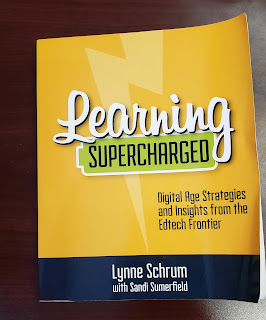
I briefly discussed this book in a previous entry. While technically not a "CBE book," I found Learning Supercharged to be highly useful when connecting CBE related pedagogies with best practices in blended learning. Chapters on makerspaces, project-based learning, personalized learning and more allow you to see how crucial digital tools will be when creating an effective "transfer task" culture of mastery learning.
Honorary Mentions of other CBE authors and websites:
This entry is an attempt to compile a useful -- but by no means exhaustive -- list of CBE related books that I personally feel have been either extremely illuminating in pragmatic ways (detailed models, insightful anecdotes, clear "how to's") or it inspired me to stay the course. Often the same book did both! Instead of ranking them in order of importance, or even in the order I actually read them, I have put them in what I think would be the most useful reading sequence that would best grow one's CBE knowledge as well as help you strategically plan for implementation in your own classroom, school or district.
One very important point here: as with all of my Edtech Elixirs entries and my personal social media posts, this is only Adam Watson's ideal list as of this posting. While my CBE knowledge would not nearly be as robust without my work in Shelby, and although many of these books were part of our leadership reading, this list is not meant to imply any district endorsement of these texts or of the sequence I have described.
1. What School Could Be by Ted Dintersmith (2018)

Before getting too deep into CBE terminology and logistics, teachers and admin should be given the chance to ideate for an "outside the box" transformative classroom experience. This book's title succinctly states its purpose: we need to dream up a different way of doing school. Dintersmith was the executive producer of the engaging documentary Most Likely to Succeed, which mainly focused on High Tech High in San Diego and how that school challenges how education achievement can be done. This book is basically Dintersmith's road trip covering all 50 states in a single school year as he searches for inspirational models of educational transformation. What School Could Be is both a wakeup call to rally against the status quo as well as a potential map of locations to visit.
2. Reinventing Crediting for Competency-Based Education: the Mastery Transcript Consortium Model and Beyond by Jonathan E. Martin (2010)

Don't let the slim nature of this book (151 pages!) fool you. As Martin describes examples of what a competency-based report card/transcript may look like (in particular, the work of the Mastery Transcript Consortium), you realize how crucial it is to have an effective reporting tool of learning, especially for high school. Beginning your CBE planning with such an end in mind is highly recommended, as we in Shelby can speak from experience that communicating and creating a new reporting tool was an area of challenge in our journey, especially for some of our high school teachers, students and parents.
3. How to Grade for Learning: Linking Grades to Standards by Ken O'Connor (4th edition, 2019)
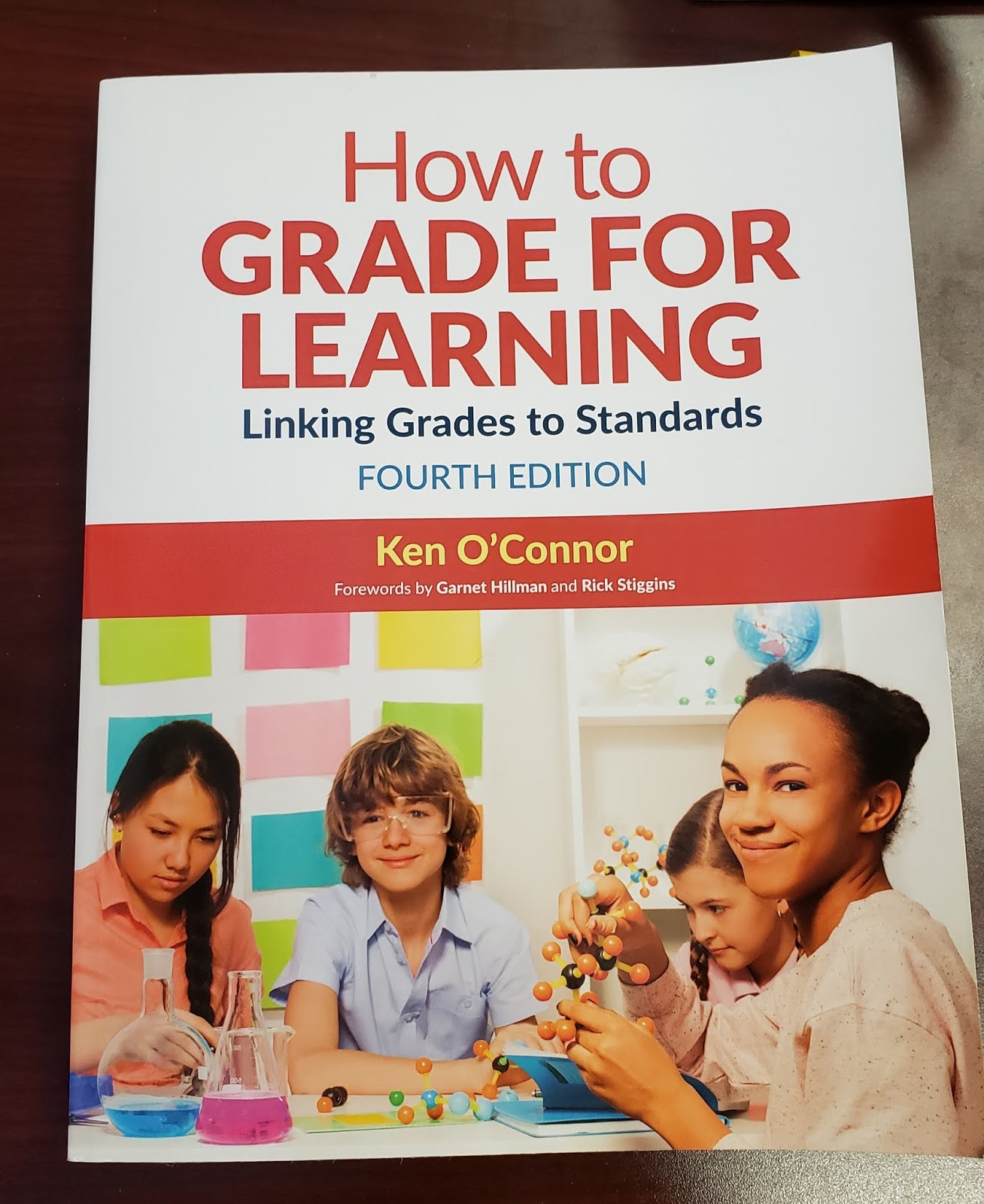
O'Connor has been challenging the idea of what grading should be for many years; in fact, the first edition of How to Grade for Learning came out two decades ago. This book is likely the most "dense" and longest on this list, but it is chock full of very useful examples, anecdotes, and templates. I would argue that the principles laid out in the book are critical for moving to competency-based learning, as you need strong, clear, and consistent standards-based grading (SBG) practices to get there. As I discussed in a previous entry, you need teachers and admin to understand the limits of traditional points / percentage / letter based grading and how SBG is more effective for learning. O'Connor expertly leads you through that shift. I especially appreciate how he devotes whole chapters to looking at how to calculate grades beyond merely averaging numbers (for example, Chapter 5: Emphasizing More Recent Evidence). Make sure classroom teachers have a chance to discuss key excerpts!
4. Transforming Schools Using Project-Based Learning, Performance Assessment, and Common Core Standards by Bob Lenz with Justin Wells and Sally Kingston (2015)

Transforming Schools was one of the earliest books I read on my CBE journey, as I was learning how instructional classroom models like project-based learning fit into a bigger transformative educational system. (This is something not to be glossed over; through communication and strategic planning, your journey to a CBE system should make clear how competency-based learning is not "one more thing on your plate" but instead becomes the plate where personalized learning, PBL, blended learning and other initiatives smoothly "sit" on and build toward.) Lenz and his contributors do an excellent job of sharing their narrative of how they changed learning at one school, which then evolved into a system of transformative schools (Envision Learning). The book also helped me think more deeply about the importance of advisory scheduling, graduate profiles, and students doing defenses of learning. Bonus: it includes a DVD with video clips!
5. Breaking with Tradition: The Shift to Competency-Based Learning in PLCs at Work by Brian M. Stack and Jonathan G. Vander Els (2018)

Stack and Vender Els write from the perspective of principals "doing the work" in New Hampshire, a state well known for its CBE leadership. (In fact, Stack is still principal at Sanborn Regional High School.) As the subtitle suggests, it is important to invest wisely and deeply in the professional development of your staff as you shift away from traditional practices, and Stack and Vander Els insightfully outline a successful way to navigate that process. Helpful examples of competency frameworks, as well as how they were created, are shared in detail. I also appreciated the book's discussion of what intervention and enrichment looks like in a CBE system, so students can truly "move when ready." Lastly, both Transforming Schools and Breaking with Tradition explain the need for change in performance assessment practices, and the urgency for creating new performance assessments that better match competency-based learning.
Bonus: Learning Supercharged: Digital Age Strategies and Insights from the Edtech Frontier by Lynne Schrum with Sandi Sumerfield (2018).

I briefly discussed this book in a previous entry. While technically not a "CBE book," I found Learning Supercharged to be highly useful when connecting CBE related pedagogies with best practices in blended learning. Chapters on makerspaces, project-based learning, personalized learning and more allow you to see how crucial digital tools will be when creating an effective "transfer task" culture of mastery learning.
Honorary Mentions of other CBE authors and websites:
- Rose Colby. Colby has been talking about CBE for at least a decade and she is often quoted, including in many of the books above. Her 2017 book Competency-Based Education: A New Architecture for K-12 Schooling is a recent example of her work.
- Chris Sturgis. Besides writing the forward to Breaking with Tradition, Sturgis is an author of many influential white papers on CBE; she also helped launch CompetencyWorks, itself an important online resource.
- Aurora Institute (formerly iNACOL). The site, and its related conferences, continues to be a leader in sharing and discussing the work of CBE and the educators behind it. As a starting point, read its updated definition of CBE published in November 2019.
What are some significant CBE books you have read? Please share in the Comments below!
Full disclosure: Over the last few years, Shelby County has nurtured both one-time consultancies as well as ongoing partnerships with several of the authors and organizations mentioned above.
Full disclosure: Over the last few years, Shelby County has nurtured both one-time consultancies as well as ongoing partnerships with several of the authors and organizations mentioned above.
Tuesday, February 25, 2020
Share Fair 2020
Our sixth annual Share Fair is now in the rearview mirror. Thanks to our teachers, students, librarians and building tech who led fantastic presentations!
While I must give special thanks to all of our attendees, I feel it necessary to point out a group of educators who likely win the contest for "longest distance traveled to come to Share Fair." Principal Shannon Treece and her team from Babcock Neighborhood School traveled a thousand miles from Babcock Ranch, Florida in order to attend our sessions. (Well...in full disclosure, they also visited several Shelby schools earlier in the day!) Not only did they appreciate what our presenters discussed, but they were also so inspired by the Share Fair format that they have already started work on hosting a Share Fair of their own this fall. It is beyond flattering to think that the first (known!) Share Fair outside of Kentucky will soon be happening.
Speaking of firsts: This year, I used Wakelet for the first time to create a Collection for Share Fair 2020, capturing the story of the event -- in particular, the #SCsharefair tweets. It is embedded below or available directly here.
Thanks again, and we can't wait to see you next school year!
While I must give special thanks to all of our attendees, I feel it necessary to point out a group of educators who likely win the contest for "longest distance traveled to come to Share Fair." Principal Shannon Treece and her team from Babcock Neighborhood School traveled a thousand miles from Babcock Ranch, Florida in order to attend our sessions. (Well...in full disclosure, they also visited several Shelby schools earlier in the day!) Not only did they appreciate what our presenters discussed, but they were also so inspired by the Share Fair format that they have already started work on hosting a Share Fair of their own this fall. It is beyond flattering to think that the first (known!) Share Fair outside of Kentucky will soon be happening.
Speaking of firsts: This year, I used Wakelet for the first time to create a Collection for Share Fair 2020, capturing the story of the event -- in particular, the #SCsharefair tweets. It is embedded below or available directly here.
Thanks again, and we can't wait to see you next school year!
Tuesday, February 4, 2020
Wakelet
For several years, Storify was one of my favorite free "go to" edtech tools. You could use it to collect digital artifacts -- URLs, pictures, YouTube videos, social media posts -- and you could sequence these items to create a narrative in order to share with others. However, like other online tools that come and go, it unfortunately shut down in May 2018.
When one edtech door closes, another one often opens. Last year, I was excited to be introduced to Wakelet. In the months since, I've not only seen how Wakelet is more than able to fill the void that Storify left, but I have also been impressed with how it continues to mature and improve with new features.
How does it work?
Making a "Collection" in Wakelet is quick and easy; the interface is very user friendly. First, you need to create a free account. You can use Google, Microsoft, Facebook, or just use your email address. When you create an account, you will choose a name that will determine your profile's URL. (Here's mine as an example.) Once your account is created, you can follow other Wakelet users, and they can follow you. Your followers will be notified when you publish a public Collection, as you will be notified when the people you follow do the same.
As you create a new Collection, you begin to make choices such as the title and whether it will be public or private. Once you start a new Collection, what can you add? You can insert text, websites via their URLs, YouTube videos, tweets (you can search by username or hashtag), pictures, PDFs, and even include files straight from your OneDrive or Google Drive.
One of the newest features of Wakelet is inserting "Flipgrid Shorts." This is an opportunity for the person making the Collection to record a webcam video up to three minutes long; as with standard Flipgrid videos, you can use fun filters or insert graphics and text. The 49 second video below shows how this works. Note that this Wakelet option is not really the full Flipgrid experience; you cannot log into your separate Flipgrid account to natively insert what you've already created, nor are viewers of the Collection able to respond to your "Flipgrid Short" with comments or video replies of their own while within the Wakelet site. (Tip: if you're wanting to create an opportunity for an interactive Flipgrid experience, simply insert your grid's URL into your Collection like you would any other website.)
There are other Wakelet features that affect the viewing experience. The creator of the Collection can choose various ways of presenting the materials, including a "Mood Board" option. Another new feature utilizes Microsoft's "Immersive Reader" in order to read aloud your Collection! Lastly, if viewers are logged into their own Wakelet profile, they can copy a Collection to their account to edit and publish their own version as they see fit, assuming that the creator of the Collection permits this to happen.
Wakelet makes sharing a published Collection very simple, with built in tools for several social media platforms, as well as options like a shortened URL and a QR code.

Recently, Wakelet now allows multiple ways for users to collaborate on the same Collection. In theory, collaborators do not even need Wakelet accounts to interact in a Collection. Collaborators can be given access directly via their Wakelet profile name or email, or indirectly via URLs and QR codes. (Keep in mind that collaboration tools are in beta as of February 2020.)

Last but not least, Wakelet offers iOS and Android apps. This allows users to be able to create Collections from their mobile device, albeit the options are more limited than the full website version of Wakelet. I've created a Collection that demonstrates how the mobile app works, which is also embedded below:
How could you use it?
Teachers could use Wakelet to capture resources while at a conference -- the key tweets sent out from a hashtag, the Google Docs shared by presenters, and so on. You could also create narratives consisting of text, websites, and social media posts that chronicle a current event to share with students. Students could use Collections as a way of saving research, composing mini-"hyperdoc" essays, creating an online portfolio of learning artifacts, or collaborating with team members on resources while working through a PBL.
Downsides?
Storify allowed you to natively find and embed Facebook and other social media posts; I would like Wakelet to easily do the same beyond just Twitter. For now, the workaround would be to find the social media post's public URL and add it to your Collection as you would any other website.
As I mentioned above, I first discovered Wakelet last year at KySTE 2019 thanks to Stella Pollard, a wonderful educator and frequent presenter! Because Stella is an experienced user of Wakelet -- be sure to check out her Wakelet profile -- what better time to interview her, as well as share her thoughts on other edtech tools?
When one edtech door closes, another one often opens. Last year, I was excited to be introduced to Wakelet. In the months since, I've not only seen how Wakelet is more than able to fill the void that Storify left, but I have also been impressed with how it continues to mature and improve with new features.
How does it work?
Making a "Collection" in Wakelet is quick and easy; the interface is very user friendly. First, you need to create a free account. You can use Google, Microsoft, Facebook, or just use your email address. When you create an account, you will choose a name that will determine your profile's URL. (Here's mine as an example.) Once your account is created, you can follow other Wakelet users, and they can follow you. Your followers will be notified when you publish a public Collection, as you will be notified when the people you follow do the same.
As you create a new Collection, you begin to make choices such as the title and whether it will be public or private. Once you start a new Collection, what can you add? You can insert text, websites via their URLs, YouTube videos, tweets (you can search by username or hashtag), pictures, PDFs, and even include files straight from your OneDrive or Google Drive.
 |
| As you add certain content, Wakelet remembers them as "Bookmarks." This makes it easier to insert that content in future Collections. |
There are other Wakelet features that affect the viewing experience. The creator of the Collection can choose various ways of presenting the materials, including a "Mood Board" option. Another new feature utilizes Microsoft's "Immersive Reader" in order to read aloud your Collection! Lastly, if viewers are logged into their own Wakelet profile, they can copy a Collection to their account to edit and publish their own version as they see fit, assuming that the creator of the Collection permits this to happen.
Wakelet makes sharing a published Collection very simple, with built in tools for several social media platforms, as well as options like a shortened URL and a QR code.

Recently, Wakelet now allows multiple ways for users to collaborate on the same Collection. In theory, collaborators do not even need Wakelet accounts to interact in a Collection. Collaborators can be given access directly via their Wakelet profile name or email, or indirectly via URLs and QR codes. (Keep in mind that collaboration tools are in beta as of February 2020.)

Last but not least, Wakelet offers iOS and Android apps. This allows users to be able to create Collections from their mobile device, albeit the options are more limited than the full website version of Wakelet. I've created a Collection that demonstrates how the mobile app works, which is also embedded below:
How could you use it?
Teachers could use Wakelet to capture resources while at a conference -- the key tweets sent out from a hashtag, the Google Docs shared by presenters, and so on. You could also create narratives consisting of text, websites, and social media posts that chronicle a current event to share with students. Students could use Collections as a way of saving research, composing mini-"hyperdoc" essays, creating an online portfolio of learning artifacts, or collaborating with team members on resources while working through a PBL.
Downsides?
Storify allowed you to natively find and embed Facebook and other social media posts; I would like Wakelet to easily do the same beyond just Twitter. For now, the workaround would be to find the social media post's public URL and add it to your Collection as you would any other website.
As I mentioned above, I first discovered Wakelet last year at KySTE 2019 thanks to Stella Pollard, a wonderful educator and frequent presenter! Because Stella is an experienced user of Wakelet -- be sure to check out her Wakelet profile -- what better time to interview her, as well as share her thoughts on other edtech tools?
Stella, welcome to Edtech Elixirs! Please share your educator story.
I have been an educator since 2013. My journey began in Perry County Schools as a para-educator for a first-grade classroom. My husband and I moved to central Kentucky in 2014 where I was offered my first official teaching position as a middle school math and science teacher at Williamstown Jr. High School. I was offered a job closer to home in 2015 as a 6th-grade science teacher at Bondurant Middle School in Franklin County. I am currently an Instructional Technology Coordinator (Digital Learning Coach) for Franklin County Schools and I work with each of our 13 schools on effective implementation of instructional technology.
I have been an educator since 2013. My journey began in Perry County Schools as a para-educator for a first-grade classroom. My husband and I moved to central Kentucky in 2014 where I was offered my first official teaching position as a middle school math and science teacher at Williamstown Jr. High School. I was offered a job closer to home in 2015 as a 6th-grade science teacher at Bondurant Middle School in Franklin County. I am currently an Instructional Technology Coordinator (Digital Learning Coach) for Franklin County Schools and I work with each of our 13 schools on effective implementation of instructional technology.
How do you personally use Wakelet?
I started using Wakelet back in early 2018. I jumped onto the #WakeletWave because I was #NotAtISTE18 and needed a way to store all of the resources I found so I could come back to them at a later date. Since then, I have made Wakelet Collections for recipes to resources, lesson materials to videos, and everything in between. I love how easy it is to use on every platform (iPhone, Chrome browser, Chromebook, etc).
I started using Wakelet back in early 2018. I jumped onto the #WakeletWave because I was #NotAtISTE18 and needed a way to store all of the resources I found so I could come back to them at a later date. Since then, I have made Wakelet Collections for recipes to resources, lesson materials to videos, and everything in between. I love how easy it is to use on every platform (iPhone, Chrome browser, Chromebook, etc).
Have you seen students and teachers use Wakelet?
I have! I have seen teachers use Wakelet as a collaborative workspace for students to digitally share and explore the work of their peers.
I have! I have seen teachers use Wakelet as a collaborative workspace for students to digitally share and explore the work of their peers.
What is one of your favorite features of Wakelet?
I love the ability to automatically store your Screencastify videos directly to a Wakelet. It's quick and effective and in my role as a Digital Learning Coach, I am always making videos for our teachers. Since you can easily access your Google Drive inside of a Collection, this gives me the ability to share those videos quickly.
I love the ability to automatically store your Screencastify videos directly to a Wakelet. It's quick and effective and in my role as a Digital Learning Coach, I am always making videos for our teachers. Since you can easily access your Google Drive inside of a Collection, this gives me the ability to share those videos quickly.
Besides Wakelet, what are some other new edtech tools you are currently using?
One of my newest edtech tools that I have found recently is Actively Learn - it's similar to Newsela but has features that include: asking questions in the text, including specific notes for sections for your students while they're reading, the ability to embed a video or link to a different website, and more. In addition, it speaks directly to Google Classroom so there's minimal set-up for teachers to begin. Finally, one of my favorite things about it is that the free version is pretty solid.
I want to thank Stella for taking the time to share her wisdom. Be sure to follow her on Twitter, Wakelet and beyond! And be sure to share your creative ways for using Wakelet in the Comments below.One of my newest edtech tools that I have found recently is Actively Learn - it's similar to Newsela but has features that include: asking questions in the text, including specific notes for sections for your students while they're reading, the ability to embed a video or link to a different website, and more. In addition, it speaks directly to Google Classroom so there's minimal set-up for teachers to begin. Finally, one of my favorite things about it is that the free version is pretty solid.
What's your advice to teachers just starting to integrate edtech into their classrooms?
It's okay to not know everything about a tool. Students can and will figure it out long before we ever will. Don't be afraid to have your students try new things and give them the chance to input their voice in the assignments.
It's okay to not know everything about a tool. Students can and will figure it out long before we ever will. Don't be afraid to have your students try new things and give them the chance to input their voice in the assignments.
Sunday, January 26, 2020
How SBG Led Us to Empower: The Power of Evidence (Part 2 of 2)
This is part two of a two-part blog series. When our district began a move to standards based grading (SBG), we realized that we needed a different digital tool. In the previous blog entry, I discussed how the limitations of a traditional grading system led us to SBG, and ultimately, Empower Learning. In this entry, I give an overview on the grading features of Empower and how it integrates with our standards based learning philosophy.
While Empower is a fully functioning learning management system, its core capability of capturing student evidence and calculating this for overall standard scores is really the "crown jewel" of the tool.
But first, what do you see when you log into Empower? There are three main interface tabs. The Instruction Tab is where you can see classes (either fed from your student information system or custom created groups), as well as create and assign instructional materials like Activities and Quizzes. The Reporting Tab is where you can output progress reports and export other data. The Scoring Tab is where "gradebooks" are located, and the place where evidence and standards are scored. (Remember, as is necessary in SBG, these scores are based on established Mastery Scales -- for Shelby, these range in whole numbers from 0 to 4.)
Empower has two types of gradebooks. The first is a class's default gradebook (also called the "master course playlist" by Empower), designed and managed at the district level, that designates the prioritized standards for the course. This master gradebook determines many important reporting and analytical aspects of Empower, such as progress reporting and the final course grade calculation. (In a knowing nod to a traditional system needing a final "number" grade at the end of the year for secondary classes, Empower can take the end of year scores of all the prioritized standards and average them together.) The second type are gradebooks custom created by the user, in order to help teachers focus on a smaller lens of standards (perhaps just a few standards addressed in your Unit One) or to make cross-content project assessment much easier (think of PBL possibilities!).
Under the Scoring Tab, you can toggle between "Score Standards" and "Score Evidences," which show the interrelationship between the two -- they are truly two sides of the same coin. Under "Score Evidences," you can see tasks that have been targeted to various standards and score these individual evidences accordingly. These may have been created in the Instructional area, such as Activities and Quizzes, but one of my favorite Empower features is the ability to make "Quick Evidence" -- within a button push and a few clicks, you can quickly create and score evidence. (Many learning management systems only allow grading of digital activities created inside its system, but Empower allows you to score and assess virtually anything in seconds -- analog activities, observation of classroom discussions, and so on.) Under "Score Standards," a teacher can score an overall standard if they wish. However, one of Empower's most powerful tools is the Marzano True Score Estimator (MTSE), which is accessible within a gradebook's "Standards" toggle side. You can use it to look behind a particular standard, and not only examine the body of evidence each student has demonstrated, but see how Empower calculates and projects an overall standard score based on the evidence score numbers and when the evidence occurred. To do this, Empower actually runs the evidence scores through three different formulas -- average, Linear, and Power Law -- then recommends one or more as the most reliable for the given set. This creates a completely different nuance to grading (which constantly updates as new evidence is entered), and a very necessary one when deciding and defending a student's mastery of a standard.

Let's briefly walk through these formulas. We are very used to averaging, but I will highlight here that it is the only one of the formulas that is indifferent to when the evidence scores happened -- in other words, whether the scores were from two years ago, last September, or yesterday. Linear is looking for a trend line; if we graphed these scores, are we trending upwards or downwards? Therefore, more recent evidence is important when determining the direction of the trend. Lastly, Power Law is based on an intuitively typical human learner. When most of us encounter a new concept, we struggle to understand it, and if we were "scored" on our skill or knowledge, would likely score low with 1's and 2's. As time and experience went on, we would get better, likely scoring 2's and 3's, and in time would achieve mastery with 4's. Power Law takes that progression into account by mathematically counting earliest scores with considerable less "weight," and mathematically counting most recent scores with considerably more weight. In short: for Power Law, how you just performed is much more important than your potential low scores in the early part of your learning.
Take a moment to compare these multiple, nuanced levels of assessing learning to Part One's story of Timmy and his traditional grading conundrum, who like many students struggled with such a low test score early in a unit that it didn't matter that he aced the final test; in a traditional system of averages and percentages, only a student who is freakishly perfect from the start would maintain a high grade, and a student who starts off poorly cannot avoid the demotivating academic hole they can't statistically crawl out of. Empower changes the entire approach to looking at what grading is communicating, and at least as importantly, gives students specific guidance on how to improve their learning -- they not only know their overall standard strengths and challenges, but how their evidence behind a standard has an accumulating history, and the importance of today's performance is actually calculated as more important than whatever struggles the student may have had earlier. (There is an additional positive side effect of this as well: students that perform exceptionally well at the beginning of an academic year cannot rest on their good laurels and coast into a passing grade when "spring senioritis" sets in and their present performance significantly drops.)
I admit that when I first began learning and teaching others about how Empower calculates scores, I struggled to understand and explain this well to others. As the school year began, I created a Scoring Calculations Doc to help explain how this worked to our district staff. For the sake of this blog entry, I'm only bringing the Doc up to point out one common concern that parents, students and even some teachers have: in a system of mastery scales and standards based grading, will final course grades, GPA's, etc. go down for most students? In the Doc, I attack this head on by using a fictional set of four students and examining their evidence scores under a single hypothetical standard. Luke is the Marzano ideal student of human learning, who starts with scores of 1's, then 2's and 3's, and finally 4's. Han is the opposite: he started at all 4's and wound down to 1's in several recent scores. Lando is all over the place scorewise for a while, but settles out and eventually scores consistent 4's by the end of his scoring timeline. Lastly, Leia has mid-level scores fairly consistently, although she tends to score 3's (including recently).

When comparing the simple average of the scores versus their Linear/Power Law projected calculations, the above table shows how the idea of averaging conflates the academic "stories" of these four students as equal, when we can see this is limiting at best and strongly inaccurate at worst. Interestingly, in a mastery SBG system that goes beyond merely averaging, three of these students do as good or better than they would in a traditional grading system. With SBG, there is not only more of a chance for a student to score a higher GPA, but such a GPA may actually reflect a true accomplishment of (mastery) learning instead of just an accumulation of points. Out of our four fictional friends, the only student that does worse in SBG -- Han -- is the one student we can clearly see is "bottoming out" or having a bad case of the senioritis we mentioned earlier, but instead of facing an academic penalty for this in traditional grading, Han would unfairly coast into the same grade as his peers.
Empower is an example of a powerful digital tool that is a potential game changer for assessing student learning. Of course, a learning management system is merely a holder of digital data entered by humans -- it cannot replace a teacher's professional judgment and relationship building necessary for student learning and growth to occur. Empower can calculate scores quantitatively, but has no ability to determine the qualitative nature of the assessments themselves; this is where "the art of teaching" and a teacher's discernment come into play. (This is one reason why Empower always allows a teacher to determine an overall standard score, even if that means overriding what Empower suggests based on evidence scores.) Empower does not magically make teachers effective in standards based grading practices, or make their assessments automatically any deeper, more rigorous, or authentic. Excellence in SBG requires dedication, professional learning, and time. Empower does not short cut this or offer a silver edtech bullet. However, I do have to say that in the six years I have been a part of education technology in Shelby County, there have been few if any digital tools that have pushed and challenged our teachers to teach transformatively as much as Empower. It is impossible to use it fully and faithfully and still maintain a traditional grading mindset. In that same vein, as we continue to support and fulfill our current Strategic Leadership Plan, tools like Empower are a valuable asset in order to move forward in our goal to enrich and enlarge our capacity to personalize our students' learning with a "mastery of standards" philosophy, and leave behind the idea of school as a game of compliance and points.
While Empower is a fully functioning learning management system, its core capability of capturing student evidence and calculating this for overall standard scores is really the "crown jewel" of the tool.
But first, what do you see when you log into Empower? There are three main interface tabs. The Instruction Tab is where you can see classes (either fed from your student information system or custom created groups), as well as create and assign instructional materials like Activities and Quizzes. The Reporting Tab is where you can output progress reports and export other data. The Scoring Tab is where "gradebooks" are located, and the place where evidence and standards are scored. (Remember, as is necessary in SBG, these scores are based on established Mastery Scales -- for Shelby, these range in whole numbers from 0 to 4.)
 |
| Example of a test class/group (with a single student) and a sample gradebook with one standard shown. |
Empower has two types of gradebooks. The first is a class's default gradebook (also called the "master course playlist" by Empower), designed and managed at the district level, that designates the prioritized standards for the course. This master gradebook determines many important reporting and analytical aspects of Empower, such as progress reporting and the final course grade calculation. (In a knowing nod to a traditional system needing a final "number" grade at the end of the year for secondary classes, Empower can take the end of year scores of all the prioritized standards and average them together.) The second type are gradebooks custom created by the user, in order to help teachers focus on a smaller lens of standards (perhaps just a few standards addressed in your Unit One) or to make cross-content project assessment much easier (think of PBL possibilities!).
Under the Scoring Tab, you can toggle between "Score Standards" and "Score Evidences," which show the interrelationship between the two -- they are truly two sides of the same coin. Under "Score Evidences," you can see tasks that have been targeted to various standards and score these individual evidences accordingly. These may have been created in the Instructional area, such as Activities and Quizzes, but one of my favorite Empower features is the ability to make "Quick Evidence" -- within a button push and a few clicks, you can quickly create and score evidence. (Many learning management systems only allow grading of digital activities created inside its system, but Empower allows you to score and assess virtually anything in seconds -- analog activities, observation of classroom discussions, and so on.) Under "Score Standards," a teacher can score an overall standard if they wish. However, one of Empower's most powerful tools is the Marzano True Score Estimator (MTSE), which is accessible within a gradebook's "Standards" toggle side. You can use it to look behind a particular standard, and not only examine the body of evidence each student has demonstrated, but see how Empower calculates and projects an overall standard score based on the evidence score numbers and when the evidence occurred. To do this, Empower actually runs the evidence scores through three different formulas -- average, Linear, and Power Law -- then recommends one or more as the most reliable for the given set. This creates a completely different nuance to grading (which constantly updates as new evidence is entered), and a very necessary one when deciding and defending a student's mastery of a standard.

Let's briefly walk through these formulas. We are very used to averaging, but I will highlight here that it is the only one of the formulas that is indifferent to when the evidence scores happened -- in other words, whether the scores were from two years ago, last September, or yesterday. Linear is looking for a trend line; if we graphed these scores, are we trending upwards or downwards? Therefore, more recent evidence is important when determining the direction of the trend. Lastly, Power Law is based on an intuitively typical human learner. When most of us encounter a new concept, we struggle to understand it, and if we were "scored" on our skill or knowledge, would likely score low with 1's and 2's. As time and experience went on, we would get better, likely scoring 2's and 3's, and in time would achieve mastery with 4's. Power Law takes that progression into account by mathematically counting earliest scores with considerable less "weight," and mathematically counting most recent scores with considerably more weight. In short: for Power Law, how you just performed is much more important than your potential low scores in the early part of your learning.
Take a moment to compare these multiple, nuanced levels of assessing learning to Part One's story of Timmy and his traditional grading conundrum, who like many students struggled with such a low test score early in a unit that it didn't matter that he aced the final test; in a traditional system of averages and percentages, only a student who is freakishly perfect from the start would maintain a high grade, and a student who starts off poorly cannot avoid the demotivating academic hole they can't statistically crawl out of. Empower changes the entire approach to looking at what grading is communicating, and at least as importantly, gives students specific guidance on how to improve their learning -- they not only know their overall standard strengths and challenges, but how their evidence behind a standard has an accumulating history, and the importance of today's performance is actually calculated as more important than whatever struggles the student may have had earlier. (There is an additional positive side effect of this as well: students that perform exceptionally well at the beginning of an academic year cannot rest on their good laurels and coast into a passing grade when "spring senioritis" sets in and their present performance significantly drops.)
I admit that when I first began learning and teaching others about how Empower calculates scores, I struggled to understand and explain this well to others. As the school year began, I created a Scoring Calculations Doc to help explain how this worked to our district staff. For the sake of this blog entry, I'm only bringing the Doc up to point out one common concern that parents, students and even some teachers have: in a system of mastery scales and standards based grading, will final course grades, GPA's, etc. go down for most students? In the Doc, I attack this head on by using a fictional set of four students and examining their evidence scores under a single hypothetical standard. Luke is the Marzano ideal student of human learning, who starts with scores of 1's, then 2's and 3's, and finally 4's. Han is the opposite: he started at all 4's and wound down to 1's in several recent scores. Lando is all over the place scorewise for a while, but settles out and eventually scores consistent 4's by the end of his scoring timeline. Lastly, Leia has mid-level scores fairly consistently, although she tends to score 3's (including recently).

When comparing the simple average of the scores versus their Linear/Power Law projected calculations, the above table shows how the idea of averaging conflates the academic "stories" of these four students as equal, when we can see this is limiting at best and strongly inaccurate at worst. Interestingly, in a mastery SBG system that goes beyond merely averaging, three of these students do as good or better than they would in a traditional grading system. With SBG, there is not only more of a chance for a student to score a higher GPA, but such a GPA may actually reflect a true accomplishment of (mastery) learning instead of just an accumulation of points. Out of our four fictional friends, the only student that does worse in SBG -- Han -- is the one student we can clearly see is "bottoming out" or having a bad case of the senioritis we mentioned earlier, but instead of facing an academic penalty for this in traditional grading, Han would unfairly coast into the same grade as his peers.
Empower is an example of a powerful digital tool that is a potential game changer for assessing student learning. Of course, a learning management system is merely a holder of digital data entered by humans -- it cannot replace a teacher's professional judgment and relationship building necessary for student learning and growth to occur. Empower can calculate scores quantitatively, but has no ability to determine the qualitative nature of the assessments themselves; this is where "the art of teaching" and a teacher's discernment come into play. (This is one reason why Empower always allows a teacher to determine an overall standard score, even if that means overriding what Empower suggests based on evidence scores.) Empower does not magically make teachers effective in standards based grading practices, or make their assessments automatically any deeper, more rigorous, or authentic. Excellence in SBG requires dedication, professional learning, and time. Empower does not short cut this or offer a silver edtech bullet. However, I do have to say that in the six years I have been a part of education technology in Shelby County, there have been few if any digital tools that have pushed and challenged our teachers to teach transformatively as much as Empower. It is impossible to use it fully and faithfully and still maintain a traditional grading mindset. In that same vein, as we continue to support and fulfill our current Strategic Leadership Plan, tools like Empower are a valuable asset in order to move forward in our goal to enrich and enlarge our capacity to personalize our students' learning with a "mastery of standards" philosophy, and leave behind the idea of school as a game of compliance and points.
Subscribe to:
Posts (Atom)